


Privacy curtains
The fabric matters less than where it stops.
Privacy curtains are curtains woven densely enough to stop a view through the cloth — a tight semi-sheer by day, a lined blockout once your lights are on. Density does the work in daylight. After dark nothing translucent works, and most of what leaks goes around the curtain rather than through it.
Forced to pick one: a lined blockout, hung wall to wall on a runnered track, with a sheer in front for the daytime.
Most guides answer the fabric question and stop. Fabric is the easy half. A curtain is cloth hung in front of a hole, and the gap at the top, the gaps at each end and the join down the middle are all still there when the fabric is perfect. Here is the order we check it in on a measure.

Privacy runs whichever way the light does
The brighter side is the side that gets seen. In daylight the outside is brighter than your room, so a translucent curtain scatters the light coming in and the person on the footpath gets a wash of fabric instead of your living room. You can still see out reasonably well, because you are looking from the dark side toward the bright one.
At dusk that flips. Your lamps come on, the room becomes the brighter side, and the same curtain that hid you all afternoon turns into a lit screen with your silhouette on it. No weave density fixes this, because the problem is not the weave — it is which side the light is on. Privacy blinds run into exactly the same two problems and split the same way, which is why the honest answer on both is usually two layers rather than one clever fabric.
So there are two questions, not one: what you want by day, and what you want after dark. Most people answer the first and get surprised by the second around seven in the evening.

Spend on the fabric, not on the fullness
Fullness is the ratio of flat fabric to finished track width, and it is the number most guides reach for when they talk about privacy. Ours are fixed and we will put them on the quote. A wave fold runs 2.3 : 1. Box pleat, reverse pleat, gathered and knife pleat all run 1.8 : 1. On a 3 metre track that is 6.9 metres of fabric in wave fold against 5.4 metres at 1.8 : 1.
More fabric across the opening does cut transmission — roughly 2.3 layers of cloth in the light path instead of 1.8. Real, and smaller than it sounds, because the extra is not spread evenly. It doubles at the crest of each fold and pulls thin in the trough, so a full sheer reads denser while still carrying vertical lines you can see straight through. Change the fabric and transmission changes across the whole curtain. Add fullness and it changes in stripes.
That extra 1.5 metres is a drape decision. It buys deeper, more even folds and a curtain that hangs like a curtain rather than a bedsheet, and we will sell it to you gladly on those grounds. It is not the lever to pull if the problem is your neighbour.

Pick the fabric by what it has to do after dark
Sorted by what actually holds up, rather than by what photographs well:
- Lined blockout. The only thing on this list that gives you privacy with the lights on, and the only one that works at any hour. Blockout curtains are the bedroom default for that reason, not the sleep argument.
- Dense semi-sheer, or light filtering. Tight enough that daylight arrives as glow rather than image. Good all day, useless at night. This is what most people mean by a privacy curtain.
- Metallised curtain fabric. Verosol SilverScreen comes as a curtain cloth, not only a blind. The aluminium layer on the back reflects solar radiation rather than absorbing it, which makes it a different material to dyed polyester. We will not quote you a reflectance figure — those numbers are Verosol's, not ours to verify.
- Open-weave voile or net, alone. Pretty, and the weakest thing here. Fine as the front half of a pair. As the only layer on a street-facing window it is decoration with a privacy story attached.
Lining is the standard upgrade and does two jobs — an opaque layer, plus sun protection for the face fabric, which is no small thing on this coast. What we do not make is interlining, the third layer between face and lining that overseas sites mean by double thickness. Where one curtain is not enough our answer is a second curtain, not a fatter one, and a sheer and a blockout on a double track is better anyway because you choose which layer is closed.
| Open sheer | Dense semi-sheer | Lined blockout | Sheer + blockout pair | |
|---|---|---|---|---|
| Daytime privacy | Partial | Good | Total, closed | Good |
| Privacy with lights on | None | None | Total | Total |
| Daylight kept | Most | Some | None, closed | Most, then none |
| View out by day | Softened | Mostly gone | None, closed | Softened |
| Track needed | Single | Single | Single | Double |

Overlap the centre and take the track to the wall
This is where a good fabric gets undone. A curtain measured to the window is measured to the wrong thing: the opening is the glass, plus the frame, plus however far a sightline reaches past it. Four places give you away, and none care what the cloth cost.
- The centre join. Two curtains meeting edge to edge leave a vertical line at eye height, which is the whole problem in one. The fix is an overlap, one leading edge crossing past the other by a hand's width. That takes runners: panels threaded onto a single pole share one rail, so their edges can only meet, never pass. Every track we supply runs on runners — no poles, no eyelets. Want the look of a pole? A decorative track gives you that and keeps the overlap.
- The ends. Run the track past the frame both sides and return it to the wall, so the curtain finishes against plaster rather than mid-air. The return also kills the gap a flat-hanging curtain leaves for a sightline to slip down behind.
- The top. A ceiling-fixed track closes most of it, a pelmet the rest — the same detail the government's passive design guidance credits with trapping still air at the glass. One fitting, two problems.
- The floor. Sill-length curtains leave a gap you can see under from outside on a sloping block. Go full length, close enough to the floor to look deliberate.
Not sure which windows actually need it?
We will measure the openings, look at what is opposite them, and quote it component by component within 24 to 48 hours. Curtains run 2 to 4 weeks from measure to install, depending on the fabric.

Specify it room by room, not house-wide
Street-facing living areas. The pair, on a double track. The sheer handles daylight and stays closed most of the time; the blockout comes across when the lamps go on. It is the most common thing we fit, for the boring reason that it is the only arrangement answering both questions.
Bedrooms. Blockout, lined, full length, wall to wall. Privacy and darkness want the same thing here, so there is no trade-off to manage.
Ground-floor rooms and home offices. A dense semi-sheer usually does, because these rooms are rarely lit and looked into at once. If guests sleep there, treat it as a bedroom.
Bathrooms. Not curtains. Fabric and moisture is a bad pairing and no lining fixes it — a wet room wants a shutter. We would rather say so now than replace a mouldy curtain in three years. It is the one room where we will talk you out of the product this page is about.
If you would rather not take our word for it, the Window Shading Association of Australia publishes the standards its members work to. We are members. The family started this in 1978, so there are 48 years and more than 10,000 installations behind the paragraphs above.
Frequently asked questions
Can you see through privacy curtains at night?
Through anything translucent, yes. With your lights on the room becomes the brighter side, and a sheer or semi-sheer turns into a lit screen showing shapes and movement. Only an opaque layer stops it, which is why we specify two layers where privacy is needed at both hours.
Do sheer curtains give you privacy during the day?
A dense one does. Daylight makes the outside the brighter side, so light scatters in the weave and someone outside sees fabric rather than furniture while you keep a softened view out. Open-weave voile and net give far less than people expect, and neither does anything after dark.
What curtain fabric gives the most privacy?
A lined blockout, by a wide margin — the only common curtain fabric that is genuinely opaque. Below it sits dense semi-sheer or light filtering cloth: excellent by day, no help at night. Metallised curtain fabric such as Verosol SilverScreen is different again, its aluminium backing reflecting rather than absorbing, though we publish no performance figures for it.
Do privacy curtains need a lining?
For night-time privacy, effectively yes. A lining adds an opaque layer and shields the face fabric from sun damage, which matters here. We do not make interlined curtains — the extra layer between face and lining — so where one curtain is not enough we hang a second on a double track rather than build a thicker single one.
How much fullness do curtains need for privacy?
Fullness is a drape decision with a small privacy side-effect, not a privacy decision. Our wave fold runs 2.3 : 1; box, reverse, gathered and knife pleat all run 1.8 : 1, so a 3 metre track takes 6.9 metres of fabric against 5.4. The fuller curtain transmits slightly less light, but unevenly — thick at each fold crest, thin in the trough. Changing fabric does far more.
Are curtains or blinds better for privacy?
They fail in different places, so the answer is the window, not the product. A blind is one flat piece with no centre join, but its brackets leave side gaps. A curtain has no side gaps once the track returns to the wall, but it has a centre join to overlap. We fit both, and on wide glazing often together.
What curtains work in a bathroom?
None of them, honestly. Fabric holds moisture and a bathroom window puts steam against it daily, so linings go patchy and hems mark. A polymer shutter gives adjustable privacy in the same opening and does not mind humidity. It is one of the few places we will tell you a curtain is the wrong product.
Sources Australian Government Your Home — Glazing · ACCC blinds and window fittings mandatory standard · Sleep Health Foundation
Back to the journalKeep reading
Related from the journal
 Guides
Privacy Blinds: What Actually Works After Dark
Privacy blinds solve two different problems, and they swap over at dusk. What works in daylight, what works after dark, and the openness number to ask for.
Read more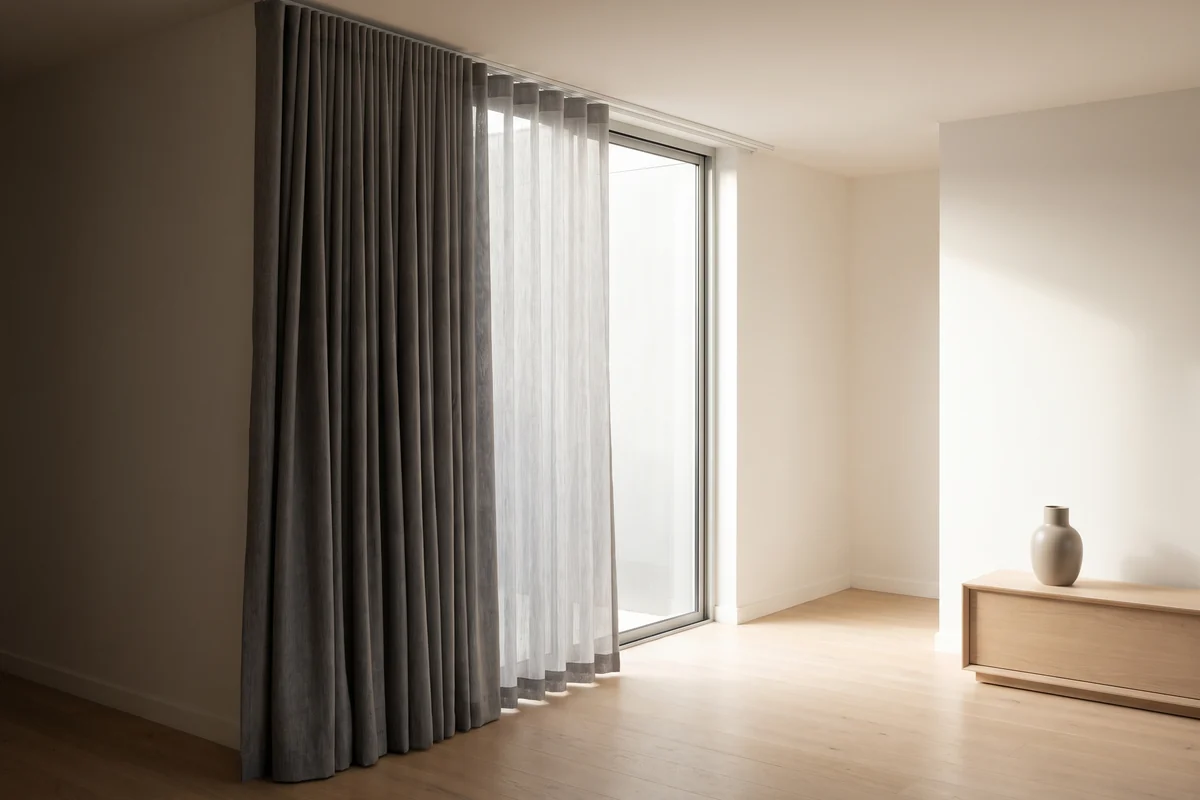 Guides
Double Curtains: How to Hang Two Layers Properly
Double curtains hang a sheer behind a blockout on one track. Which layer goes in front, what the track has to clear, and what the second layer really costs.
Read more Guides
Bathroom Window Coverings That Survive Humidity
What lasts in a Queensland bathroom and what quietly rots: why polymer beats timber, why we avoid cellular blinds here, and where the mould actually starts.
Read more