


Curtain Rods vs Tracks
One of them is chosen for how it looks. The other is chosen for what it has to hold — and that is usually the decision that matters.
A curtain rod is decorative hardware you're meant to see — it carries rings, suits eyelet and pleated curtains, and mounts to the wall on brackets. A curtain track is a channel you're meant not to notice, usually fixed to the ceiling, and it glides better under weight.
Forced to pick one: track, for almost everything. It carries more, bends around a bay and lets a curtain start at the ceiling — and when the hardware is meant to be seen, a decorative track gives you that without giving up the mechanism.
Where we stand, before you read any further: we hang curtains on track, and every track we supply runs on runners. We do not make eyelet curtains and we do not supply rods or poles. That is a deliberate position rather than a gap in the range — the runner is what makes a heavy curtain draw smoothly for twenty years, and it is the first thing to go when a curtain is threaded straight over a pole. If you want the hardware on show, that is what a decorative track is for: it reads as a pole from the room, and the curtain still travels on runners. The rest of this page explains the comparison properly, because it is worth understanding either way.
Most people arrive at this decision from the wrong end. They choose a rod because they saw one they liked, and then find out what it can and can't carry. It's worth doing in the other order, because the fabric, the heading and the opening between them usually make the choice for you.
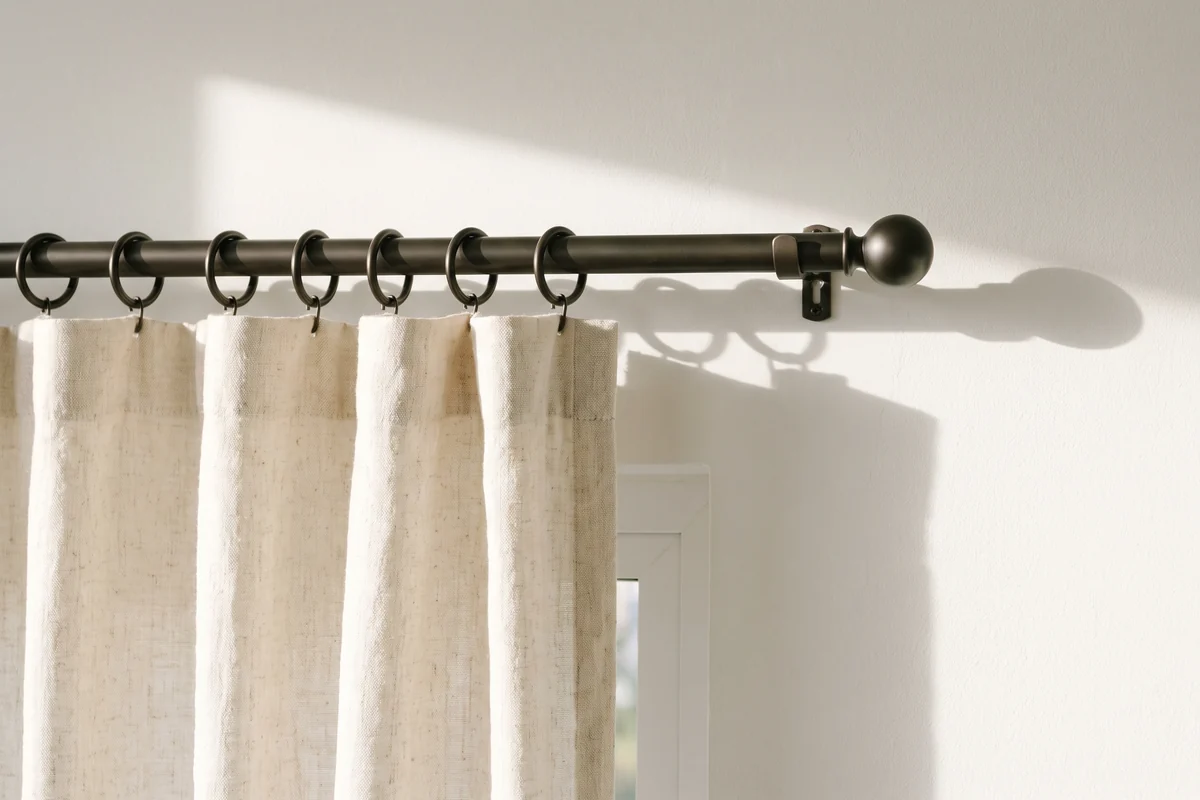
What a curtain rod does well
A rod is a pole on two or three brackets, and the curtain hangs from rings, eyelets or hooks threaded onto it. Everything about it is visible — the diameter, the finish, the finials on the ends — which is the point. A rod is the one piece of window hardware people buy for how it looks and then live with for how it works.
The appeal is real. Wooden curtain rods in oak or walnut read warm in a period room, and a brass curtain pole against a deep colour is a design decision rather than a concession. A rod also sits proud of the wall, so the curtain hangs clear of a radiator, a sill or a window that opens inward. Worth knowing, though, that almost all of that look is available on a decorative track — a visible bar with finished ends, sitting off the wall — with runners inside it instead of rings over it.
The honest limits: a rod's load goes through a small number of brackets rather than being spread along its length, so a long span needs a centre bracket — and a centre bracket is something your curtain has to get past every time you draw it. Rods also want more wall above the window than people expect, because the curtain hangs *below* the pole rather than level with it.
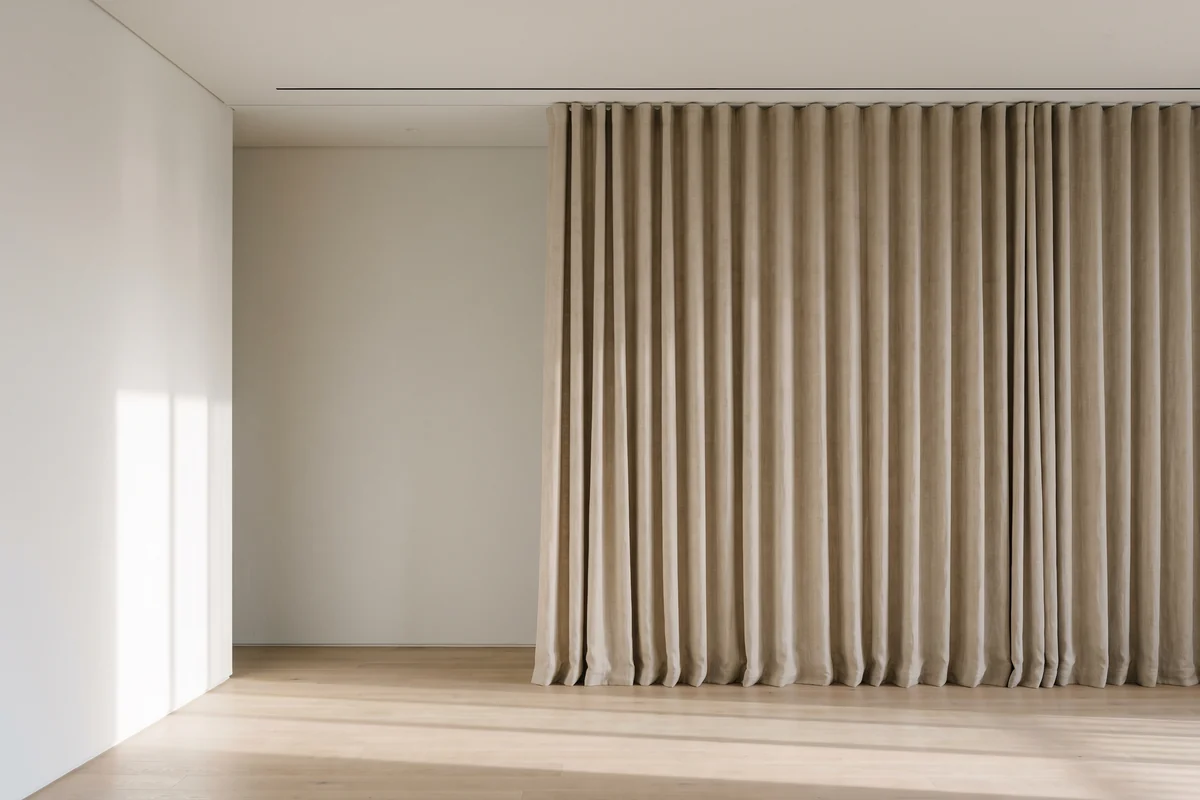
What a curtain track does well
A track is an aluminium or plastic channel with gliders running inside it, fixed either to the ceiling or to the wall face. Nobody has ever complimented a curtain track. That's the job — it disappears, and the fabric is the only thing in the room.
Because the fixings run along the whole length rather than sitting at two points, a track spreads load instead of concentrating it, and it keeps gliding when the curtain is heavy. It's also the only option that can be ceiling-mounted flush, which lets a curtain start at the ceiling line and run to the floor — the single cheapest way to make a room read taller.
A double curtain track carries two layers on independent runners, which is how you get sheer and blockout curtains on one window without compromise. You can double up on rods too, but you're then looking at two poles, six brackets and a lot of visible hardware to achieve what one track does quietly.

Curtain rods vs tracks at a glance
| Rod | Track | |
|---|---|---|
| Meant to be seen | Yes — it's decorative | No — it disappears |
| Mounts to | Wall, on brackets | Ceiling or wall face |
| Load path | Two or three points | Spread along the length |
| Heavy lined fabric | Workable | Better |
| Ceiling-to-floor look | No | Yes |
| Bays and corners | Needs corner joints | Bends in one piece |
| Two layers | Two poles | One double track |
| Cost | Wide — plain to expensive | Plain tracks are cheapest |
The third option the table leaves out
A rod-versus-track table makes it look like you must choose between hardware you can see and hardware that works. You don't. A decorative track is a track — runners, load spread along its length, all of it — finished so that what the room sees is a bar above the window rather than a channel. It is the answer for the window that wanted a pole, and it is what we specify when a client asks for one. The curtain still draws on runners, which is the part that has to keep working long after anyone has stopped noticing the hardware.
On cost, ignore the headline. A basic white track is the cheapest way to hang a curtain and decorative hardware is dearer, but the hardware is a small fraction of the job — the fabric and the making are most of the quote, and moving from a plain track to a decorative one rarely shifts the total much.
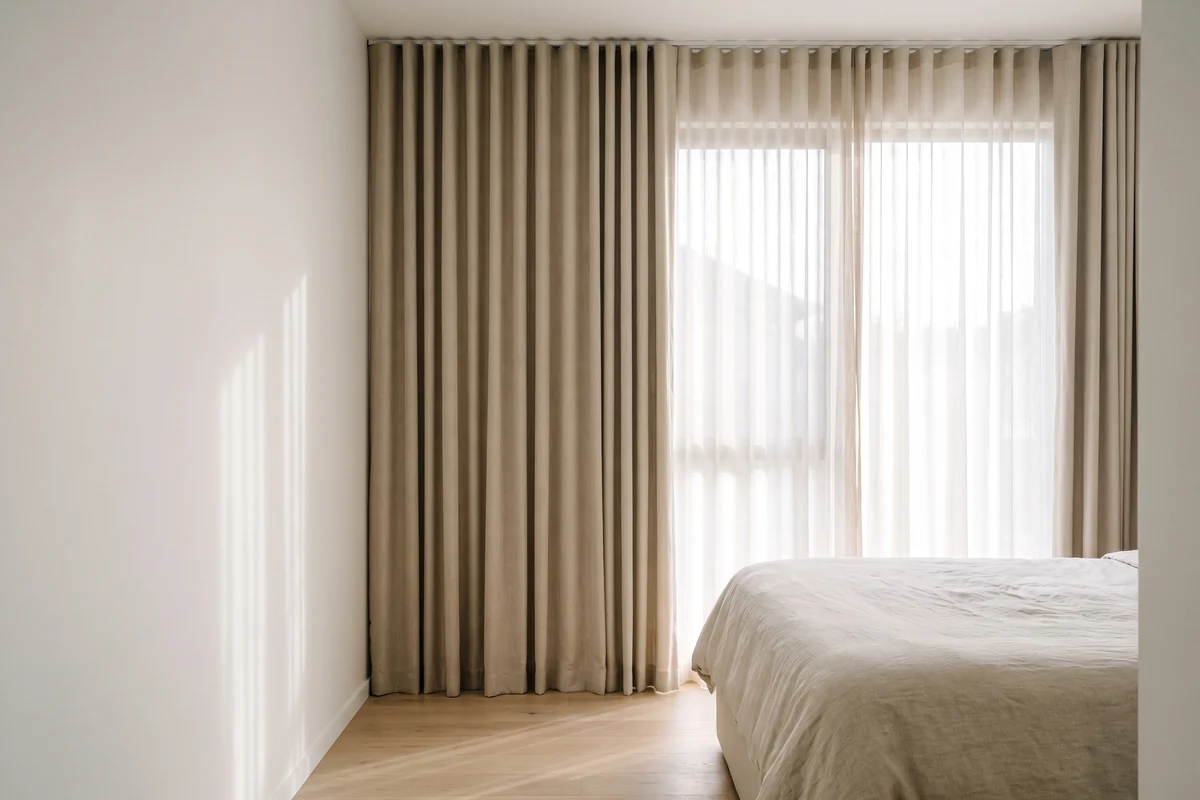
Your curtain heading may have already decided
This is the part people find out too late. The heading at the top of the curtain determines what it can hang from, so if you've settled on a look, the hardware question may be closed already.
- S-fold needs a track. The wave comes from carriers fixed at even spacing, and no rod reproduces it.
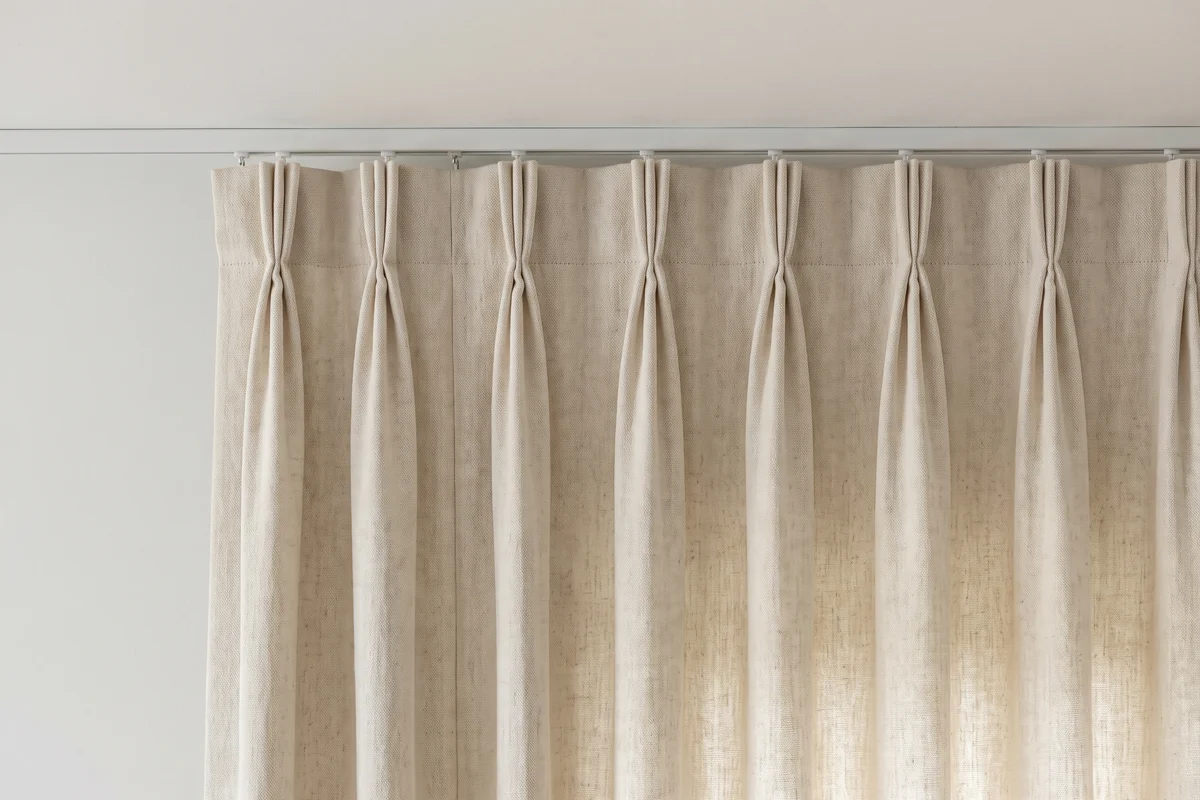
- Pinch pleat and pencil pleat go on either — hooks into track gliders, or into rings on a rod.
- Eyelet curtains need a rod. The pole threads straight through the eyelets; there's nothing for a track to grip.
So the sequence that saves money is: room first, heading second, hardware third. Choosing the rod first and the heading afterwards is how people end up with an eyelet curtain in a room that wanted an S-fold. There's more on that decision in our guide to pinch pleat, pencil pleat and S-fold headings. And if you've already settled on a track, the curtain half of the decision — which headings run on runners, how much fabric each one takes and where it all goes when the curtain is open — is covered in curtains on a track.
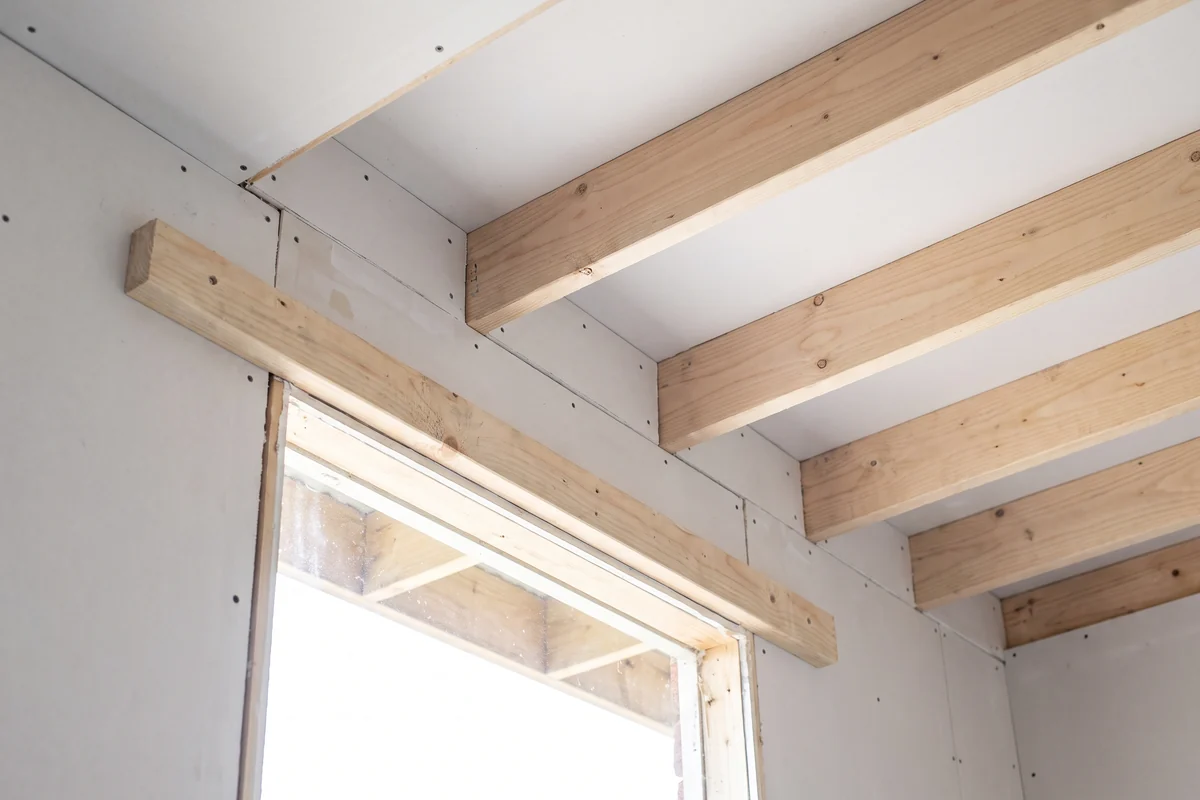
The part that fails is the fixing, not the hardware
Tracks and rods almost never break. What lets go is what they're screwed into, and it lets go slowly enough that nobody connects the two events.
A full-height lined curtain across a wide opening is heavier than it looks, and all of that weight is hanging off a few screws in your ceiling or wall. Plasterboard has one job, and holding up several metres of lined fabric is not it. It might hold for a year. Every system is sold with a stated load rating — ask for it, and ask what it's being fixed into, because the second answer matters more than the first.
What good looks like:
- Into timber. Ceiling joists, or the timber above the window head. This is the strong, ordinary answer.
- Into a batten. Where there's no joist in the right place, a timber batten fixed through the plasterboard into the structure gives you something to screw into anywhere along its length.
- Into steel or masonry. Steel-framed ceilings and brick each need their own fixings, rated for the load.
None of this is exotic — it's just work that has to be identified at the measure, when there's still time to do something about it. That's the whole reason we want the dimensions and the aspect of a room before quoting rather than after.
Not sure what's above your ceiling?
Neither is anyone else until it's checked. We measure the opening and the fixing before recommending hardware, and the quote comes back itemised within 24 to 48 hours.

Bays, corners and everything not rectangular
A track is bent to shape, in one continuous piece, so a curtain runs around a bay without stopping. A rod can't do that — a bay needs either separate poles per facet, with a gap and a bracket at every angle, or corner connectors that a ring has to be lifted over. Both work. Neither is smooth.
Same logic on a corner window, a curved wall, or a run long enough that a rod needs a centre bracket. If the curtain has to travel past a join, a track is the answer, and it's usually the answer for blockout curtains too, since a bay is exactly where light gets in around the edges.
One safety note that applies to both, and that the hardware aisle won't raise: a cord-drawn system is a corded internal window covering, and those are covered by an Australian mandatory safety standard. In a child's room, specify a wand or motorised operation instead. While you're deciding, it's worth knowing that windows are the weakest thermal point in most Australian homes — a ceiling-fixed track that lets the curtain seal at the top does measurably more thermal work than a rod with a gap above it.
Frequently asked questions
Are curtain tracks better than curtain rods?
For heavy, full-height or wide curtains, yes — a track spreads its load along the fixing line and glides better under weight. And where the hardware is meant to be part of the look, a decorative track gives you a visible bar with runners still inside it, so you are choosing a finish rather than trading away the mechanism. We hang everything on runnered track for that reason, and don't supply rods.
Can you hang any curtain on a track?
Almost, but not quite. Pinch pleat, pencil pleat and S-fold all work on a track. Eyelet curtains do not, because the pole has to pass through the eyelets, and there's nothing on a track for them to thread onto.
Do curtain tracks hold more weight than rods?
Generally yes, because the fixings run along the whole length rather than concentrating the load at two or three brackets. The bigger variable is what the hardware is fixed into — a heavy-duty track screwed into plasterboard alone will fail long before a modest rod fixed properly into timber.
What is a double curtain track?
A single track with two independent runners, so two layers of curtain can be drawn separately. It's how a sheer and a blockout curtain share one window, giving you four settings instead of one compromise, and it needs about 100–120mm of depth to fit.
Can a curtain track bend around a bay window?
Yes. Tracks are bent to the shape of the bay in one continuous run, so the curtain travels the whole way without catching. A rod can only manage a bay with separate poles or corner connectors, and the rings have to negotiate every join.
Are curtain tracks cheaper than curtain rods?
A plain white track is the cheapest way to hang a curtain, and a decorative timber or brass rod is among the most expensive. But hardware is a small share of a made-to-measure job — the fabric and the making dominate the quote, so this rarely decides anything.
Can you fix a curtain track straight into plasterboard?
Not for a curtain of any weight. Plasterboard alone won't hold a full-height lined curtain over time, and the failure is gradual rather than dramatic. Fix into ceiling joists or the timber above the window head, or install a batten first to give yourself something structural to screw into.
Sources Australian Government Your Home — Glazing · ACCC blinds and window fittings mandatory standard · Sleep Health Foundation
Back to the journalKeep reading
Related from the journal
 Guides
Pinch pleat vs pencil pleat vs S-fold curtains
The heading decides what your curtain can hang from, so this is the decision that comes before the hardware. Including the stackback numbers nobody publishes.
Read more Styling
Sheer vs blockout curtains: which should you choose?
A double track exists because most rooms want both. Sheers handle glare and daytime privacy, blockouts handle sleep and heat — and the two want different things from your hardware.
Read more Curtains
Custom curtains, Brisbane & Gold Coast
Every heading and fabric we make, lead times, and how the check-measure works — including the part where we find out what is actually above your ceiling.
Read more