

Modern curtains: four decisions, not a fabric
The look is settled before anyone opens a fabric book. Here is what each of the four decisions actually costs.
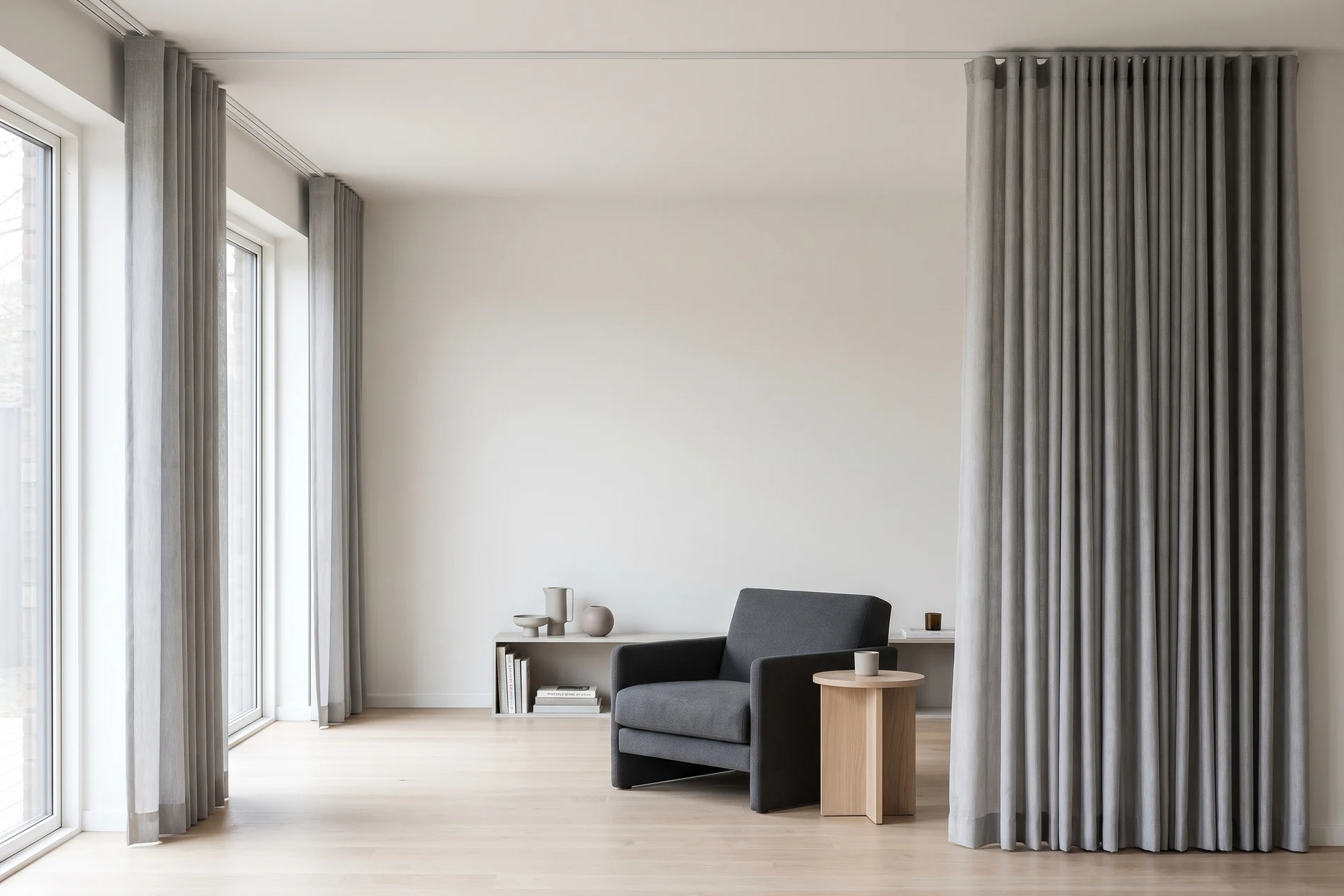
Modern curtains are not a fabric you buy. They are four decisions made before the fabric book opens: the track goes at the ceiling rather than above the window, the heading is a wave fold rather than a gathered one, the colour stays quiet so the texture can work, and the hardware disappears.
Forced to pick one: put the track at the ceiling. Everything else on this page is easier to fix later.
Search the term and you get twenty numbered ideas — geometric prints, a velvet, something with an LED in it. None of that is what makes a room read as modern. What does it is proportion and restraint, and both are set by decisions nobody photographs. So this is a page about the four that matter, what each one costs, and the three situations where I would tell you not to bother.
What actually makes a curtain modern
Strip out the styling language and the modern look is four things, in this order.
- Height. The track sits near the ceiling, not on the window architrave, and the fabric runs to the floor.
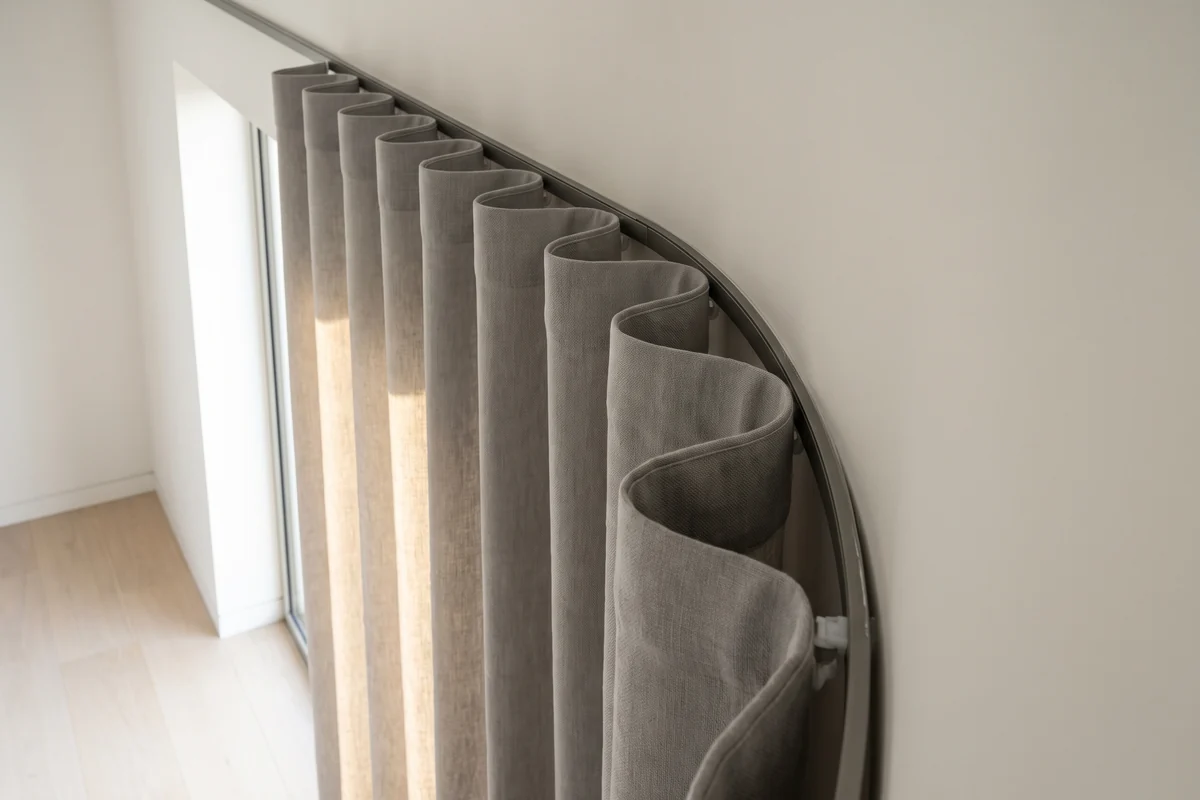
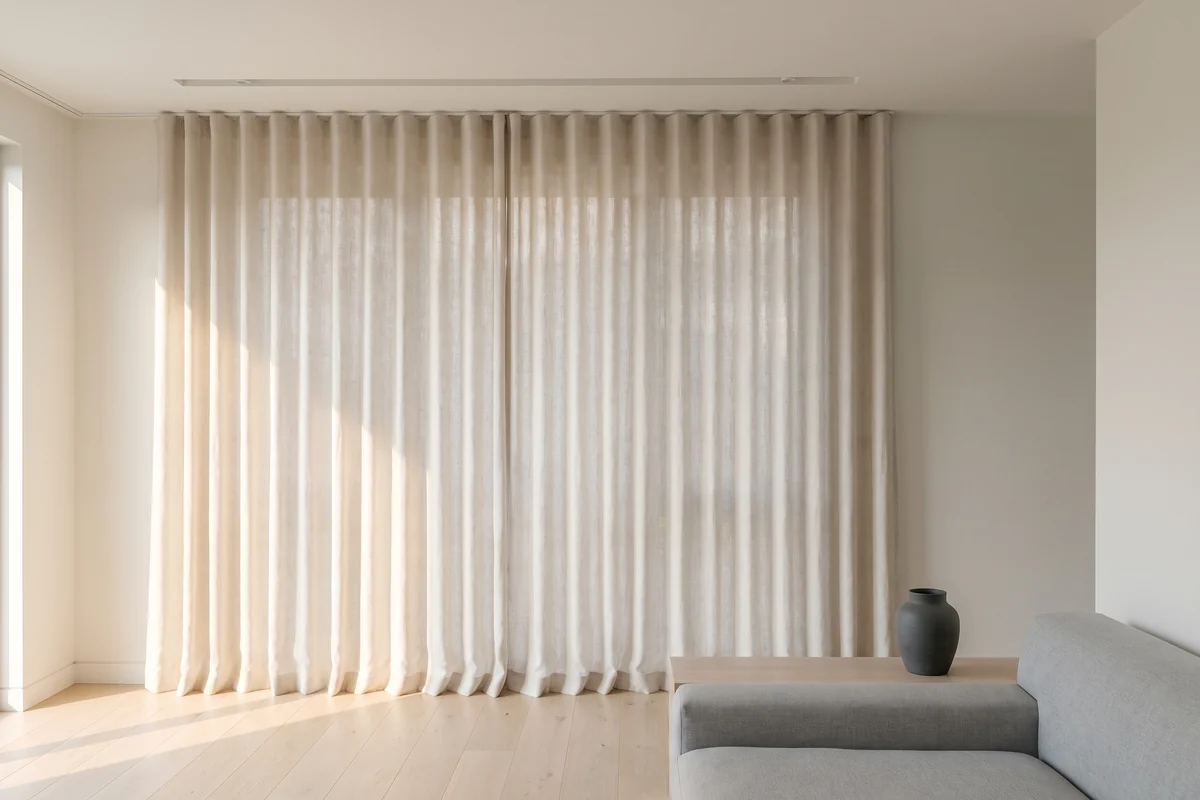
- The heading. Even, rounded, evenly spaced folds that hold their shape whether the curtain is open or closed — a wave fold, also sold as S-fold or S wave.
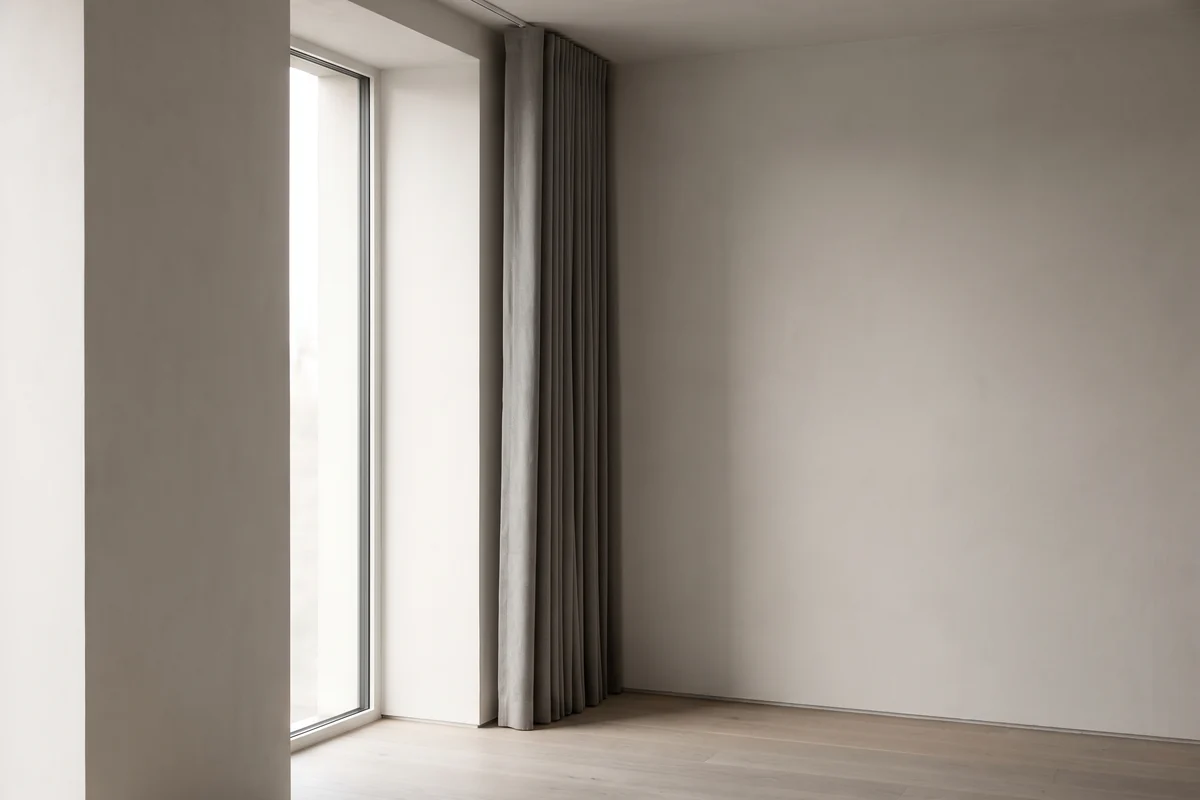
- Colour discipline. One tone, close to the wall, with the interest coming from weave rather than pattern.
- Invisible hardware. No visible fixings, no finials, no rings. Ideally no visible track either.
Worth clearing up a distinction the American guides make and Australian ones usually skip. Modern is a period — the mid-century design language of clean lines, natural materials and function ahead of ornament. Contemporary just means whatever is current. In practice, when someone says they want modern curtains in their house, they mean the first one: quieter, taller, less of it.
Here is how that plays out against the traditional treatment most of us grew up with.
| Modern | Traditional | |
|---|---|---|
| Where it is fixed | Ceiling, or as close as the structure allows | To the architrave, just above the window |
| Drop | Full wall height, to the floor | To the sill or just below it |
| Heading | Wave fold, evenly spaced on runners | Gathered, pinch pleat or box pleat |
| Fullness | 2.3 : 1 | 1.8 : 1 |
| Colour | One quiet tone, texture-led | Pattern, trim, contrast lining |
| Hardware | Recessed or concealed track | Visible pole, finials, rings |
| Operation | Wand, cordless, or motorised | Hand-drawn by the leading edge |
Nothing in the right-hand column is wrong. A pinch pleat in a Queenslander with high skirting and picture rails is the correct answer, and a wave fold in the same room looks like it wandered in from an apartment. The point of the table is that the two columns are internally consistent — the mistake is mixing them, which is how you end up with a wave heading on a pole, or a sill-length curtain with concealed hardware.
Put the track on the ceiling, not above the window
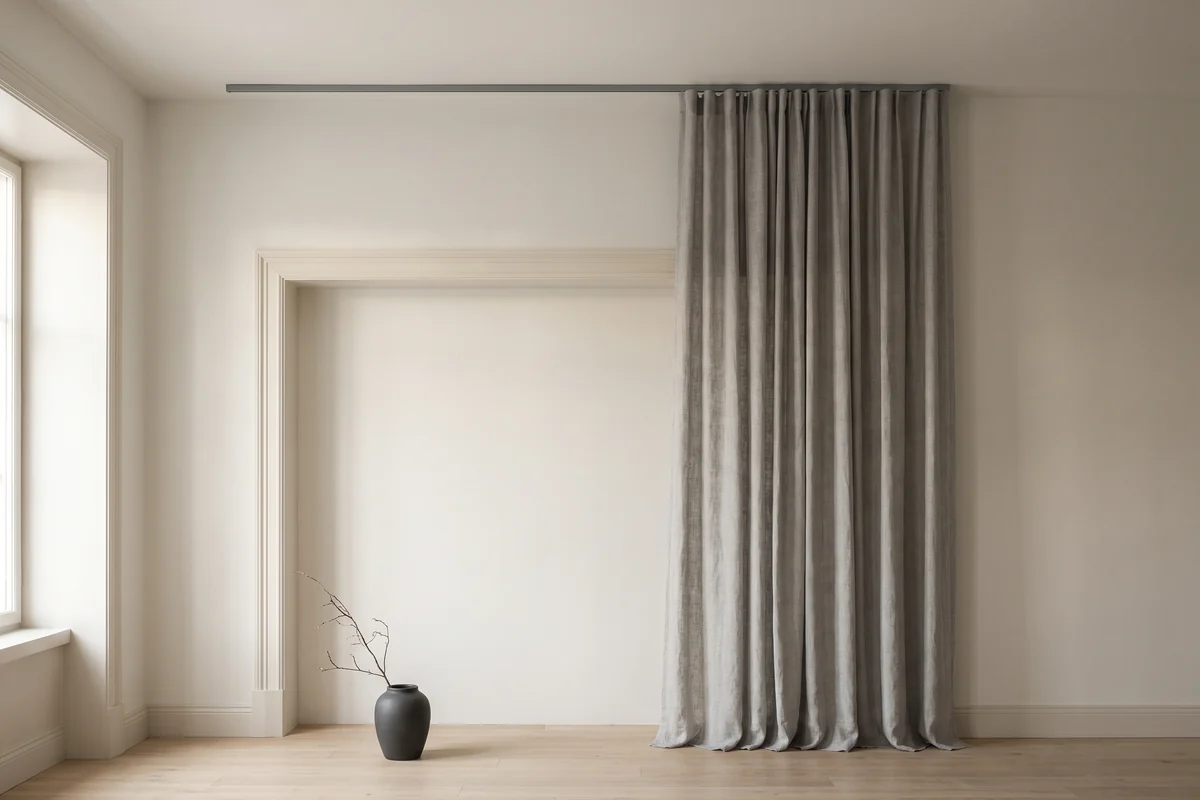
This is the single decision that does the most work, and it costs almost nothing at the quoting stage. A curtain hung at the ceiling and run to the floor makes the wall read as one uninterrupted plane. The same curtain hung on the architrave draws a horizontal line across the room at window-head height and cuts the wall in two.
Two rules that come out of it, and they are worth writing on the back of your hand before anyone measures.
- Measure to the wall, not to the window. A curtain measured to the window is measured wrong. You want the track running well past the reveal on both sides so the fabric can stack back onto solid wall and leave the glass clear.
- The drop is floor to ceiling, not floor to window. Ceiling to floor sheer curtains are the version of this most people have seen and not been able to name. The fabric ends about 10mm off the floor — close enough to read as touching, far enough that it does not drag on the carpet every time it moves.
Now the part that nobody selling you fabric will raise. A full-height curtain is heavier than a sill-length one and it is hanging off your ceiling, which in most Australian homes means plasterboard with a joist somewhere behind it. A track fixed into plasterboard alone will fail — it is a matter of when, not whether. We have been called out to more than one track that pulled out of a ceiling six months after someone else installed it. The fix is a batten or a fixing into structure, decided at the measure, and it is why we want the dimensions and the aspect of the room before quoting anything.
If the ceiling genuinely cannot take it, or there is a bulkhead in the way, that is a real constraint and a good installer will tell you at the measure rather than on install day. The honest fallback is to go as high as the structure allows and accept a slightly shorter wall, which still beats sitting the track on the architrave.
Choose the heading before you choose the fabric
The heading is the top of the curtain — the mechanism that decides how the fabric folds. It is also the decision that quietly sets your budget, because fullness is expressed as a ratio of flat fabric to finished track width, and the modern heading has the highest ratio in the range.
Our confirmed numbers: a wave fold heading runs 2.3 : 1. Box pleat, reverse pleat, gathered and knife pleat all run 1.8 : 1. That is not a rounding difference. Across a 3m track, the wave heading takes 6.9 metres of fabric and the 1.8 : 1 headings take 5.4 metres — about 28% more cloth for the same window, before anyone has chosen a colour.
So the opinion, and it is one that costs us the easy upsell: the modern look is a fabric-quantity decision before it is a style decision. If your fabric is $90 a metre, the heading you pick has just moved the quote by roughly $135 on one 3m opening, and you will feel it more on a run of four. Knowing that up front is what lets you spend the money where it shows — a better cloth at 1.8 : 1 will usually beat a cheaper cloth at 2.3 : 1, because the wave only looks like a wave if the fabric has enough body to hold the shape.
The other thing the ratio buys you is behaviour. At 2.3 : 1 the folds are deep enough to stay put when the curtain is stacked back, which is why a wave curtain looks tidy open and a skimped one looks like a bundle. This is the whole argument for the heading, and it is worth reading alongside the track and hardware comparison, because the heading and the hardware are one decision pretending to be two.
Layer a sheer and a blockout on one twin track
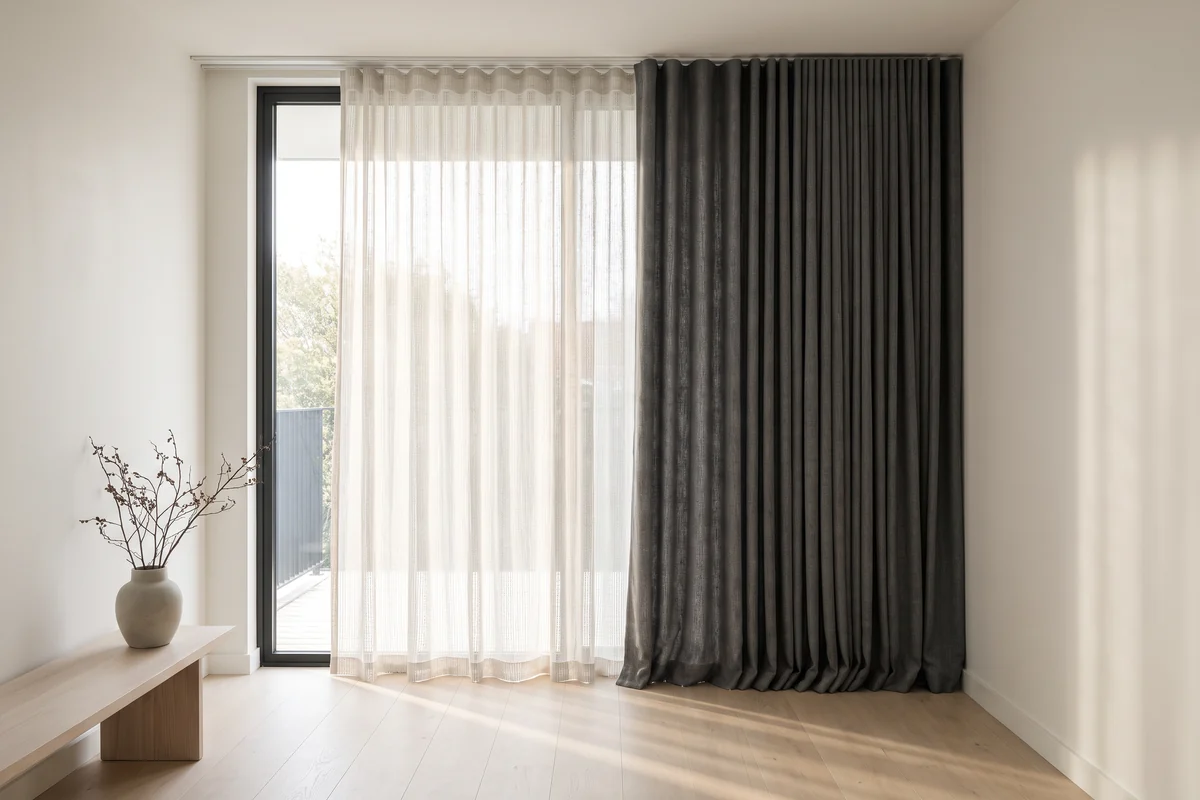
Every guide on this keyword recommends layering and none of them says how it is actually built, which is a twin track: two channels on one bracket, two curtains, operated independently. The sheer goes on the rear channel nearest the glass. The heavier curtain goes on the front channel nearest the room.
Done that way, the room has three states rather than two. Sheer closed and blockout open gives you daylight without the view in. Both open gives you the full window. Both closed gives you the night. A single curtain gives you two states, one of which is a dark room in the middle of the day, which is how curtains end up sitting half-drawn all year because no position is quite right.
Two honest limits. A sheer gives you nothing after dark — once the lights are on inside, a sheer reads as a lit window from the street no matter how dense the weave, and that is physics rather than a product gap. And the second layer is not half price: it is a second curtain, at its own fullness ratio, on a deeper bracket. The full arithmetic of the second layer is worth reading before you commit, because it is the most common place a quote comes in above what someone expected.
Where heat is the real problem rather than light — a west-facing wall of glass, which the Gold Coast has rather a lot of — there is a third option worth asking about. Verosol SilverScreen is a metallised curtain fabric: the backing reflects solar radiation outward instead of absorbing it and re-radiating it into the room. That is the mechanism, and it is the honest version of the claim. The Australian Government's Your Home guidance on shading is blunt about the ranking, though: external shading beats anything you hang inside, every time.
Keep the colour quiet and let the texture do the work
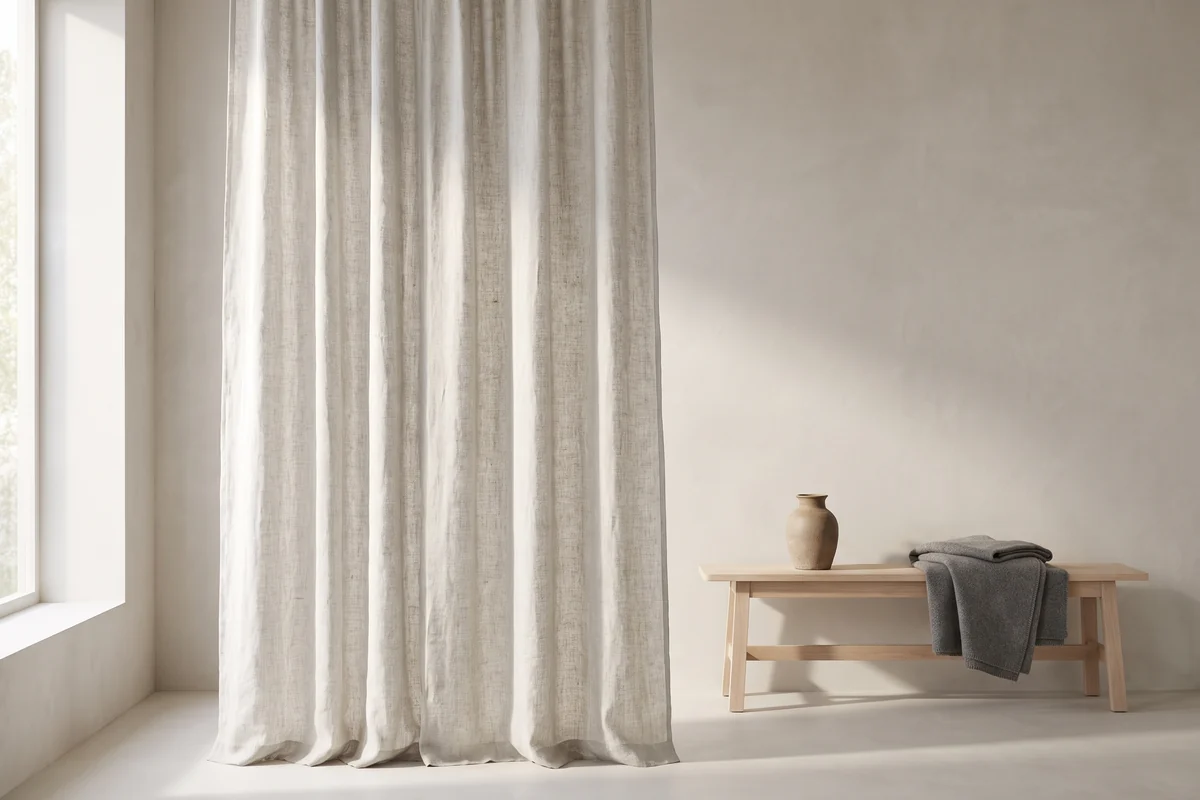
Modern drapery designs for a living room are almost always one tone, and the tone is almost always within a shade or two of the wall. Off-white on off-white. Warm grey on warm grey. The curtain is meant to read as part of the wall when it is closed, which is the whole reason for running it floor to ceiling in the first place.
That sounds boring written down. In a room it is the opposite, because once the colour stops competing you start noticing the weave — a slub linen, a fine basket, an open-weave sheer with visible slubs in the yarn. Texture reads at a metre and colour reads at ten, so a textured neutral gives you something to look at up close and nothing to argue with from the doorway.
Where an accent belongs, put it in a small quantity and keep it out of the curtain. If you want the curtain itself to carry the colour, go one clear step darker than the wall rather than a contrasting hue, and check the sample vertically in the actual room at about four in the afternoon. Fabric behaves differently hanging in your light than it does flat on a showroom bench. The longer piece on choosing a curtain colour covers the sampling properly.
One thing to avoid, and it is the most common misfire on this look: a pattern chosen from a swatch the size of a postcard. Repeats scale up, and a print that reads as subtle at 100mm across can read as a feature wall at three metres.
Want to know what this costs on your windows?
We measure, then send an itemised quote within 24 to 48 hours — heading, fabric, track and installation priced separately, so you can see exactly what the wave fold is adding. Curtains run 2 to 4 weeks from check-measure to installation.
Hide the hardware, and skip the eyelets
A window with curtains reads as modern largely by what you cannot see. There are three ways to get there, in ascending order of cost.
- A slim ceiling-fixed track. Fixed flat to the ceiling, the fabric hanging directly beneath it. Cheapest and, on a plain ceiling, the cleanest.
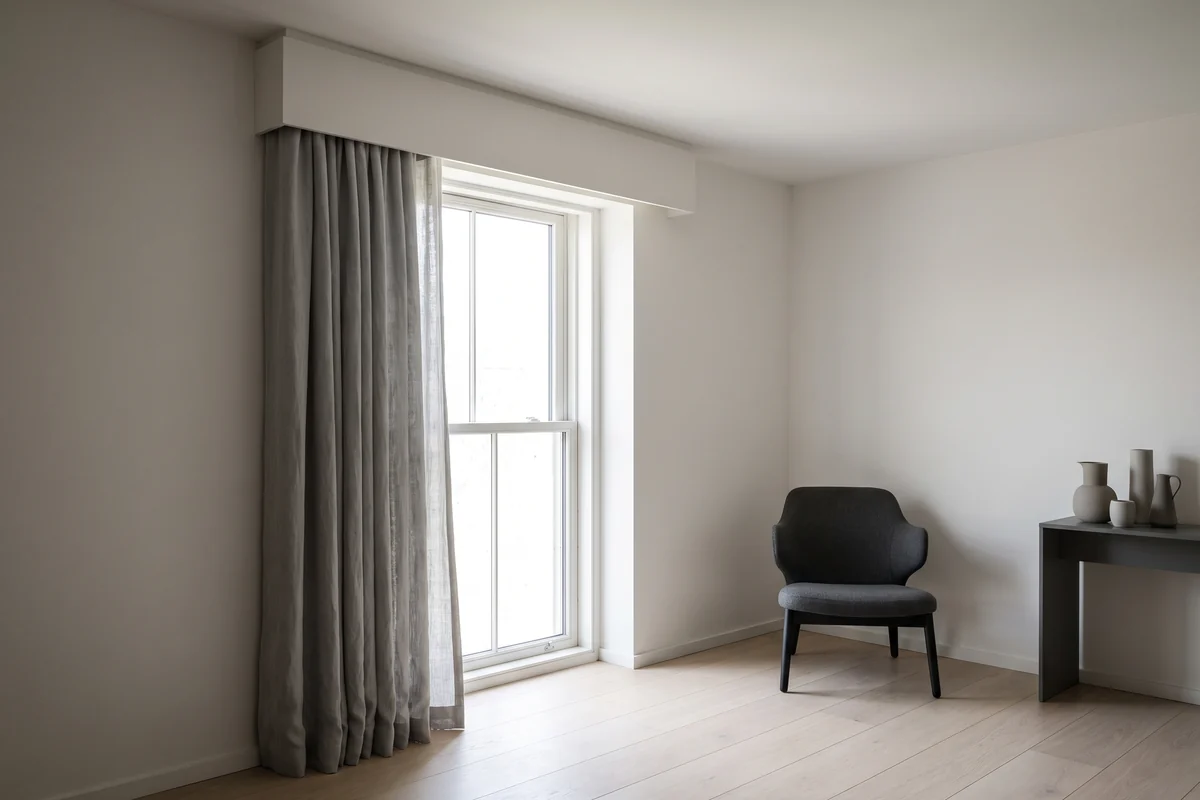
- A pelmet. A boxed board that encloses the track and the top of the heading. It hides the mechanism and, because it traps a layer of still air at the top of the curtain, it is also the single most useful thermal addition to a curtain.
- A recess. A shadow line built into the ceiling at construction. Best result, only available if you are building or renovating the ceiling anyway.
Now the part where I talk you out of something. Eyelet curtains are frequently marketed as the modern option, and mechanically they are the opposite. An eyelet slides on the pole itself, so the fabric is carried by the same thing you are looking at, and the folds are spaced by wherever the eyelets happen to sit. A wave heading hangs from runners inside a track, which is what makes the spacing consistent and repeatable. We do not supply poles or eyelet curtains at all — every track we fit runs on runners. Where someone wants the look of a pole, the answer is a decorative track, which reads as a pole and works as a track.
On operation: a wand or a cordless leading edge is both tidier and safer than a cord loop. If there are small children in the house that stops being a preference — corded window furnishings are covered by an ACCC mandatory standard, and the sensible specification in a child's room is no accessible cord at all. Motorisation does the same job and adds convenience on a tall or hard-to-reach window, but it is chosen when the curtain is made, not added afterwards, and I would not put it on a bedroom window you walk past every morning.
When modern curtains are the wrong call
Three situations where I would tell you to spend the money elsewhere.
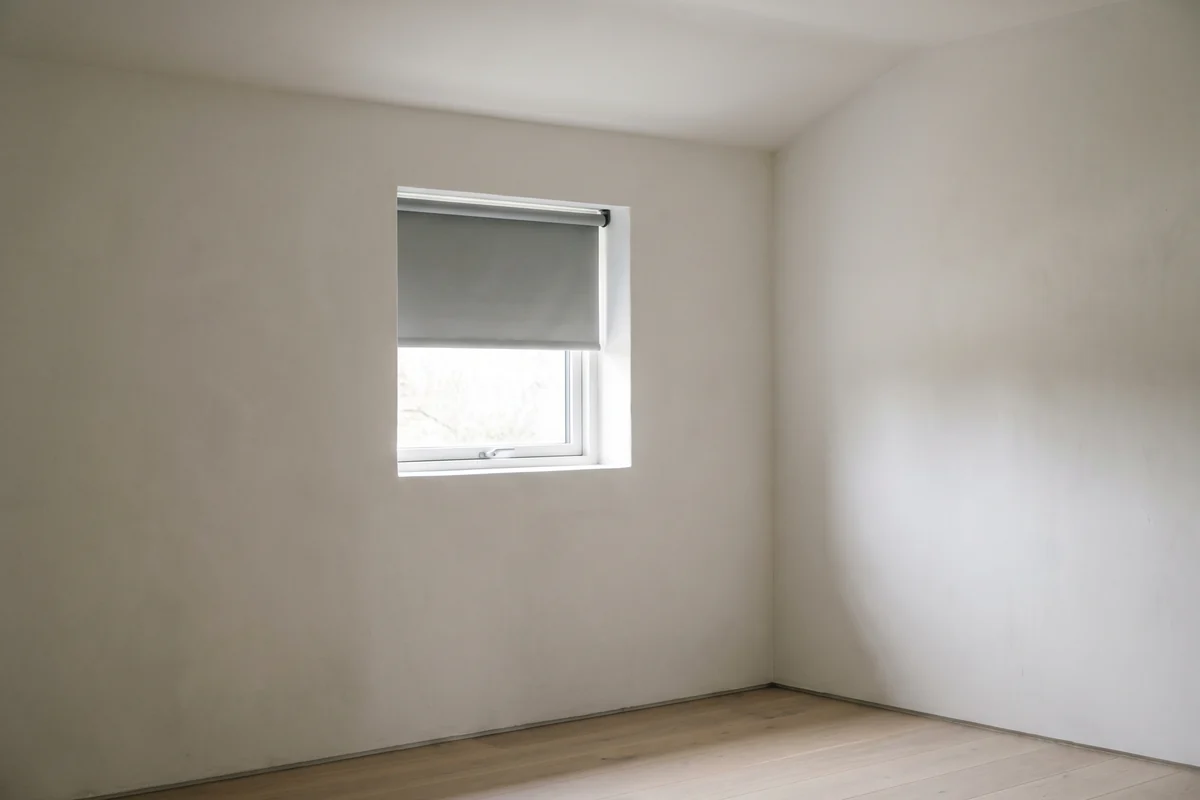
- The window is short and the ceiling is low. The whole effect depends on a tall uninterrupted drop. On a 2.4m ceiling with a 900mm window, a full-height curtain reads as a lot of fabric doing very little, and a neat blind in the reveal looks better and costs less.
- There is nowhere for the curtain to stack. If the wall beside the window runs straight into a corner or a door, the fabric has to stack across the glass. You lose light all day to buy a look, which is a bad trade in a room you actually use. Check the return wall before you commit.
- The room is wet, or the window is small and functional. Fabric and moisture are a poor combination, so bathrooms and laundries want shutters or a blind, not drapery. Same for a kitchen window over a sink.
And a fourth that is less about the room than the budget. Cheap curtains are more expensive, because you buy them twice — a thin fabric at 2.3 : 1 fullness will still look thin, and a track chosen on price will be the thing that fails, not the cloth. If the numbers are tight, drop the fullness before you drop the quality of the track. Bedrooms are the usual place to start, and the bedroom-specific version of this decision is a slightly different problem because the light matters more than the look.
Frequently asked questions
What are modern curtains?
Modern curtains are floor-to-ceiling panels with an evenly spaced wave fold heading, hung on a concealed or ceiling-fixed track in a single quiet colour. The defining features are proportion and restraint rather than a particular fabric — the track goes near the ceiling instead of on the architrave, and the hardware is hidden rather than decorative.
Should modern curtains touch the floor?
They should come within about 10mm of it. That reads as touching from anywhere in the room, but keeps the hem off the carpet so the fabric is not dragging every time the curtain moves. A curtain that genuinely puddles on the floor is a traditional look, not a modern one, and it collects dust.
Are eyelet curtains still in style?
Eyelets are often sold as modern, but mechanically they are the opposite of the wave look: the fabric slides on the pole itself and the folds are spaced by wherever the eyelets sit. A wave fold hangs from runners in a track, which is what keeps the spacing even. Lusso does not supply poles or eyelet curtains — where you want the appearance of a pole, a decorative track gives you the look with a runner mechanism behind it.
What colour curtains look most modern?
A tone within a shade or two of the wall — off-white, warm grey, oatmeal, taupe. The intent is that the curtain reads as part of the wall when closed, with the interest coming from the weave rather than a pattern. If you want the curtain to carry colour, go one clear step darker than the wall instead of picking a contrasting hue.
How much fabric do wave fold curtains need?
A wave fold heading runs at 2.3 : 1 fullness, which is the ratio of flat fabric width to finished track width. Across a 3 metre track that is 6.9 metres of fabric. Box pleat, reverse pleat, gathered and knife pleat headings all run at 1.8 : 1, or 5.4 metres on the same track — so the wave heading takes roughly 28% more cloth.
Do modern curtains need a pelmet?
Not structurally, but a pelmet is the tidiest way to hide a track and it is the most useful thermal addition you can make to a curtain, because it traps a layer of still air at the top instead of letting warm air spill over the heading. If you are not fitting one, a slim ceiling-fixed track achieves most of the visual result at a lower cost.
Sources Australian Government Your Home — Shading · Australian Government Your Home — Glazing · ACCC blinds and window fittings mandatory standard · Window Shading Association of Australia
Back to the journalKeep reading
Related from the journal
 Curtains
S fold curtains
The wave heading itself — how the track makes the fold rather than the sewing, and what 2.3 : 1 fullness looks like on a real opening.
Read more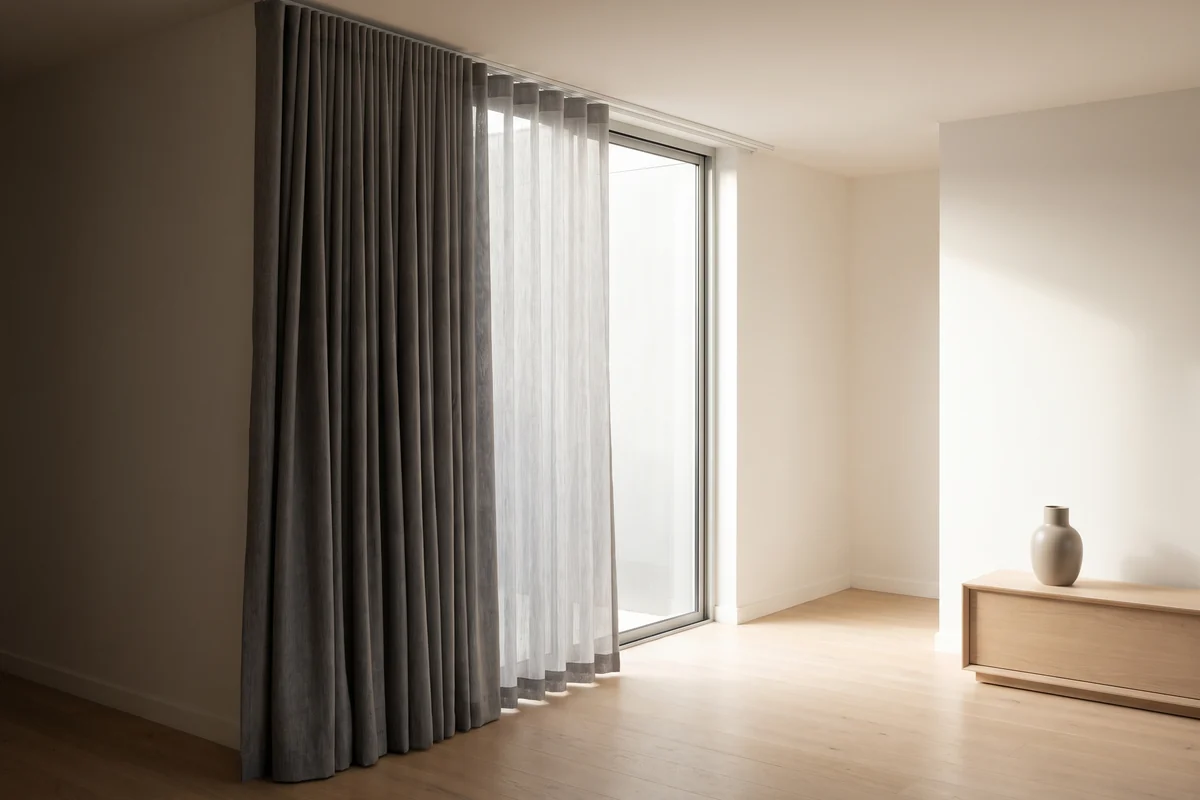 Guides
Double curtains: how to hang two layers properly
A sheer behind, a blockout in front, both on one twin track. Which layer goes where, and the fullness arithmetic that tells you what the second layer really costs.
Read more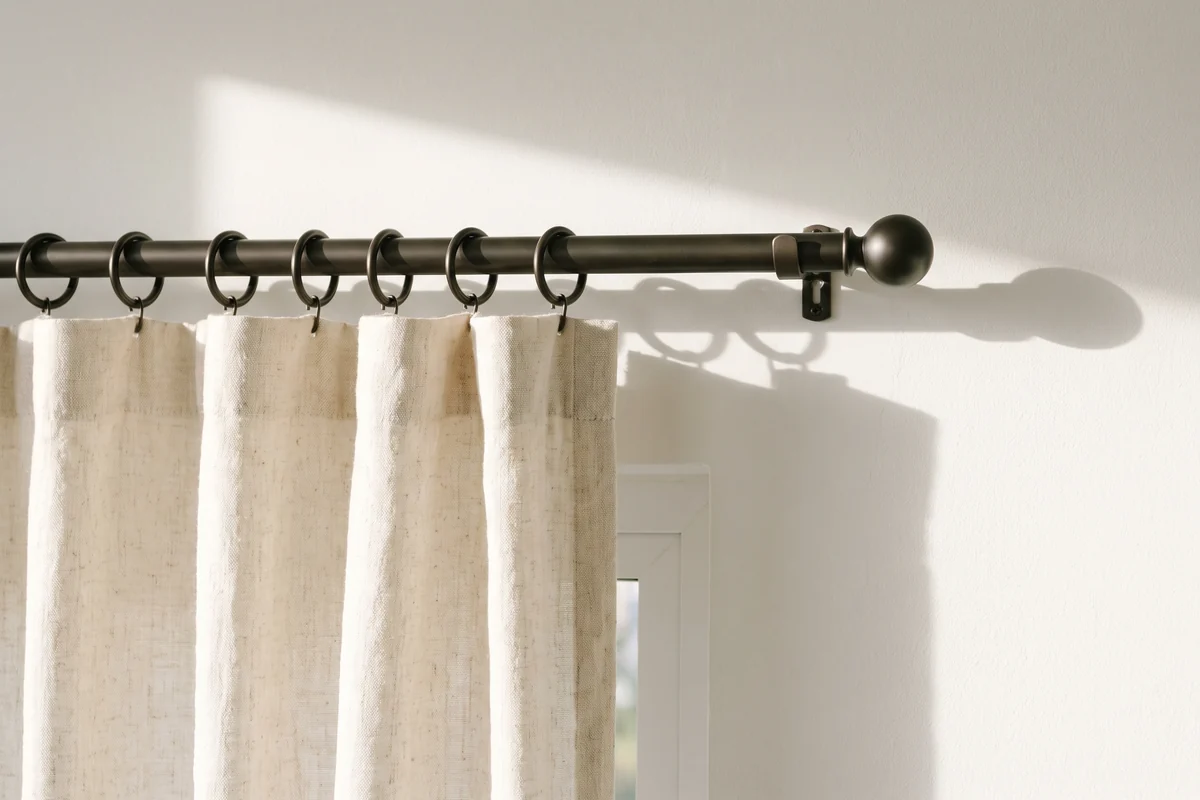 Guides
Curtain rods vs tracks: which should you choose?
One is chosen for how it looks, the other for what it has to hold. What each system carries, which headings fit which, and the fixing question that quietly decides it.
Read more