


Laundry blinds
The water comes off the dryer, the winder handle decides the fit, and neither of those is a fabric question.
Laundry blinds have to survive a room that gets wet from the dryer rather than the tap, and clear a winder handle projecting into the reveal. That rules out anything holding damp in a fold, and rules in a hard, non-porous slat.
Forced to pick one: an aluminium venetian, face fixed clear of the winder, with nothing hanging over the trough.
Most guides list the same five blinds and tell you PVC resists moisture. True, and it skips the two things that decide the job: where the water comes from, and whether the blind clears the hardware.

The water comes off the dryer, not the wash
A bathroom gets a burst of steam that clears in twenty minutes with the fan on. A laundry gets something slower: a vented dryer running an hour in a shut room, moving water out of the clothes and into the air around your window. Most pages on this treat the two as one problem.
So the first question is which dryer, not which blind. A condenser or heat-pump machine collects that water in a tank, and the choice opens right up. A vented one has to be ducted outside — Your Home is blunt that an exhaust belongs outside, not in the roof space — and until it is, the blind hangs downwind of a humidifier. Mean 3pm humidity in Brisbane runs 57 per cent through January, so the outdoor air is no help. What rots in that is covered in our guide to bathroom window coverings.

Measure the winder before you choose the blind
A laundry window is usually the plainest in the house: an aluminium awning sash, a security screen, and a winder handle sticking into the reveal. That handle, not the depth of the recess, decides whether a blind fits inside at all. Usually it does not, so it goes on the wall face.
Then there is reach. The window sits above the trough, so a control you lean across a full tub to work is a blind that never moves again. Face fix, and measure it the way we measure a roller blind: at least 70mm above the opening and 50mm each side.

What we would fit, and what we would not
| Why it suits a laundry | Lead time | |
|---|---|---|
| Aluminium venetian | Non-porous slats, tilt for airflow, wipe clean | 2–3 weeks |
| Thermalite shutter | Polymer, does not absorb moisture, best over a glazed door | 4–6 weeks |
| Vertical blind | Suits a door-height opening, vanes clear the sill | 2–3 weeks |
| Roller blind | Fine where the dryer is ducted out, in a wipeable fabric | 2–3 weeks |
The aluminium venetian is the one we fit most, because it is the only one there that shuts the window off and still moves air through it. Over a glazed laundry door a Thermalite shutter panel beats all of them, and costs accordingly. A roller blind is not wrong, just conditional.
Three we would not hang:
- Honeycomb. The cells hold damp air against themselves and never dry out.
- Roman. The same fault in a different shape.
- Sheers. Mould in an open weave does not come out.
Not sure the winder leaves you room?
We measure it, and the itemised quote comes back within 24 to 48 hours. If the window does not need a blind, we say so.

Blockout in a laundry is money spent on nothing
Nobody sleeps in there. Blockout is the dearest thing you can hang at that window and it buys a benefit the room has no use for, so we talk people out of it more often than we sell it. Mould, condensation and moisture damage are excluded from our warranty, and from every fabric warranty we have read. We warrant our workmanship for 12 months and the product carries 12 months to 7 years — none of it covers a blind hung in front of a vented dryer. Fix the duct first.
Frequently asked questions
What are the best blinds for a laundry?
An aluminium venetian, in most laundries. The slats are non-porous, they tilt to move air through a closed window, and they wipe clean. Over a glazed back door, a polymer shutter panel is better.
Do blinds go mouldy in a laundry?
Fabric ones can, and it is almost always a ventilation problem rather than a fabric one. A vented dryer discharging into the room puts warm damp air onto whatever hangs at the window. Duct it outside and the blind stops being the weak point.
Are aluminium venetian blinds good for wet areas?
Yes, which is why we recommend them for laundries and ensuites. Aluminium does not absorb water, so it cannot swell, warp or grow anything a timber slat will. Watch the ladder cord, which wants wiping too.
Should a laundry blind be fitted inside or outside the window recess?
Usually outside, on the face of the wall. The winder handle on an aluminium awning window leaves too little clearance inside the reveal. Face fixing also covers the gap around the frame, where most of the light gets past.
Sources Australian Government Your Home — Ventilation and airtightness · Bureau of Meteorology Brisbane climate averages
Back to the journalKeep reading
Related from the journal
 Guides
Bathroom Window Coverings That Survive Humidity
What lasts in a Queensland bathroom and what quietly rots: why polymer beats timber, why we avoid cellular blinds here, and where the mould actually starts.
Read more Guides
Kitchen window coverings: grease, heat and cleaning
Cooking aerosolises oil, so the film reaches the whole room, not just the wall behind the hob. What belongs at a kitchen window, and where a roman blind is still fine.
Read more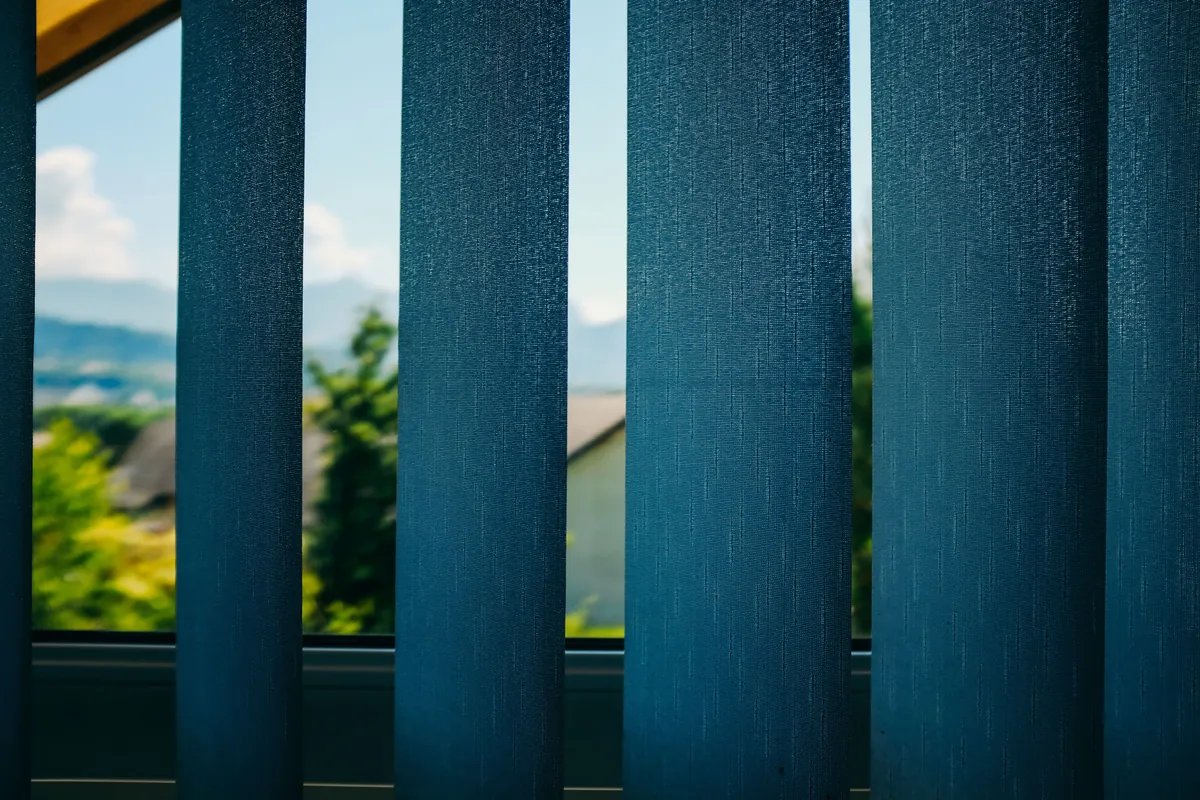 Guides
How to clean blinds without wrecking them
Dust monthly, wet-clean twice a year, and never soak a blockout roller. A type-by-type method for rollers, venetians, verticals, Romans and honeycombs — plus the mould routine, which is really a ventilation problem in disguise.
Read more