

Kitchen window coverings
Cooking aerosolises oil, so the whole room gets a film on it — not just the wall behind the hob. That changes what belongs at a kitchen window and what quietly ruins.
The best blinds for a kitchen window are non-porous and wipeable — an aluminium or PVC venetian, or a roller in a wipe-clean fabric. Fabric in folds belongs well away from the cooking, and nothing absorbent belongs over a hob.
Forced to give one rule: measure the distance from the cooktop. That number decides more than the style you like.
Kitchens get written about as a cleaning problem, which is right, but the mechanism usually gets described wrongly. It is not splatter. Splatter is local and obvious and you wipe it up. The thing that actually coats a kitchen is finer than that, and it explains why a blind on the far side of the room still ends up tacky.
The problem is airborne, not splatter
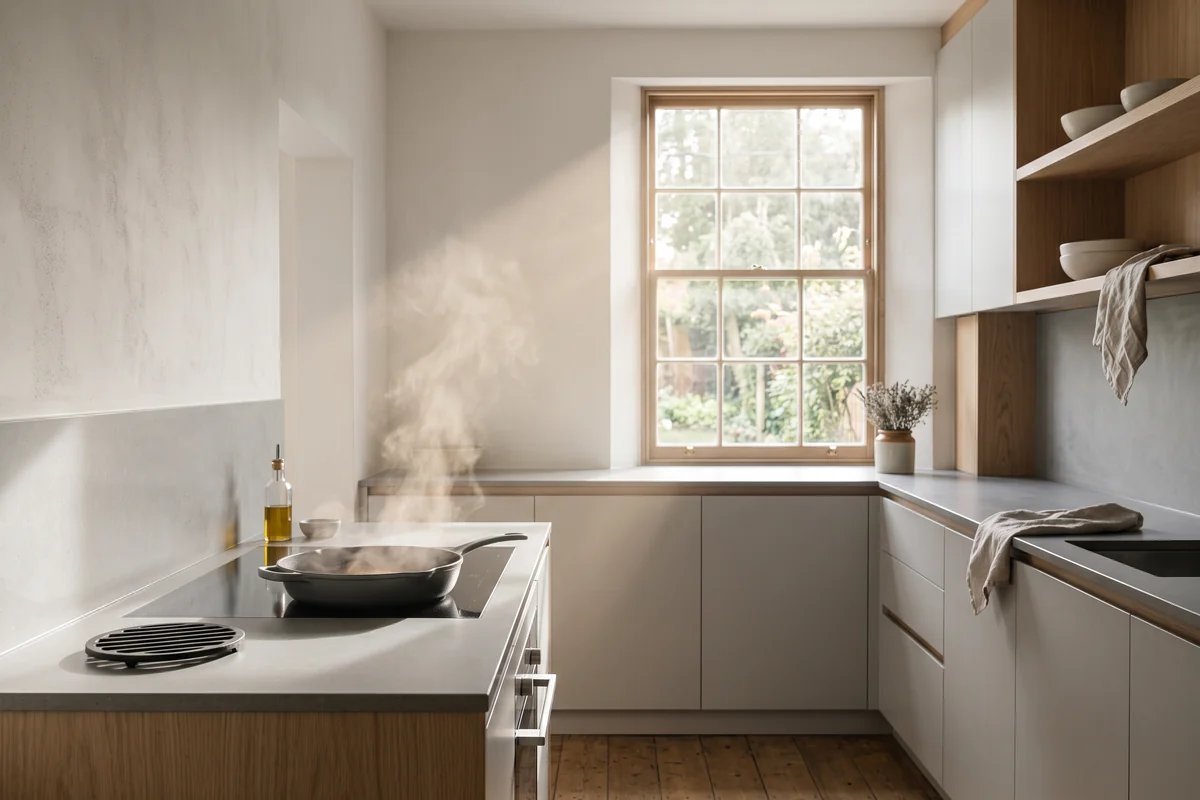
Frying, roasting and even boiling put oil into the air as a fine aerosol. It rises with the warm air, spreads through the room, and settles on every surface it meets — cool ones first. That film is what turns a light switch tacky, what dulls the top of the fridge, and what gets into a window furnishing three metres from the pan.
Two consequences follow, and they run in different directions.
First, distance helps but does not exempt you. A window across the room gets a much thinner film than one beside the cooktop, but it still gets one. Anything in a kitchen needs to be cleanable eventually, even if it looks safely far away.
Second, texture matters more than distance. A flat, non-porous surface collects the same film but releases it to a damp cloth. A woven fabric absorbs it into the fibre and a folded fabric traps it in the crease, where no cloth reaches. That is why the honest rule is about what the covering is made of and what shape it holds, not simply how far it sits from the stove.
What belongs at a kitchen window
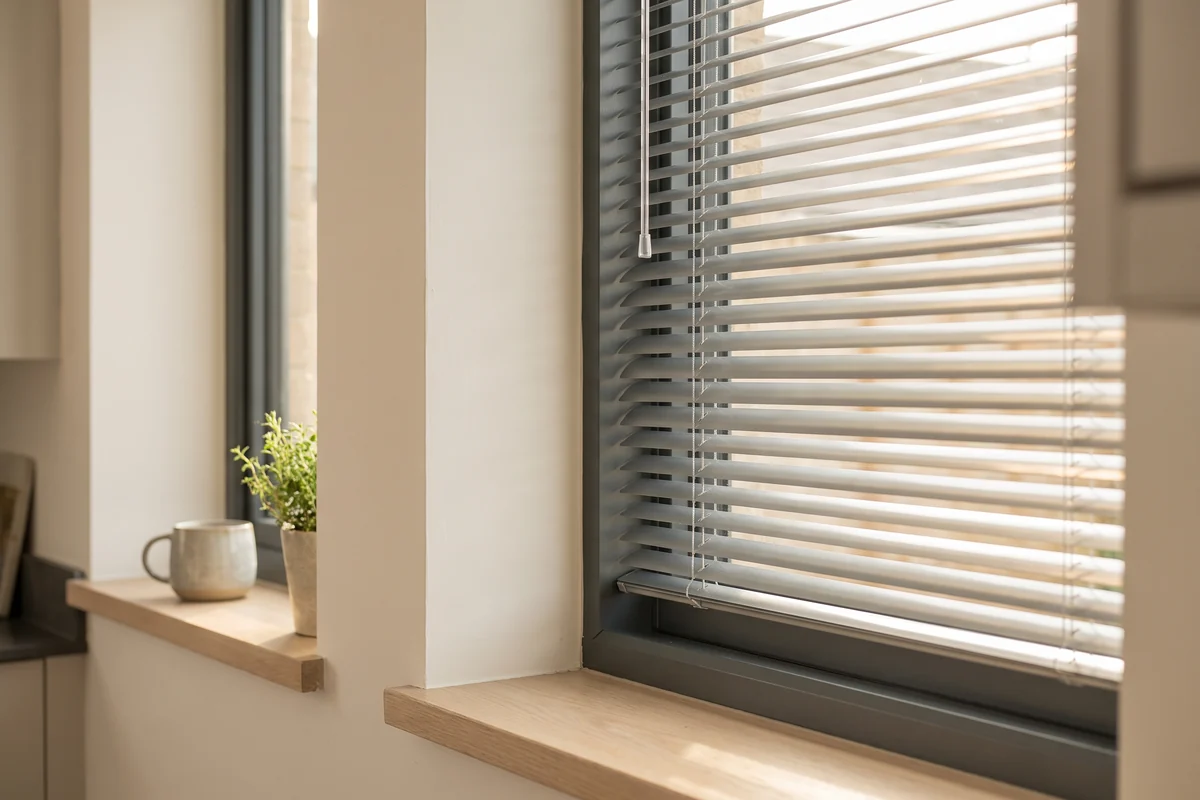
- Aluminium or PVC venetians. Non-porous, wipeable slat by slat, and adjustable so you can kill the afternoon glare over the sink without losing the light. More surfaces to clean than a roller, but every one of them comes clean.
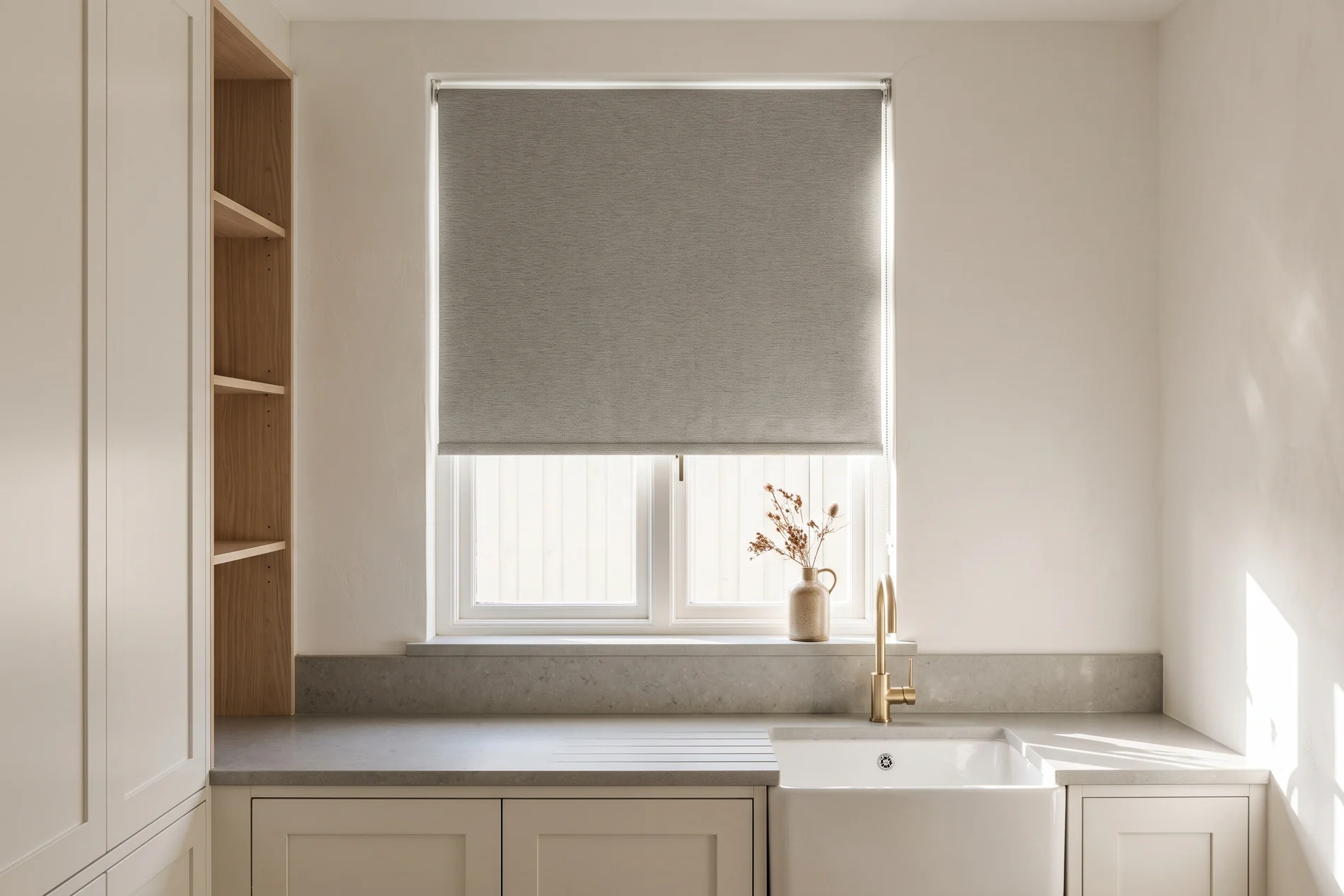
- Roller blinds in a wipe-clean fabric. One flat surface, nothing to trap the film, fastest thing in the room to clean. The default for a window near the cooking.
- Polymer shutters. The premium answer, and the same reasoning as a bathroom — Thermalite is non-porous, handles warm humid air, and the louvres wipe. Costlier, and they last.
- Panel glides or verticals on a wide opening. Where the kitchen opens to a deck through a slider, these clear the opening properly. Fabric, so keep them out of the cooking zone — but a slider is usually the far side of the room anyway.
| Beside the hob | Over the sink | Across the room | |
|---|---|---|---|
| Aluminium / PVC venetian | Yes | Yes | Yes |
| Wipe-clean roller | Yes | Yes | Yes |
| Polymer shutters | Yes | Yes | Yes |
| Roman blind | No | Not ideal | Yes |
| Curtains | No | No | Yes |
| Honeycomb / cellular | No | No | Acceptable |
Roman blinds in a kitchen — the honest answer
A lot of people arrive at this question having already decided they want a roman blind in the kitchen, because romans look like soft furnishing rather than hardware and a kitchen full of hard surfaces wants something soft in it. That instinct is right.
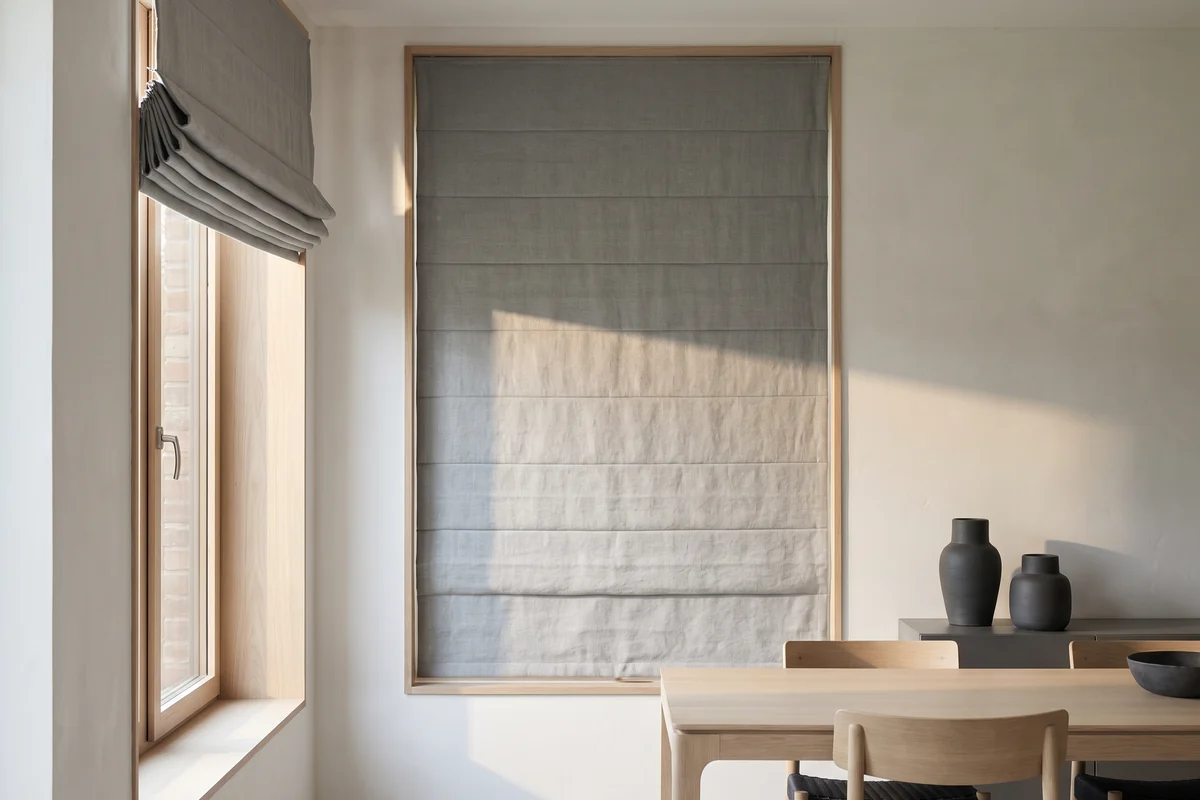
The answer is: yes, but not near the cooking. A roman is fabric that stacks into horizontal folds, and a fold is a trap. The oily film settles into it, the fold closes on it, and it stays. You cannot wipe the inside of a fold, and taking a roman down to clean it is a job people do once and then never again.
Where a roman works in a kitchen: a window in the dining end of an open-plan room, a window behind a table, or any opening genuinely across the space from the cooktop. Where it does not: over the bench beside the hob, or above a cooktop, which is the single worst position in the house for fabric.
The same logic covers honeycomb blinds, and more strongly — the sealed cells that make a honeycomb insulate are also unwipeable and undryable. Excellent in a bedroom. Not what we would put near a wok.
Kitchen window you are not sure about?
Tell us where the cooktop is relative to the window. That one measurement usually settles it, and it is the question nobody asks over the phone.
The window over the sink
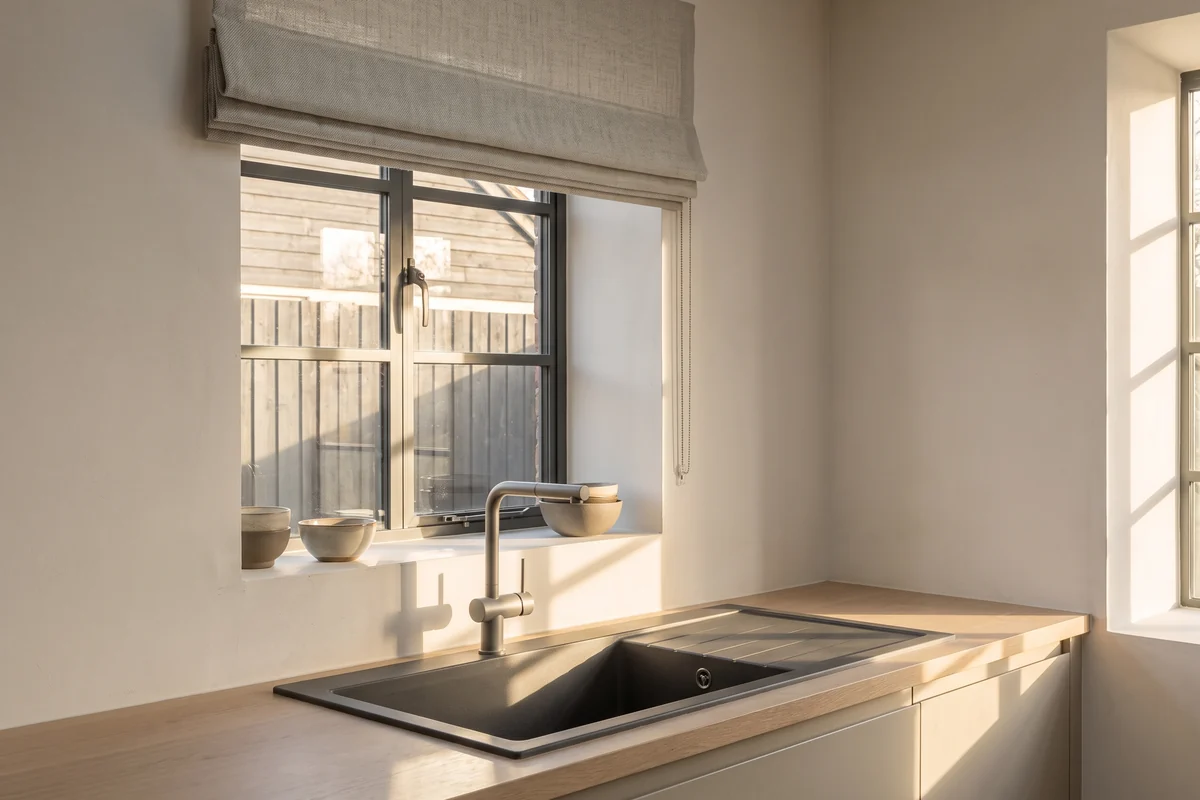
This is the hardest window in an Australian house and it rarely gets treated as one.
It takes steam from below, splatter from close range, and water from washing up. It is usually the window you stand at longest, and in a great many houses it faces west — so it also delivers low afternoon sun straight into your eyes while you are doing the dishes. Any one of those is manageable; together they rule out most of the pretty answers.
Three practical points:
- Mount it clear of the tap. A blind that fouls the mixer when you lift it is a blind that gets left up permanently. This is decided at the measure, and it is the most common installation mistake we see in kitchens.
- Choose for glare, not darkness. Nobody wants a dark kitchen. A venetian that tilts, or a sunscreen roller that keeps the view, beats a blockout that turns the sink into a cave.
- Assume it needs wiping more often than anything else. Specify something that takes thirty seconds to clean and you will actually clean it.
If the window faces west and the glare is genuinely bad, remember the light is arriving nearly horizontally in the afternoon and an internal blind is fighting heat that is already inside. Shading outside the glass does more, and an external blind on that wall is worth considering before you buy a tighter fabric.
Cleaning, and the mistake that ruins a blind
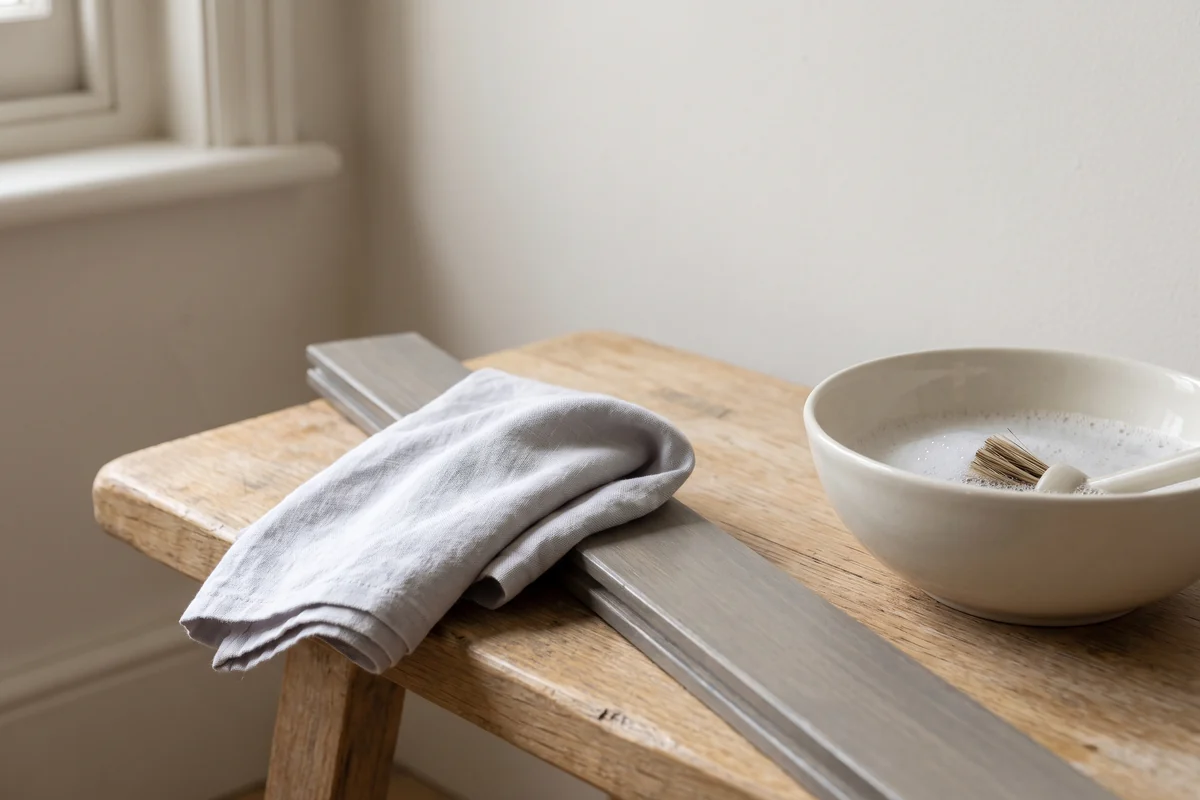
Warm water, a drop of dishwashing liquid, a soft cloth. Slat by slat on a venetian; long even passes on a roller, top to bottom, both faces. Every few months near the cooking, twice a year elsewhere. That is the entire method.
What not to use is the important part. Do not put a degreaser, a solvent, an oven cleaner or a general kitchen spray on a fabric blind. Those products work by dissolving oil, and the coating on a roller fabric is exactly the kind of thing they dissolve. The blind will look better for a fortnight and then show a patch where the finish has gone, and no warranty covers that — ours excludes damage from operation against instructions, and every manufacturer's does the same.
On aluminium or PVC you have more latitude, but there is still no need for anything aggressive. Grease that has been there a week comes off with warm soapy water. Grease that has been there three years comes off with warm soapy water and more patience, which is an argument for the every-few-months habit rather than for a stronger chemical. General blind cleaning covers the rest of the house, where the film is thinner and the intervals are longer.
Frequently asked questions
What are the best blinds for a kitchen window?
Something non-porous you can wipe: an aluminium or PVC venetian, or a roller in a wipe-clean fabric. Both handle the film of airborne oil a kitchen produces and both come clean with warm water. What you are avoiding is anything absorbent within reach of the cooking.
Can you have roman blinds in a kitchen?
Yes, if the window is well away from the hob — across the room, or in a dining end. Roman blinds are fabric in folds, and folds hold the oily film that cooking puts into the air. Over a bench beside the cooktop they will go sticky and stay sticky, because you cannot wipe a fold.
Are curtains a bad idea in a kitchen?
Near the cooking, yes. Fabric absorbs airborne grease and holds the smell, and washing it repeatedly is how a curtain ends up shrunken and out of shape. In an open-plan room where the window is a long way from the hob, curtains are fine and often look better than a blind.
How do you clean grease off blinds?
Warm water, a drop of dishwashing liquid, and a soft cloth — slat by slat on a venetian, in long passes on a roller. Never a solvent, an oven cleaner or a degreasing spray: they lift the grease and the fabric coating together, and that damage is not recoverable.
What about the window over the sink?
It is the hardest one in the house. It gets steam from the sink, splatter from close range, water from washing up, and usually the afternoon sun as well. Fit something non-porous, mount it so it clears the tap, and accept that it will need wiping more often than anything else in the room.
Do kitchen blinds need to be heat resistant?
Not in the sense the phrase suggests — a domestic cooktop does not heat a window covering a metre away. What actually matters is that the material does not soften, discolour or warp with repeated warm humid air, which is the same requirement as a bathroom and is met by the same materials.
Sources Australian Government Your Home — Glazing · ACCC blinds and window fittings mandatory standard · Sleep Health Foundation
Back to the journalKeep reading
Related from the journal
 Blinds
How to clean blinds without wrecking them
Dust weekly, wash rarely, and never soak a blockout roller. A type-by-type guide from the Gold Coast.
Read more Guides
Bathroom window coverings
A Queensland bathroom is not a wet room for twenty minutes a day; it is humid for months. That changes which materials last, and rules out two that everyone recommends.
Read more Guides
Types of curtains and blinds
Nine kinds of blind, three curtain headings, two fabric families and one shutter. What each one is genuinely good at, and the two categories we do not sell at all.
Read more