


Double Curtain Track
Two channels, one piece of metal, and a set of decisions that have to be made before the curtains are.
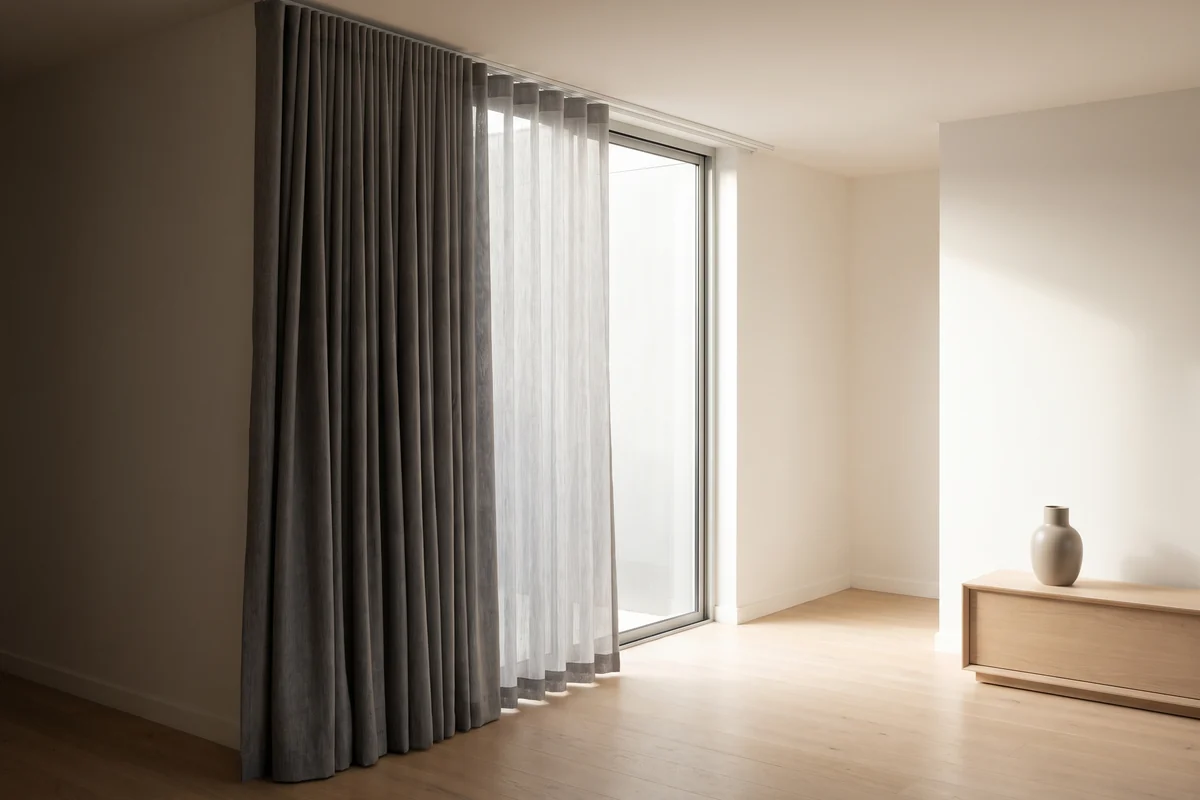
A double curtain track is one piece of hardware carrying two independent channels of runners, so a sheer and a blockout hang at the same window and draw separately. The back channel takes the sheer, nearest the glass. The front channel takes the blockout. Four settings instead of one.
Forced to pick one thing to get right: the clearance between the two channels, because every other measurement on the job is taken from it.
Most people arrive here having already decided they want two layers. That is the easy decision. The hardware is where it either works for twenty years or annoys you every morning, and almost nothing written about double tracks goes past "you can hang a sheer and a blockout". Here is the rest of it, in the order we settle it on a measure.

What a double curtain track actually is
It is an extruded channel, usually aluminium, with two rows of carriers running at different depths from the wall. Each curtain clips or hooks onto its own row and slides independently of the other. Same mechanism as a single track — there are simply two of them sharing one bracket line.
What that buys you is four positions rather than one. Both open. Sheer drawn, blockout stacked. Blockout drawn, sheer stacked. Both drawn. A single track gives you one of those and asks you to live with the compromise for a decade.
Two things are worth saying plainly here. Every track we supply runs on runners, including the decorative tracks that give you the look of a pole while working as a proper track — the rod versus track comparison covers that if you are still weighing it up. And which layer goes in front is a separate argument, made in full on how to hang two layers properly. Short version: sheer at the back, against the glass.
The metal is the least interesting part of the job, and the part that has to be decided first. Slightly unfair, that.

One double track, or two single ones
There are two ways to hang two layers, and the industry tends to present only the first. A purpose-made double track is one extrusion with both channels built in, on one line of brackets. Two single tracks is exactly what it sounds like — either on a double bracket carrying both, or on two independent bracket lines.
The double wins on most of what you would expect. One bracket line, one install, and a narrower projection, because the channels sit as close as the curtains allow rather than as close as two brackets allow. It also sits more neatly under a pelmet.
Two singles win in three specific situations, and they are worth knowing because a supplier who only sells doubles will not raise them.
- You already have a track. You cannot bolt a second channel onto a single track — the extrusion is not built to take one, and the bracket was specified for one curtain's load. Adding a layer means a second track beside it, or replacing the lot.
- The window is curved or bayed. This is the one nobody mentions. In a bay the two channels are not the same length and do not share a radius — the outer travels further around each corner than the inner. Set a bent double out from the inner channel and the front curtain binds at every corner. Two tracks bent separately to their own radii sidestep it.
- The two layers want different things. A heavy interlined blockout across a five-metre opening is a different load to a sheer, and there are runs where the weight belongs on its own section.
| One double track | Two single tracks | |
|---|---|---|
| Fixing points | One bracket line | Two, or one double bracket |
| Total projection | Narrower — set by the curtains | Wider — set by the brackets |
| Bays and curves | Set out from the outer channel or the inner curtain binds | Each track bent to its own radius |
| Adding a layer later | Not possible — replace the track | Yes, fit a second track |
| Mixed operation | Yes | Yes |
| Under a pelmet | Tidier, shallower box | Deeper box to clear both |
| Install | One visit, one set-out | One visit, two set-outs |

The clearance is set by the stack, not by the fabric
Here is the measurement that decides whether a double track is a pleasure or a low-grade irritation, and it is not the one people assume. The gap between the channels is not sized against the sheer hanging flat. It is sized against the sheer bunched at the end of its run — the state the back curtain is in whenever the front one moves past it.
How thick that bunch is depends on the heading and the fullness, not the fabric weight. A wave fold at 2.3 times the track width stacks deeper than a pinch pleat at 2 times, so two windows with identical sheers can need different clearances. The fullness ratios set the stack depth, and the stack depth sets the hardware.
Then there is whatever else lives in the reveal. Awning window winders, a security screen frame, a deep architrave — the front channel clears all of it as well as the back curtain. On a face fix the answer is a longer bracket. On a recessed fit there may not be an answer, which is why we measure the reveal before quoting the track rather than after.
I am not going to publish a millimetre figure here. It varies with the heading, the fullness and what is in the way, and a number that suits a wave-fold sheer in a plain reveal is wrong for a pinch pleat behind a security screen. Anyone quoting you one over the phone has not seen your window.

Ceiling fix or face fix
A ceiling fix is the better-looking of the two and it is not close. The curtain starts at the ceiling line and runs to the floor — the cheapest thing you can do to make a room read taller — and the track disappears above the fabric rather than sitting on the wall in front of it.
Face fixing to the wall above the head is the fallback, and a perfectly good one. The bracket has to project far enough to carry the front channel past the back curtain's stack, which is the clearance question again from a different direction. A longer bracket is a longer lever, so the fixing matters more here.
Which brings up the substrate, and it is why a double is not simply a single with extra features. Two curtains on one bracket line is roughly twice the load on the same screws. Where there is no joist or nogging in the right place the answer is a timber batten fixed back to structure — decided at the measure, not discovered on install day.

Decide how each channel opens — separately
On a double track you choose the operation twice, and the two choices do not have to match. It is the part of the specification that gets waved through, and the part you touch every day.
Hand draw is the best of them on a curtain you can reach. Take the leading edge and pull. Nothing to fail, nothing hanging down. A wand is a rigid baton clipped to the leading runner, which keeps hands off a pale sheer on a tall window, and does it without a cord.
Cord draw gives you a pull from one fixed point, which is useful on a wide run or behind furniture. On a double track it also means two cord loops at one window, and that is worth thinking about properly. The ACCC's mandatory installation standard for corded internal window coverings is specific: a loose cord must not be able to form a loop 220mm or longer at less than 1,600mm above the floor, and a cord guide fitted below that height has to stay attached under a 70N pull. It applies to each cord independently, so two corded channels double the number of things that have to stay right.
My position on that is not neutral. If there are small children in the house, do not specify two corded channels — put at least one on a wand or a motor, and preferably both. That removes the hazard rather than managing it. The child-safe specification covers the rest of the room.
Motorisation is chosen when the curtains are made, not added afterwards — the motor and carriers are built into the product. It suits the channel you would not bother reaching: the blockout behind a sofa, the sheer on a stairwell window. Expect about a week on the lead time, more if power has to be run to the opening.
One setting people forget to specify: each channel can be centre-open or one-way draw, and the two can differ. Nobody will offer that unless you ask.
Not sure what your window will take?
We measure the reveal, the structure above it and the stack space either side before quoting the track, and the quote is itemised so you can see what the second channel costs on its own.

Settle the pelmet while the track is being ordered
A pelmet is a board or box across the top of the curtain that closes the gap between the head and the ceiling. On a single track it is a styling decision. On a double it is a thermal one, and it is sized off the hardware — which is why it belongs in this conversation rather than a later one.
Warm air rises behind a drawn curtain, spills over the top, cools against the glass and falls back into the room, so the curtain becomes a convection loop rather than a barrier. Close the top and the loop stops. The Australian Government's Your Home guide puts it as snugly fitted curtains with pelmets trapping a layer of still air and eliminating the air gaps around the perimeter.
The catch is that the pelmet has to be deep enough to clear both channels plus the stacked back curtain. Built to a single track's projection, it will not fit over a double. We supply pelmets, so it is one decision rather than two suppliers pointing at each other — but it still has to be made before anything is manufactured.

When one track is enough
A double track is more hardware, more fabric and more install, and there are windows where it earns none of that back. We would rather say so at the measure.
There is nowhere for two layers to stack. With barely any wall either side of the window, both curtains park over the glass all day and you have paid for a view you cannot see. One layer that stacks badly is a shame. Two is a wall.
The room is already dark and private. A media room facing a fence does not need a daytime layer. Neither does a window that has a blind on it already — if you like the blind, a sheer over the top on a single track does the softening for less.
The sheer would never be drawn. Be honest about this one. A sheer that lives permanently stacked at one end is decoration, and there are cheaper ways to buy decoration than a second channel and a second set of curtains.
Frequently asked questions
What is a double curtain track?
A single piece of hardware carrying two independent rows of runners at different depths, so two curtains hang at one window and draw separately. The usual pairing is a sheer on the back channel against the glass and a blockout on the front channel, which gives you four settings instead of one compromise.
Can you put two curtains on one track?
Not on one channel. Two curtains sharing a single row of runners cannot pass each other, so you lose the independent operation that makes layering worth doing at all. You need two channels, whether that is one double track or two single tracks fitted side by side.
How much space do you need between two curtain tracks?
Enough for the front curtain to clear the back curtain when the back one is stacked open, which is several times thicker than it looks hanging flat. The figure depends on the heading and fullness of the back layer and on anything else in the reveal, such as window winders or a security screen, so it is measured on site rather than quoted from a table.
Can a double curtain track be motorised?
Yes, on one channel or both, and it is specified when the curtains are made rather than added later — the motor and carriers are built into the product. Motorising a channel adds about a week to the lead time, more if power has to be run to the window. Many people motorise only the layer they cannot easily reach.
Can you add a second track to an existing curtain track?
Not to the track itself — a single extrusion will not take a second channel, and its brackets were specified for one curtain's load. What you can do is fit a separate single track beside the existing one, provided there is structure to fix into and enough projection for the front curtain to clear the back one.
Does a double curtain track have to be ceiling mounted?
No, though a ceiling fix looks better and keeps both channels on the same plane. Face fixing to the wall above the window works well as long as the brackets project far enough to carry the front channel past the stacked back curtain, and as long as they are fixed into structure rather than plasterboard alone.
Sources Australian Government Your Home — Glazing · ACCC blinds and window fittings mandatory standard
Back to the journalKeep reading
Related from the journal
 Guides
Double Curtains: How to Hang Two Layers Properly
Double curtains hang a sheer behind a blockout on one track. Which layer goes in front, what the track has to clear, and what the second layer really costs.
Read more Guides
Curtains on a track: what works and what doesn't
The track decides the heading, and the heading decides the price. Which curtains run on runners, the fullness ratios nobody publishes, and why an eyelet curtain will never go on one.
Read more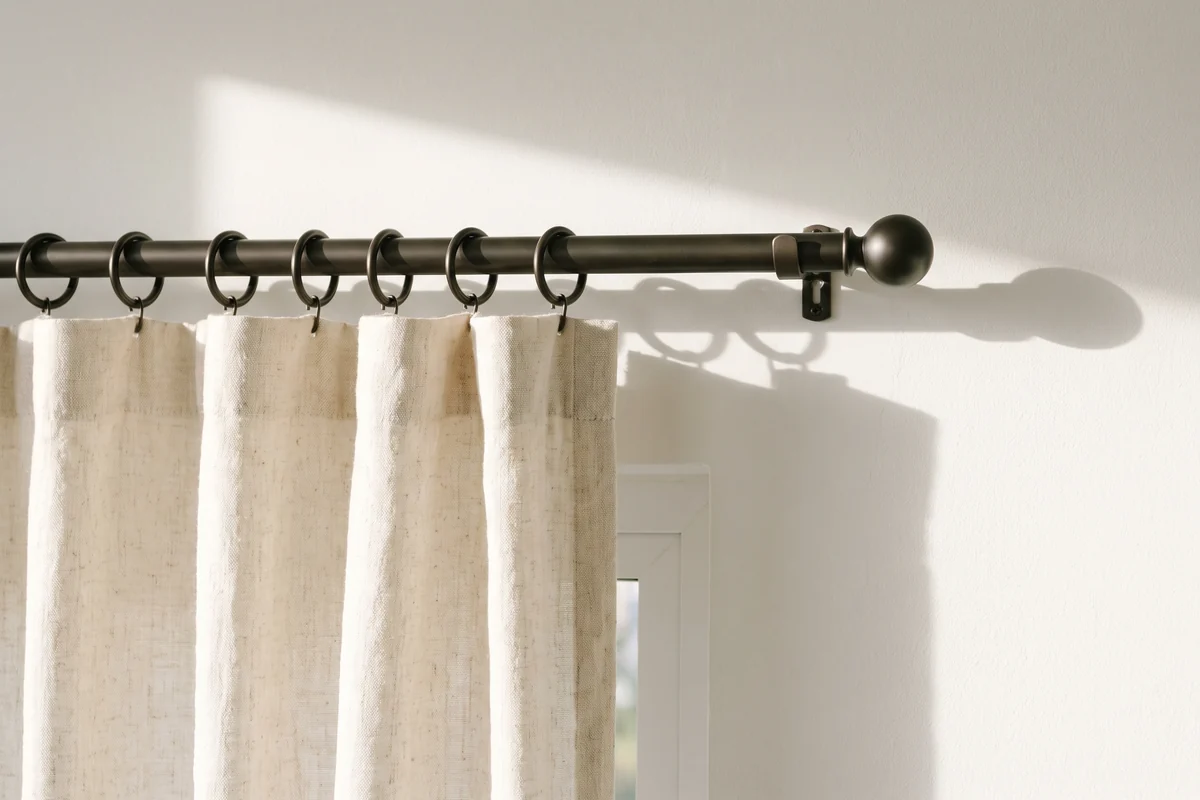 Guides
Curtain rods vs tracks: which should you choose?
One is chosen for how it looks, the other for what it has to hold. What each system carries, which headings fit which, and the fixing question that quietly decides it.
Read more