


Curtains on a Track
A track is only half the decision. The other half is the curtain hanging off it — and that is the half people get wrong.
A curtain on a track hangs from runners that sit inside the channel, so the heading has to be one that takes a hook or clips to a carrier — wave fold, pinch pleat, reverse pleat, box, gathered or knife pleat all do. Eyelet curtains do not, because an eyelet needs a pole threaded through it.
Forced to pick one: wave fold on a ceiling-fixed track, and budget 2.3 times your track width in fabric.
Most people arrive at this question from the wrong end. They have chosen a fabric, or a colour, or a photo of a room they liked, and then they find out that the thing holding it all up has opinions of its own. A track is not a neutral piece of metal. It decides which headings you can use, how much fabric you buy, how far the curtain moves off the glass, and how it sounds at six in the morning when someone pulls it back.
So here is the whole decision, in the order we actually make it on a measure — starting with what physically goes on a track, and ending with why the thing stops running smoothly three years later.

What actually hangs on a track
A track is a channel with small carriers — runners, gliders, call them what you like — sliding along the inside of it. The curtain attaches to those carriers, and that attachment is the whole compatibility question. There are two ways it happens.
- A hook through heading tape. Pleated headings are sewn with a tape along the top, the pleats are formed and hooked, and each hook drops into the eye of a runner. This is the traditional method and it suits pinch pleat, reverse pleat, box, gathered and knife pleat.
- A snap onto a carrier. Wave fold — also sold as S fold or S wave — clips directly to carriers spaced evenly along the track, which is what produces the continuous, even ripple instead of discrete pleats.
What does not work is an eyelet. An eyelet curtain is a sheet of fabric with metal rings punched through the top, and the only thing that goes through a metal ring is a pole. There is no hook, no carrier, no way in. That is not a limitation of tracks so much as a fact about eyelets, and it is worth knowing before you fall in love with a photo.
We do not supply poles, eyelet curtains or rods of any kind — every track we fit runs on runners. If what you want is the look of a pole, a visible horizontal line above the window rather than a recessed channel, the answer is a decorative track. It reads as a pole from the floor and works as a fully runnered track from the top, which means you get the appearance without giving up the mechanism. For the longer version of that argument, including what each system carries and what it has to be screwed into, see curtain rods versus tracks.

Choose the heading before you choose the fabric
The heading is the single biggest lever on what a curtain costs, and almost nobody knows it when they start. It is not a style choice sitting on top of the fabric decision — it multiplies it.
Fullness is the ratio of flat fabric width to finished track width. Our wave fold runs at 2.3 : 1. Box pleat, reverse pleat, gathered and knife pleat all run at 1.8 : 1. In practice that means a 3 metre track in wave fold takes 6.9 metres of fabric, and the same 3 metre track in a 1.8 : 1 heading takes 5.4 metres. Same window, same track, a metre and a half of difference before anyone has mentioned what the fabric costs per metre.
Nobody publishes that number, which is odd, because it is the number that decides your quote. If a curtain quote does not tell you the fullness, you cannot compare it with another one. Ours are itemised component by component for exactly this reason, and they come back within 24 to 48 hours of the measure.
Which heading suits which job:
- Wave fold. The soft modern default, and the one that suits a ceiling-fixed track best because the folds run cleanly from top to floor with no break. Best on wide, simple openings. It is also the hungriest. More on it on our S fold curtains page.
- Pinch pleat. Structured and formal, with the fabric gathered into fixed groups at the top. Reads more traditional and stacks a little tighter than wave.
- Reverse pleat. The pleat is folded to the back, so the front of the curtain is a flat, quiet plane. Good where you want the fabric to be the feature and not the tailoring.
- Box, gathered and knife pleat. Three different characters at the same 1.8 : 1 fullness — crisp, soft and sharp respectively.
| Heading | Runs on a track? | Fullness | Fabric for a 3m track |
|---|---|---|---|
| Wave fold (S fold) | Yes — clips to carriers | 2.3 : 1 | 6.9 m |
| Pinch pleat | Yes — hooks into runners | Quoted per job | Quoted per job |
| Reverse pleat | Yes — hooks into runners | 1.8 : 1 | 5.4 m |
| Box pleat | Yes — hooks into runners | 1.8 : 1 | 5.4 m |
| Gathered | Yes — hooks into runners | 1.8 : 1 | 5.4 m |
| Knife pleat | Yes — hooks into runners | 1.8 : 1 | 5.4 m |
| Eyelet | No — needs a pole | — | — |

One track or two
A double track is two channels on one bracket, and it is the standard answer for a room you use in the day and sleep in at night. The sheer goes on the inner channel, closest to the glass, and the blockout goes on the outer channel in front of it. That order is not decorative. The sheer is the layer you look at all day, and the blockout needs to sit in front to seal the light at the edges.
Here is where I will spend an opinion. Most homes over-specify the blockout and under-specify the sheer. The blockout gets the expensive fabric, the careful colour conversation and the extra week of thinking, and it is closed for eight hours a night in the dark. The sheer is drawn across every daylight hour of the year and is the layer anyone standing in the room actually sees. On a double track you are buying the fullness twice — 6.9 metres a layer in wave fold on that same 3 metre opening, 13.8 metres for the pair — so the question of which layer deserves the money is a real one, and the honest answer is usually the one people treat as an afterthought.
None of which means skip the blockout. It means specify the sheer as a product rather than as a leftover. A metallised sheer such as Verosol SilverScreen, for instance, has a microscopic aluminium backing that reflects solar radiation rather than absorbing it, which is a genuinely different mechanism from simply putting more cloth in the way. We can supply it as curtain fabric. What I will not do is quote you a performance percentage for it, because the numbers that get passed around are marketing figures and I have not verified them.
Two practical notes on double tracks. The bracket needs a certain depth to hold both channels clear of each other and clear of the window head, and that depth gets set at the measure rather than guessed from a website. And hanging two layers on one opening roughly doubles the stack, which matters more than most people expect — see below.
We do not offer interlining, so if you have read that a third layer sewn between face fabric and lining is the way to get more body and more blockout, that is a real technique and it is not one of ours. The honest route to the same result is the right fabric on the right heading with the right sheer behind it.

Fix it to the ceiling if the ceiling will take it
Where the track goes changes what the curtain looks like more than any other single decision, and it is decided in about ten seconds on a measure.
- Ceiling fixed. The track sits flat against the ceiling, the fabric starts at the ceiling line, and the eye reads the whole wall as window. It makes a standard-height room look taller and it is the only mount that gives wave fold its full uninterrupted drop. It is also the one that seals light best at the top, because there is no gap above the curtain for light to spill through.
- Face fixed to the wall. The track mounts on brackets above the window head. Necessary where the ceiling cannot be used — a bulkhead, a raked ceiling, a curtain that has to clear an air conditioner — and completely normal. The trade-off is a horizontal shadow line above the curtain and slightly less control of light at the top.
Then there is the part that decides whether any of this lasts, which is what the screws go into. A full-height lined curtain across a wide opening weighs far more than it looks, and every gram of it hangs off a handful of fixings. Plasterboard on its own is not a structure; it is a lining. A track fixed into plasterboard alone will come down, and the only real question is which year.
What we are looking for at the measure is timber — a ceiling joist, or the timber above the window head — or a batten fixed through the plasterboard into something structural so there is a solid line to screw into anywhere along the run. Steel-framed ceilings and masonry each want their own fixings. Every track system is sold with a load rating, so ask what it is rated to, then ask what it is being fixed into, because the second answer is the one that decides the outcome.
This is a job for someone who does it for a living, and I would say that even if it cost us the work. It is also why our measure and installation happens before the quote rather than after — the structure above your ceiling is not something anyone can price from a photo.

Give the curtain somewhere to go when it is open
Stack-back is the width of gathered fabric left standing when the curtain is fully drawn open. It is the most commonly ignored measurement in the whole trade, and it is the reason so many curtains sit half-drawn all year: no position is quite right, because the open position swallows a third of the glass.
The maths is not complicated. All that fabric you bought in the fullness calculation has to physically exist somewhere when the curtain is open. At 2.3 : 1 there is a lot of it. Compressed, it forms a column of fabric that has real width, and that width scales with the size of the opening and the weight of the cloth.
So the track should be wider than the window. Run it past the reveal on both sides so the open curtain parks on the wall rather than on the glass, and the window gives you all of its light and all of its view. On a double track, allow for both layers stacking, which is not simply twice one layer but is closer to it than people assume.
Two related decisions land here as well. A curtain that stops short of the floor loses its line and lets a draught under the hem, so we hang to the floor unless there is a reason not to. And if you want to hold the curtain clear of the glass in a particular way rather than just pushing it aside, that is what tiebacks and holdbacks do, and we supply them.

Decide how you will actually open it
Four options, and the right one depends almost entirely on how tall the window is and who is in the room.
- By hand. You take the leading edge and pull. Simple, free, and the reason curtain edges get grubby — the oil off a hand transfers to fabric and stays there. Fine on a window you open twice a week.
- A wand. A slim baton clipped to the lead carrier. You draw the curtain by the wand rather than the cloth, which keeps the leading edge clean and gives you more purchase on a heavy curtain. It is the quiet upgrade almost nobody asks for and almost everybody likes.
- A cord. A continuous loop driving the carriers along the track. Good reach on very tall windows. It also introduces a loop of cord into the room, and corded window furnishings are covered by a mandatory Australian safety standard for good reason — in a nursery or a child's bedroom, do not have one. Specify a wand or go cordless.
- Motorised. Worth it on a window you genuinely cannot reach, on a run too heavy to draw comfortably, or on a bank of openings you want to move together. Not worth it on a bedroom window you walk past every morning. It is chosen at the time the curtain is specified, because the motor and carriers are built into the system, and it adds about a week to the lead time — more if power has to be run to the opening.
Curtains, sheer and blockout alike, run 2 to 4 weeks from check-measure to installation depending on the fabric. The window furnishings trade in Australia has its own code of ethics and child-safety standards through the WSAA, which we are a member of, and the cord question is the one that comes up most.
Not sure what your ceiling will take?
Neither is anyone else until it is checked. We measure the opening and the fixing before recommending anything, and the quote comes back itemised within 24 to 48 hours and stays valid for 30 days.

Bays, corners and runs that are not straight
This is the one thing a track does that no other hardware can match. A track can be curved, and a curtain on a curved track draws through the bend without catching, because the carriers are inside a channel rather than threaded onto a straight line.
That covers bay windows, bow windows, corner glazing where two walls of window meet, and curtains used to close off a space rather than dress a window — a room divider across an open-plan living area, or a curtain closing a walk-in robe. The mechanism is identical. Only the shape of the run changes.
Two things worth knowing. A curved run needs to be set out accurately at the measure, because the angles of a bay are rarely the neat numbers the plans claim. And long runs may need a join, which is not a defect — it is how a straight extrusion becomes a fifteen metre track — but you want it placed deliberately, not wherever the material happened to end.
Wide, low openings are also where curtains earn their keep thermally. Glass is the weakest point in the thermal envelope of most Australian houses, and the Australian Government's guidance on glazing and on shading is blunt about it. A curtain that seals at the top, the sides and the floor does real work. One that leaves a gap at every edge does considerably less, which brings us back to where the track is fixed.

Keeping it running
Tracks fail in a boring way. They do not snap. They get stiff, then noisy, then one runner binds and you start yanking, and the yanking is what eventually pulls something out of a ceiling.
The cause is almost always dust in the channel, because a curtain track is a horizontal slot at ceiling height and that is exactly where household dust ends up. A dry cloth or a vacuum brush along the channel once or twice a year is the entire maintenance schedule.
What not to do is oil it. A lubricant collects dust, the mixture turns to paste, and the track ends up worse than it started — and then the paste transfers onto the top of the curtain, which is the expensive part. If a track has become stiff and cleaning has not fixed it, something is out of alignment or a carrier has failed, and both are repairs rather than maintenance.
On the curtain itself, follow the fabric care label and be sceptical of anyone who tells you a made-to-measure curtain is machine washable. We warrant our installation workmanship for 12 months from the date of installation, and the products carry their manufacturer's warranty — between 12 months and 7 years depending on the system, componentry and fabric. Which period applies to your job is stated on your quote, not discovered afterwards.
Forty-eight years of this and the pattern has not changed: hardware almost never fails, fixings and neglect do. If you want the whole picture on fabric, heading and lining choices rather than just the hardware, start at our custom curtains page.
Frequently asked questions
Do you need special curtains for a track?
You need a heading that attaches to a runner, which covers most made-to-measure curtains: wave fold clips to carriers, and pinch pleat, reverse pleat, box, gathered and knife pleat all hook into the runners through heading tape. The exception is an eyelet curtain, which needs a pole through the rings and cannot be hung on a track at all. If a curtain is already made with the right heading, it will generally go onto a track without alteration.
How much fabric does a curtain on a track need?
It depends on the heading, and the difference is large. Our wave fold runs at 2.3 : 1 fullness, so a 3 metre track takes 6.9 metres of fabric. Box, reverse, gathered and knife pleat run at 1.8 : 1, so the same 3 metre track takes 5.4 metres. Ask for the fullness on any curtain quote — without it you cannot compare two prices.
How much wall does a curtain take up when it is open?
Enough that you should plan for it. All the fabric from the fullness calculation has to sit somewhere when the curtain is drawn open, and compressed it forms a column with real width. The fix is to run the track past the window reveal on both sides so the open curtain parks on the wall instead of over the glass. Get this wrong and the curtain covers part of the window even when it is open.
Can you put a sheer and a blockout on the same track?
Not on the same channel, but a double track carries both on one bracket. The sheer goes on the inner channel closest to the glass and the blockout on the outer channel in front of it, so the blockout can seal light at the edges. The bracket depth needed to hold the two channels clear of each other is worked out at the measure.
Should curtains on a track touch the floor?
Yes, unless there is a specific reason not to — a heater, a bench, a door swing. A curtain that stops short of the floor loses its vertical line and lets air move underneath it, which undoes part of the thermal benefit of hanging it in the first place. Ceiling to floor is the default we work to.
Do curtains on a track come with a cord?
Only if you specify one. A track can be drawn by hand, by a wand clipped to the lead carrier, by a continuous cord loop, or by motor. A wand is the option we suggest most often because it keeps hands off the leading edge. In a child's room, avoid a cord loop entirely — corded window furnishings are covered by a mandatory Australian safety standard and a wand or a motor removes the hazard.
How do you clean a curtain track?
A dry cloth or a vacuum brush run along the channel once or twice a year. Dust settling into the slot is what makes a track stiff and noisy. Do not oil or spray a lubricant into it — the lubricant traps dust, turns to paste and transfers onto the top of the curtain. A track that is still stiff after cleaning has an alignment problem or a failed carrier, which is a repair.
How long do curtains on a track take to make?
Sheer, blockout and decorative curtains all run 2 to 4 weeks from check-measure to installation, depending on the fabric you choose. Motorisation adds about a week, and more if power has to be run to the opening. Your quote comes back within 24 to 48 hours of the measure, itemised component by component, and stays valid for 30 days.
Sources Australian Government Your Home — Glazing · ACCC blinds and window fittings mandatory standard · Sleep Health Foundation
Back to the journalKeep reading
Related from the journal
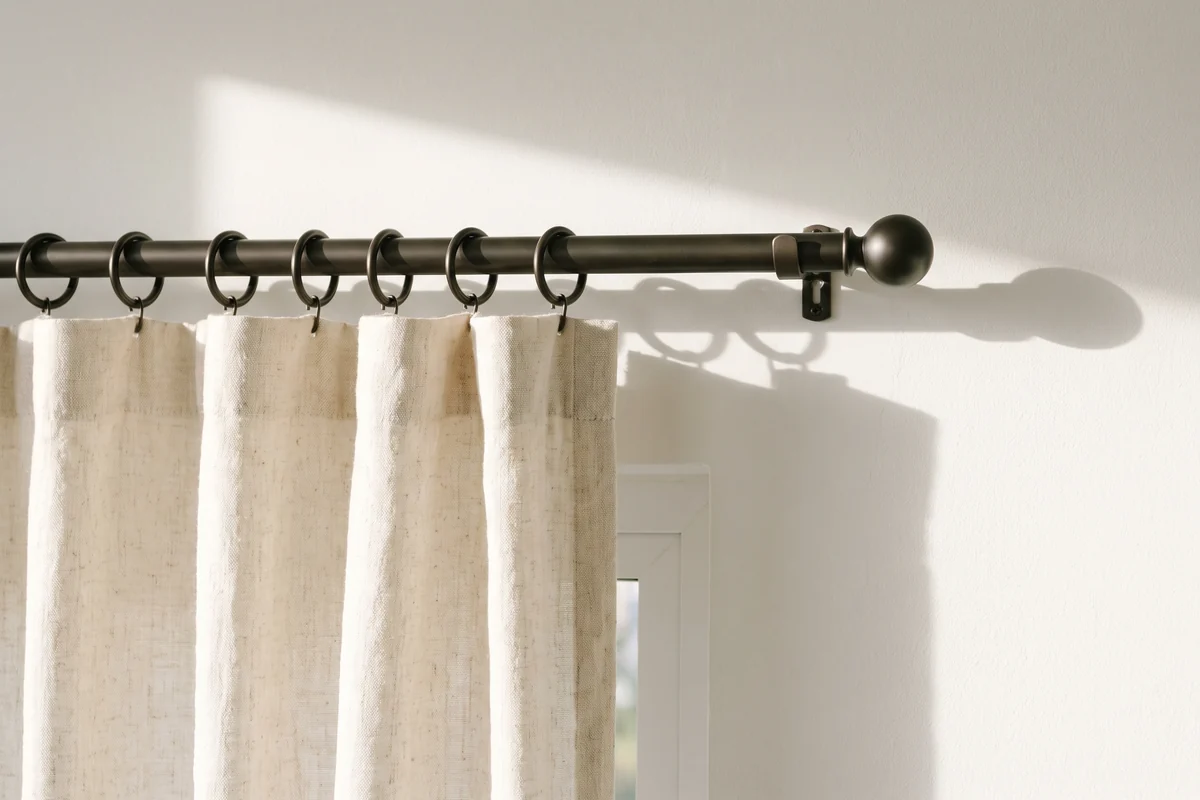 Guides
Curtain rods vs tracks: which should you choose?
One is chosen for how it looks, the other for what it has to hold. What each system carries, which headings fit which, and the fixing question that quietly decides it.
Read more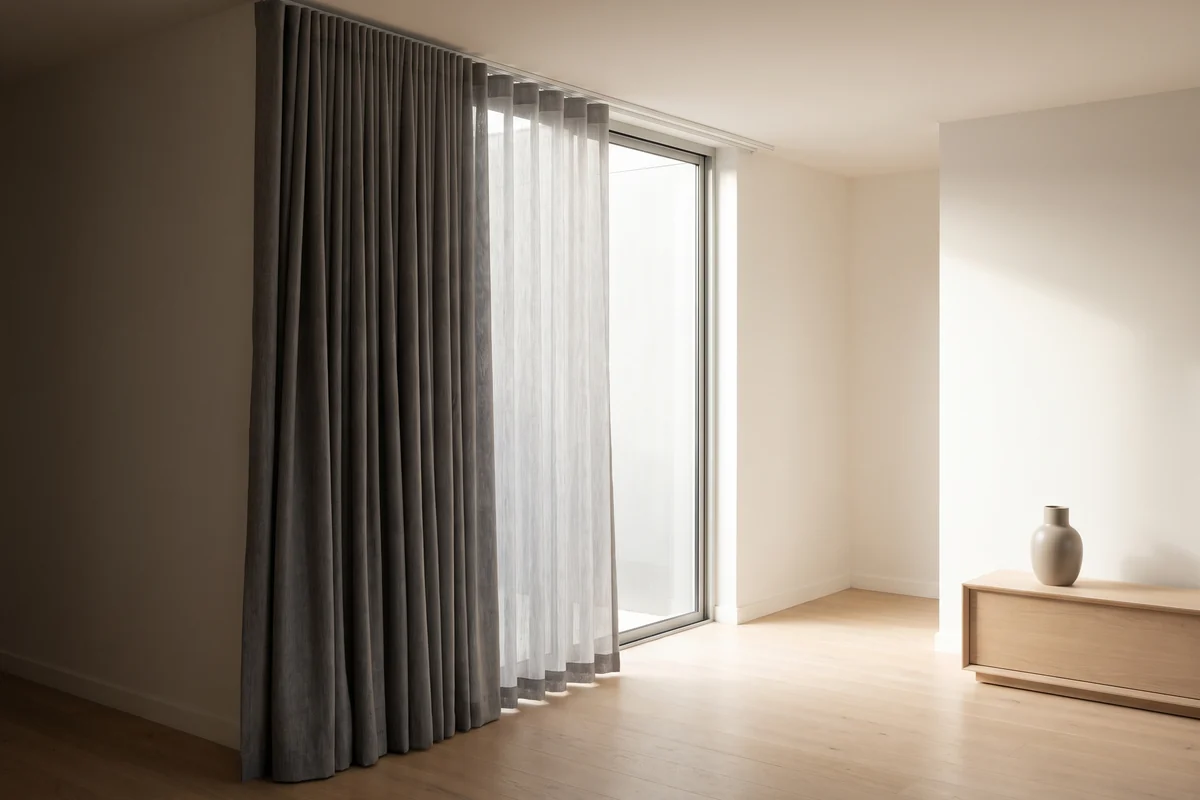 Guides
Double Curtains: How to Hang Two Layers Properly
Double curtains hang a sheer behind a blockout on one track. Which layer goes in front, what the track has to clear, and what the second layer really costs.
Read more Guides
Curtain tiebacks and holdbacks: do you need them?
One wraps around the curtain, the other is hardware it tucks behind. Where they go in millimetres, and the honest reason most curtains on a runnered track never get either.
Read more