

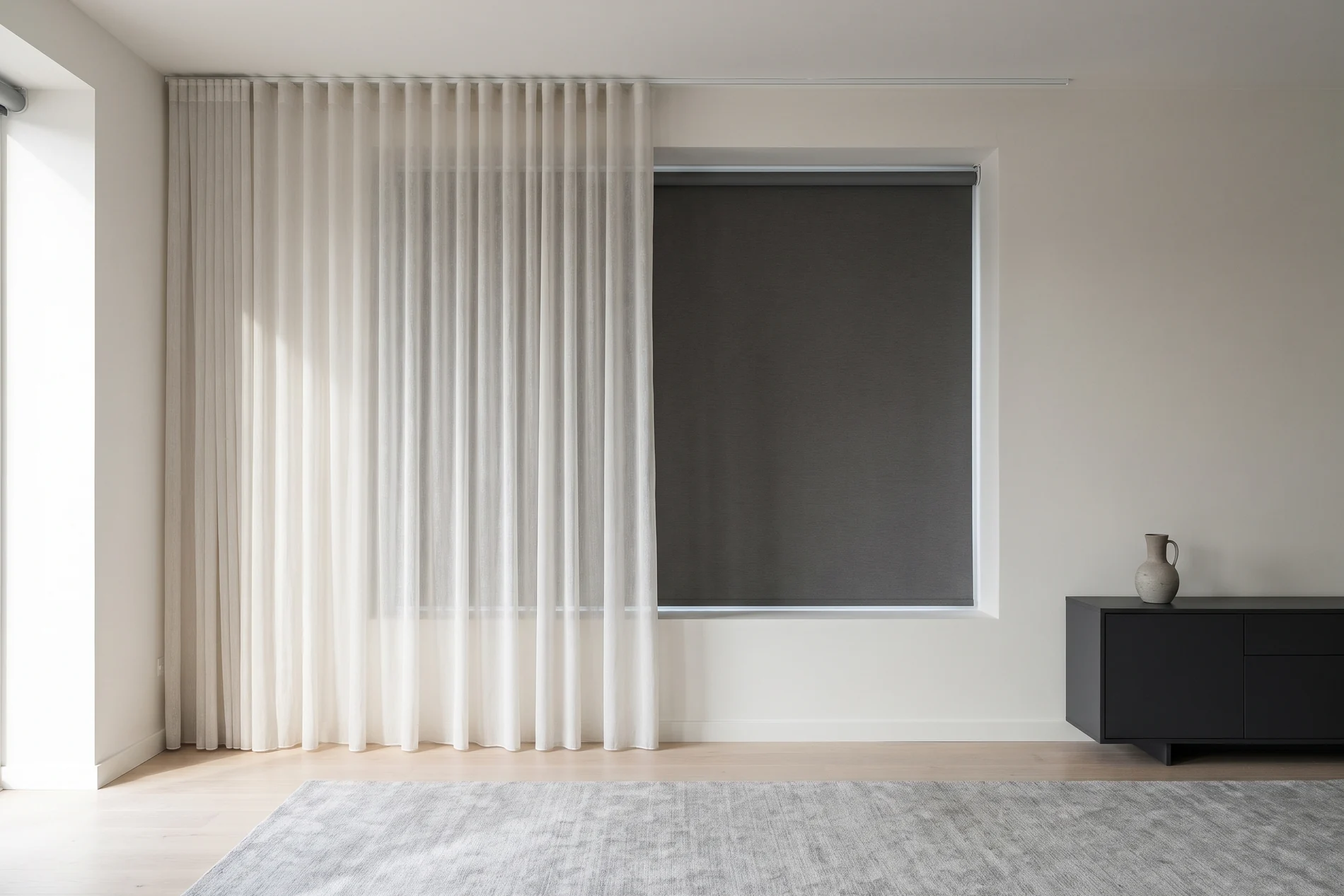
Blinds with sheer curtains
Layering a sheer over a blind is the most useful thing you can do to a window. Here is what actually goes where, and why the rod advice everywhere else does not apply.
Blinds with sheer curtains works because each layer does the job the other does badly. The blind gives you real light control and a clean line in the reveal; the sheer curtain softens the opening, gives daytime privacy and makes the window look taller than it is.
Forced to pick one thing to get right: fix the curtain high and wide enough that the fabric sits off the glass when it is open, not across it.
Layering is the most useful thing you can do to an ordinary window, and it is also where most of the advice online stops being useful the moment you are standing in an Australian house. Nearly every guide tells you to mount a rod above the blind. We do not fit rods, and the reason is not stylistic — it is that the alternative is better. More on that shortly.
Why two layers beat one
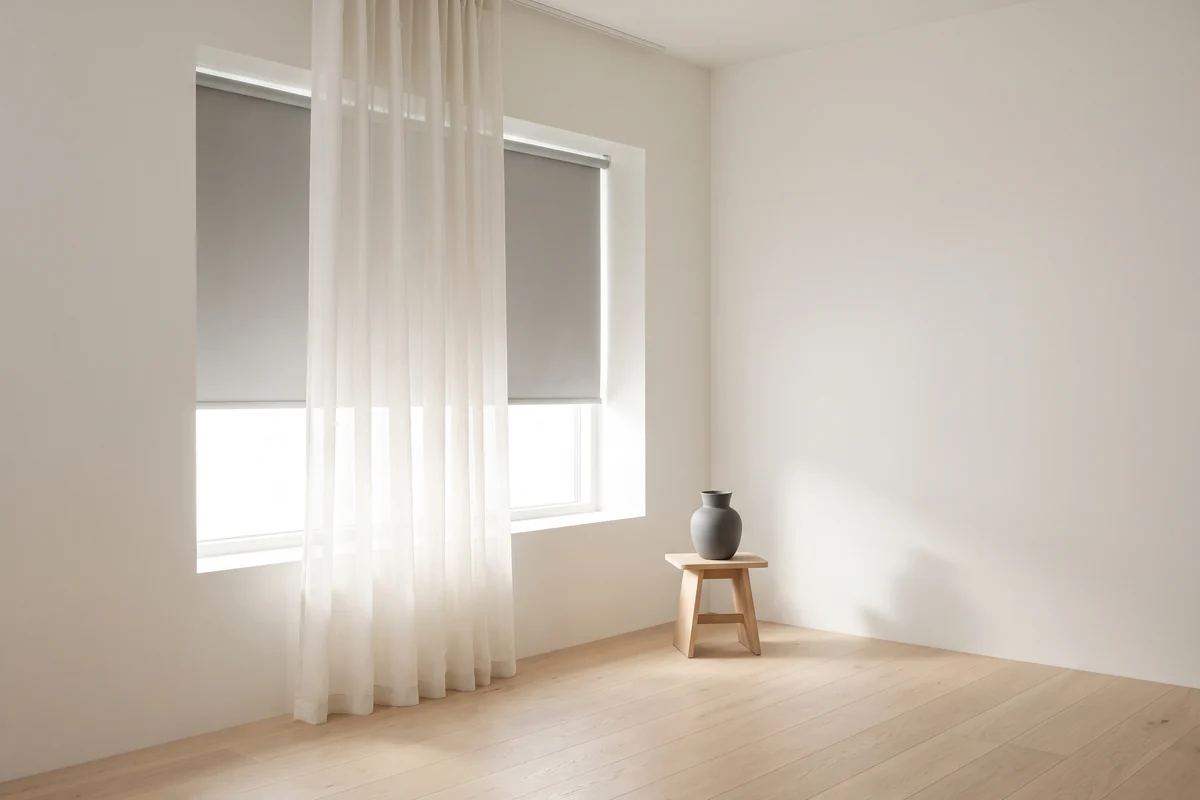
A blind is good at the thing fabric hanging in folds is bad at: stopping light in a straight, controllable line. A sheer is good at the thing a blind cannot do at all: making an opening feel soft and finished, and letting you stand in your own living room at four in the afternoon without the street watching.
Run them together and you get a window with four settings instead of two. Blind up, sheer open, for the morning. Blind up, sheer closed, for daytime privacy with the light still coming through. Blind down, sheer closed, for glare. Blind down, sheer open, when you want the room dark but the window still dressed. Nobody consciously uses all four, but a window that can only do two is the one people end up fighting.
There is a second reason, and it is the one nobody mentions: a blind alone makes a window look exactly as big as it is. A curtain fixed 150mm above the head of the window and running past the reveal on both sides makes the same opening read considerably larger. That is free, and it costs nothing but hardware placed properly.
The bit every other guide gets wrong
Search this question and you will be told to put a rod above the blind, usually with a note about how far past the frame the finials should sit. That advice is written for a market where a pole is the default. It is not what we would fit, and after 48 years of taking other people's window furnishings down, it is not what we would recommend either.
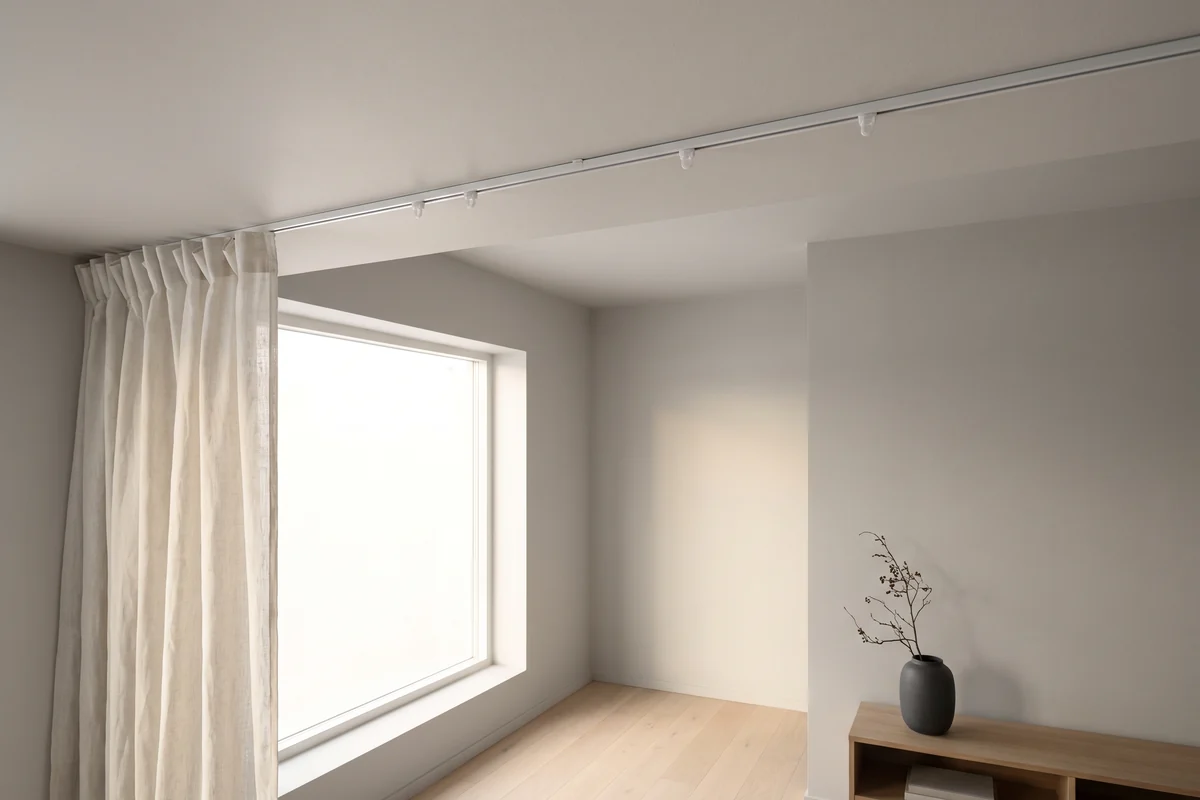
Every track we supply runs on runners. A runnered track pulls smoothly under the weight of a full-height curtain, stacks tighter against the wall, and can be ceiling-fixed so the fabric starts at the ceiling line rather than partway down it. A curtain sliding directly on a pole does none of those things as well, and eyelet curtains — the ones with the rings punched through the fabric — need a pole through them, which is why we do not make those either.
If you want the look of a pole, that is a solved problem. A decorative track looks like a pole from the room and works as a fully runnered track from the top. You get the visual weight of a rod above the blind, and the curtain still draws properly in five years. The difference between rods and tracks is worth understanding before you buy hardware, because it is the part of a layered window that is hardest to change afterwards.
What goes behind, what goes in front
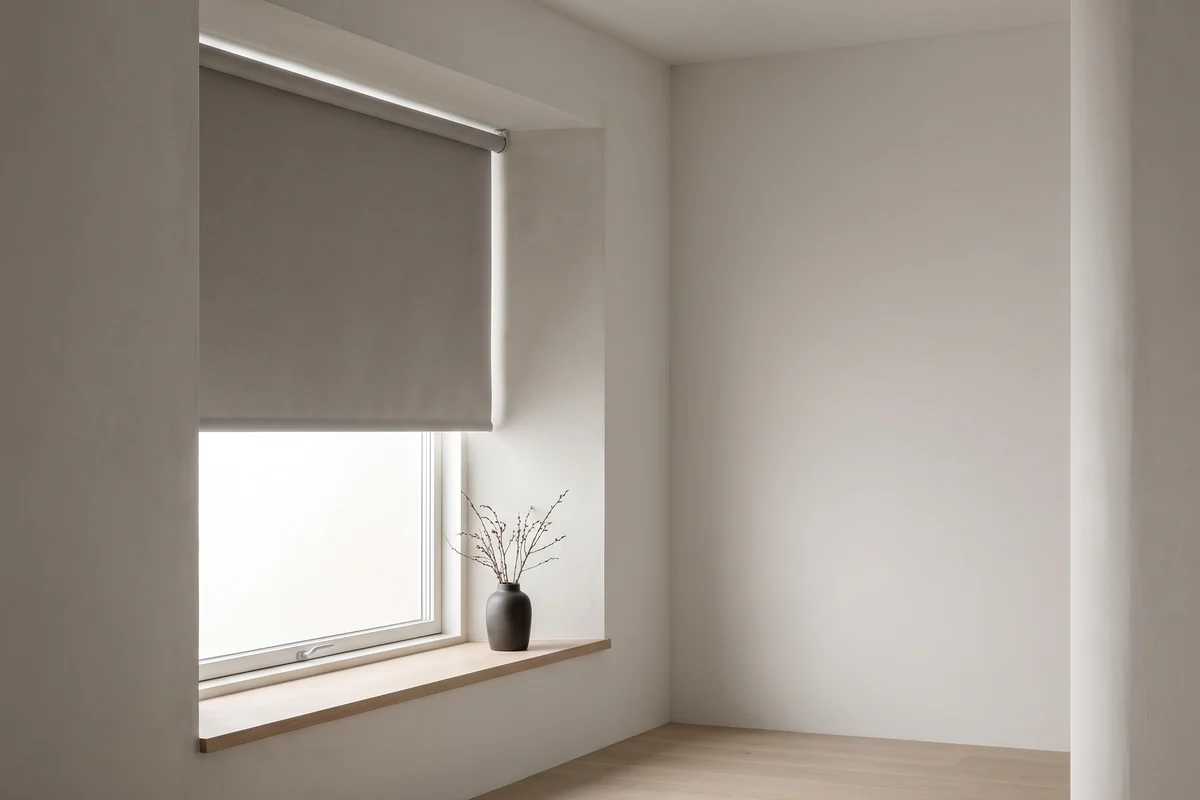
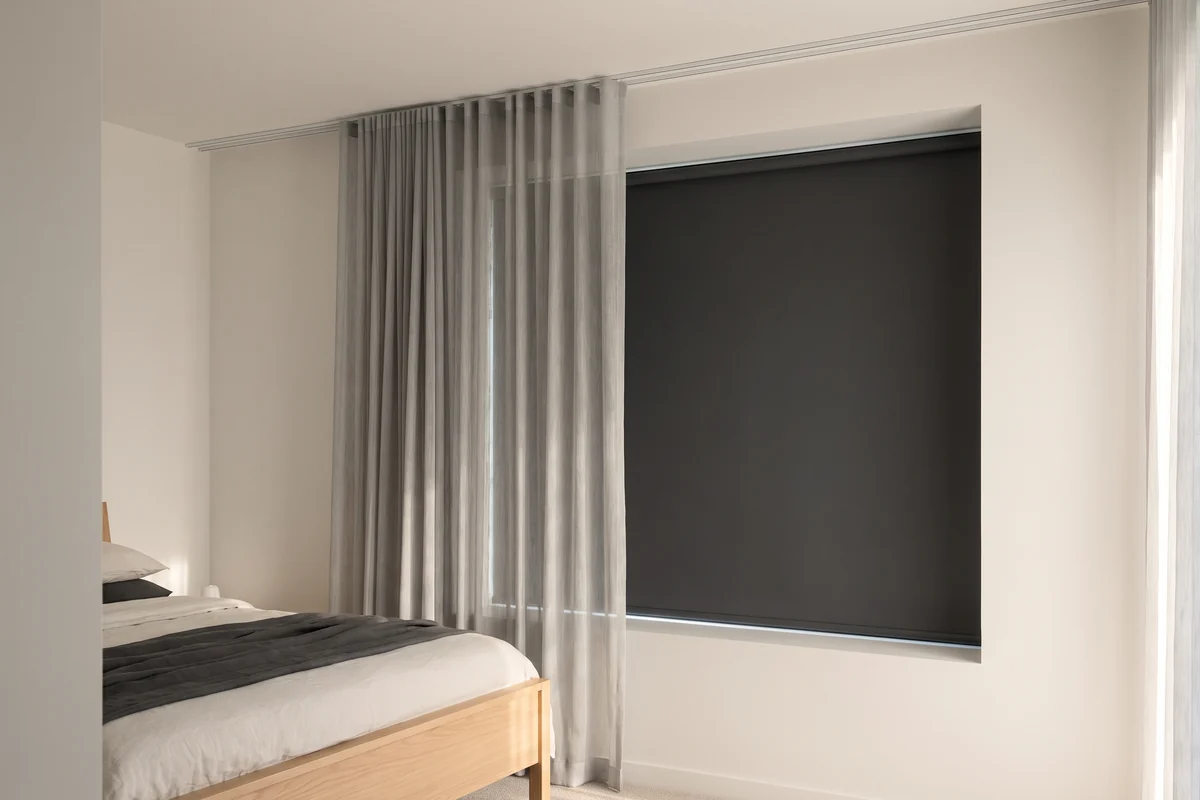
The blind goes in the reveal. The curtain goes in front of it, fixed to the wall or ceiling outside the opening. That order is not negotiable in any practical sense — a sheer behind a blind is invisible, and it will foul the blind every time it rolls.
Which blind sits behind depends on what the room needs at night:
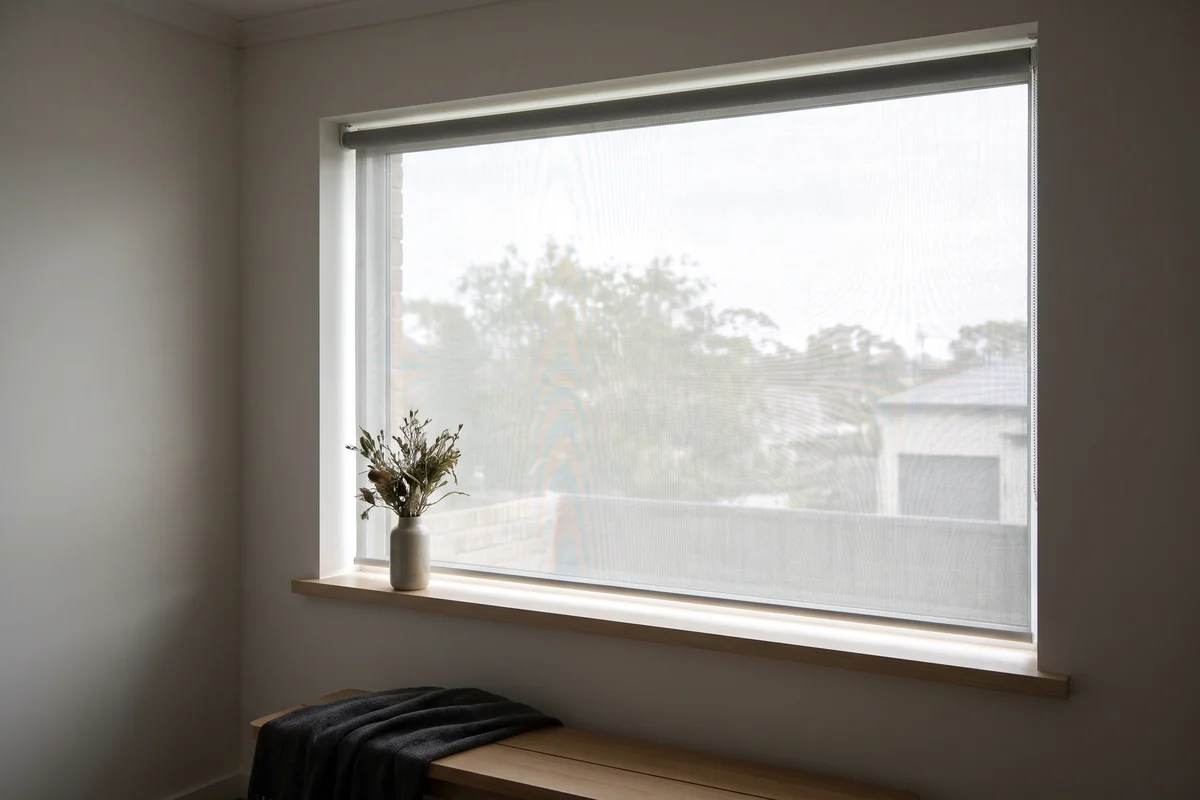
- Sunscreen roller behind a sheer. Glare control with the view kept, and the sheer adds the softness. This is the combination for a living room that faces the wrong way in the afternoon.
- Blockout roller behind a sheer. The bedroom answer. The blockout roller does the darkness, the sheer does the daytime, and neither is compromised by the other.
- Venetian or timber-look behind a sheer. Directional light — you can throw the light at the ceiling and keep the street out at the same time. It is the most adjustable version and the most work to dust.
- Honeycomb behind a sheer. Where the room is genuinely cold or genuinely hot and the window is the reason. The cells do the insulating; the sheer stops the blind looking like an appliance.
What goes in front is nearly always a sheer curtain, in a wave fold or a soft pleat, floor length. Short curtains over a blind is the one combination that consistently looks worse than either layer alone.
Do not buy the same job twice
Here is the opinion that costs us work: a lot of layered windows are two products doing one job, and the owner paid twice for it.
The clearest case is a low-openness sunscreen roller behind a sheer curtain. Openness factor is the percentage of the weave that is actually open — we carry 1%, 3%, 5% and 10%, and the lower the number, the more the fabric blocks. Put a 1% sunscreen behind a sheer and the sheer is decoration; the blind has already taken the view, the glare and most of the light. You would have been better served by a 5% or 10% blind and letting the sheer do the rest, which is also cheaper.
The same trap runs the other way. A blockout curtain in front of a blockout blind is a lot of money to make a room slightly darker than it already was. If the room is for sleeping, put the blockout in the blind, where it seals against the reveal, and keep the curtain sheer. Light leaks around fabric far more easily than it leaks around a blind fitted properly in a recess.
| Blind only | Curtains only | Blind + sheer | |
|---|---|---|---|
| Daytime privacy | All or nothing | Good | Good |
| Night darkness | Best | Good | Best |
| Makes the window look bigger | No | Yes | Yes |
| Softens noise | Barely | Some | Some |
| Wall space needed | None | Most | Some |
| Settings available | Two | Two | Four |

What the opening has to give you
Two measurements decide whether layering works, and neither is the width of the window.
The first is clearance in front of the blind. A curtain that brushes the blind will wear a line into the sheer and stop the blind rolling straight. The track has to sit far enough off the face of the blind that the fabric hangs free, which is easy on a face-fixed track and can be tight where a blind is mounted proud of the reveal.
The second is something solid above the opening. A full-height curtain on a track is heavier than people expect, and it is carried entirely by whatever the track is screwed into. Plasterboard alone is not it. On a timber-framed house we are looking for the lintel or a batten fixed across the studs; where there is nothing, we fit one. This is checked at the measure, not discovered on installation day.
If the window is a slider or a stacker, the geometry changes again and the curtain has to clear the handle as well as the blind — that case is covered separately in window coverings for sliding doors.
Not sure your opening will take both?
We measure the reveal, the clearance and what is behind the plaster before quoting anything — and we will tell you if one layer is doing all the work.
Where it is worth it, and where it is not
Bedrooms — worth it. This is the strongest case. Blockout in the blind, sheer in front, and the room works at 7am in January. The Sleep Health Foundation is blunt about light and sleep quality, and a summer sunrise here arrives well before anyone wants it.
Living rooms facing west — worth it. Sunscreen blind for the glare, sheer for the hours either side. Though it is worth saying plainly: anything you hang inside the glass is dealing with heat that is already in the house. External shading stops it before it arrives, and on a bad western wall that is the intervention that actually moves the temperature.
Bathrooms and laundries — usually not. Humidity, no real gain, and a fabric layer nobody wanted to wash. A blind on its own is the right call.
Kitchens over a bench — usually not. A curtain within reach of cooking picks up grease and holds it. Keep the blind, skip the sheer, and put the softness somewhere it will not need dry cleaning.
Rooms where the window is small and the wall is smaller — no. Layering needs somewhere for the curtain to stack. If the curtain has to sit across the glass when it is open, you have made a small window smaller, and the blind was doing fine on its own.
Frequently asked questions
Can you put sheer curtains over blinds?
Yes, and on most windows it is the better answer than either on its own. The blind does light control and the sheer does softness and daytime privacy, so each one is doing a job the other is bad at. The only real constraint is hardware: the curtain needs its own fixing in front of the blind, clear of the blind's brackets.
Do sheer curtains go in front of or behind blinds?
In front, essentially always. The blind sits in the window reveal and the sheer hangs outside it, closer to the room. Putting a sheer behind a blind means you can never see it, and the blind will catch on it every time it is raised.
Do I need a double track for sheers and blockout?
Only if you want both curtain layers. A blind plus one sheer needs a single track, because the blind is already the second layer. A sheer plus a blockout curtain with no blind is the case a double track is for.
Will a sheer over a blind still block heat?
The blind does nearly all of that work, and where the heat is stopped matters more than what is stopped. Anything on the inside of the glass is fighting heat that has already entered the room, which is why an external blind beats an internal one for west-facing glass.
Does layering make a room look smaller?
It makes a window look bigger, if the curtain is fixed high and wide enough to clear the glass when it is open. The mistake that shrinks a room is mounting the track tight to the window frame, so the stacked fabric covers the glass all day.
Can I layer over an existing blind?
Usually, yes — this is the most common version of the job. What we check at the measure is whether there is enough clearance in front of the blind for the curtain to hang without brushing it, and whether there is something solid to fix the track to above the opening.
Sources Australian Government Your Home — Glazing · ACCC blinds and window fittings mandatory standard · Sleep Health Foundation
Back to the journalKeep reading
Related from the journal
 Guides
Sheer vs Blockout Curtains
Which one your room actually needs — and why the honest answer, most of the time, is both.
Read more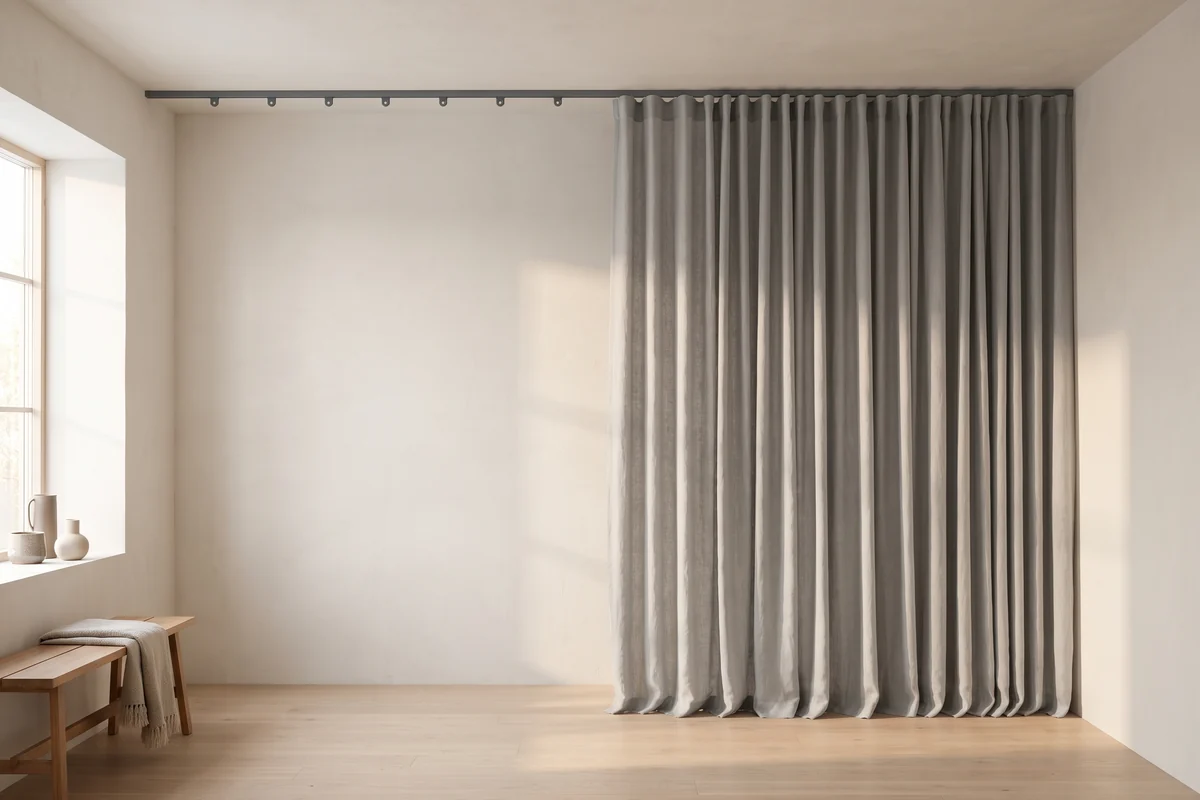 Guides
Blinds vs Curtains
Two products, one opening — and the honest answer is usually both. Here is how the choice actually gets made, window by window.
Read more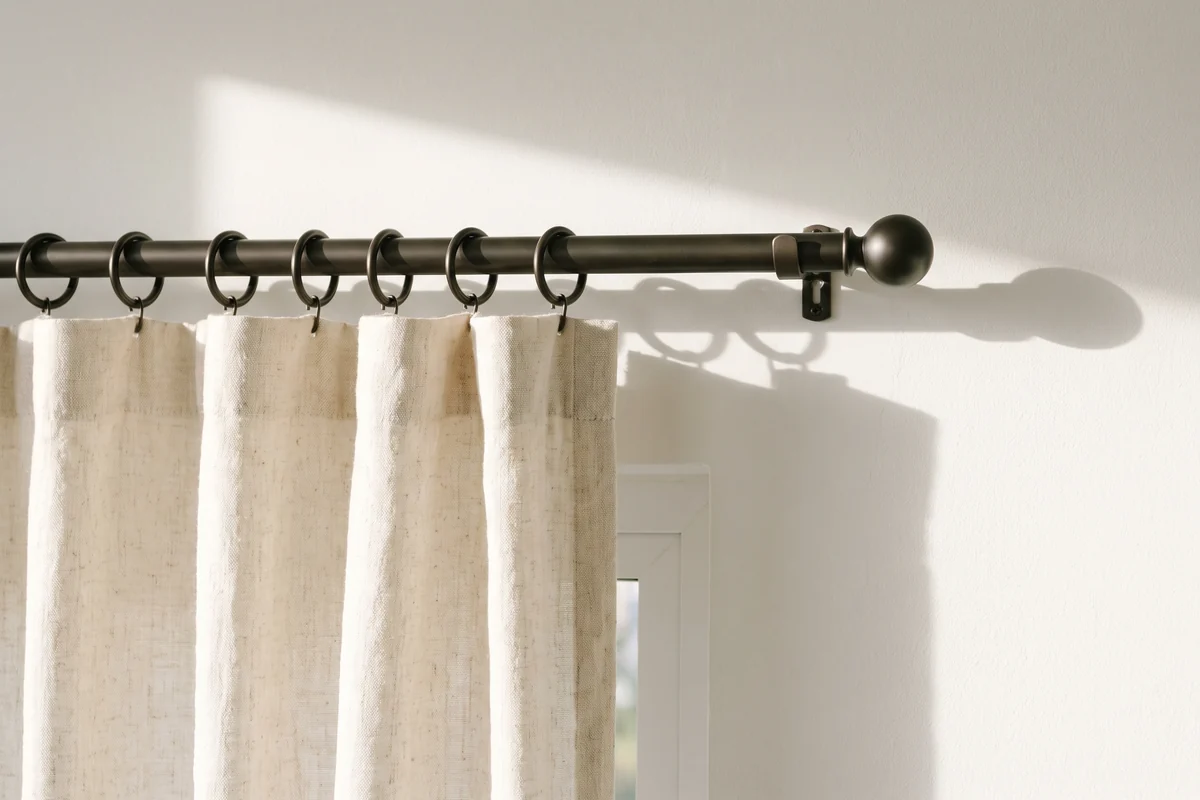 Guides
Curtain Rods vs Tracks
One of them is chosen for how it looks. The other is chosen for what it has to hold — and that is usually the decision that matters.
Read more