

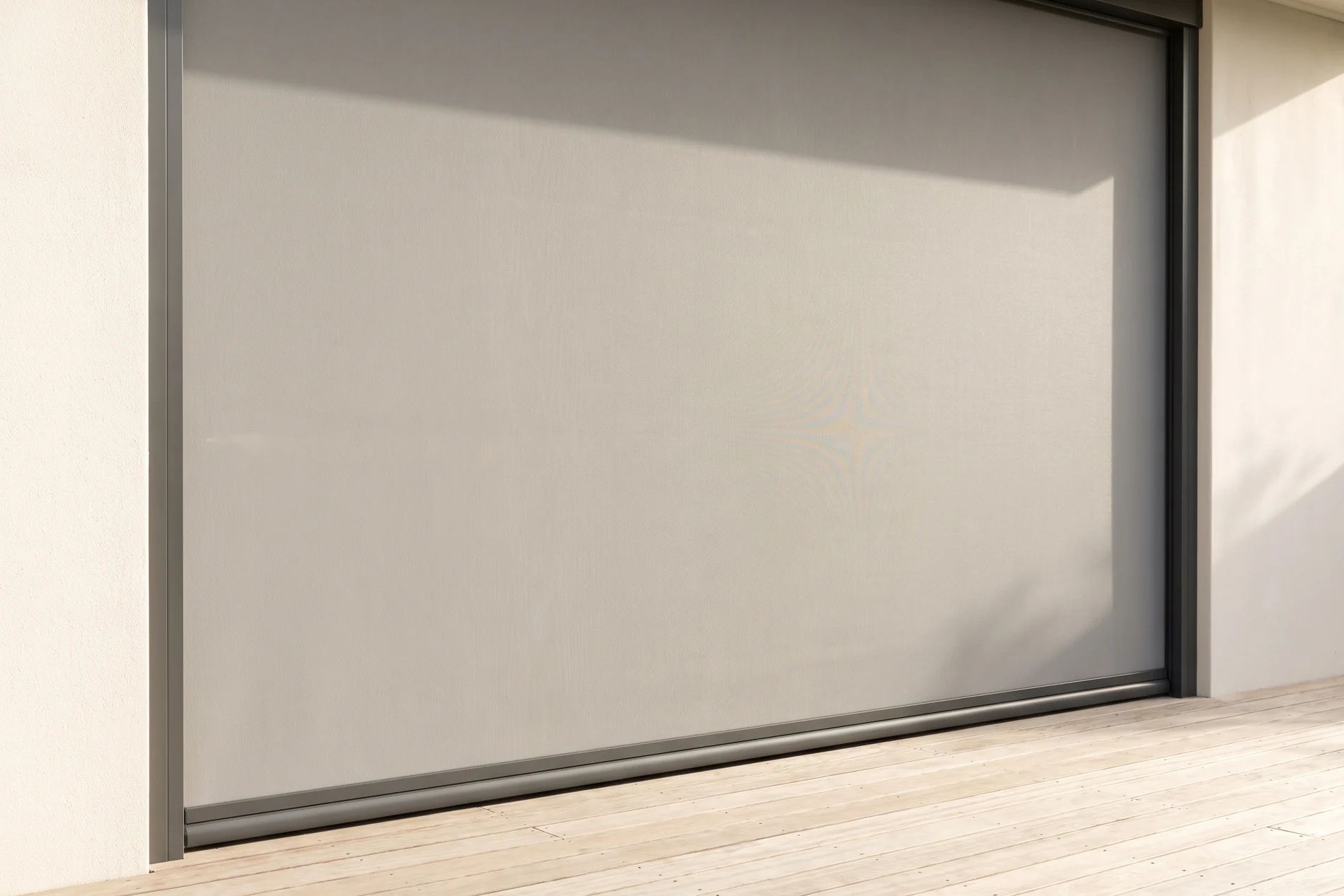
ZipScreen vs Ziptrak
Two track-guided systems, two different ways of holding the fabric — and the difference decides how the blind behaves in wind.
ZipScreen and Ziptrak are both track-guided outdoor blinds. The difference is how the fabric is held in the side channel: ZipScreen welds a zip spine to the fabric edge, Ziptrak welds a solid spline. That one choice decides how the blind seals, how it locks, and how it behaves in wind.
Forced to pick one: we fit ZipScreen, and the section on wind ratings explains why that is a smaller difference than the internet suggests.
Every second enquiry we get for an alfresco opening arrives with a brand name already attached to it. Someone has read that one system is stronger, or quieter, or better in a storm, and they want that one. Then I ask what the opening actually is — a two-metre balcony on the eleventh floor, or a six-metre patio at ground level — and the answer changes. So before you pick a brand, it is worth understanding what the two systems genuinely do differently, and how much of what you have read is engineering rather than marketing.
How each system holds the fabric
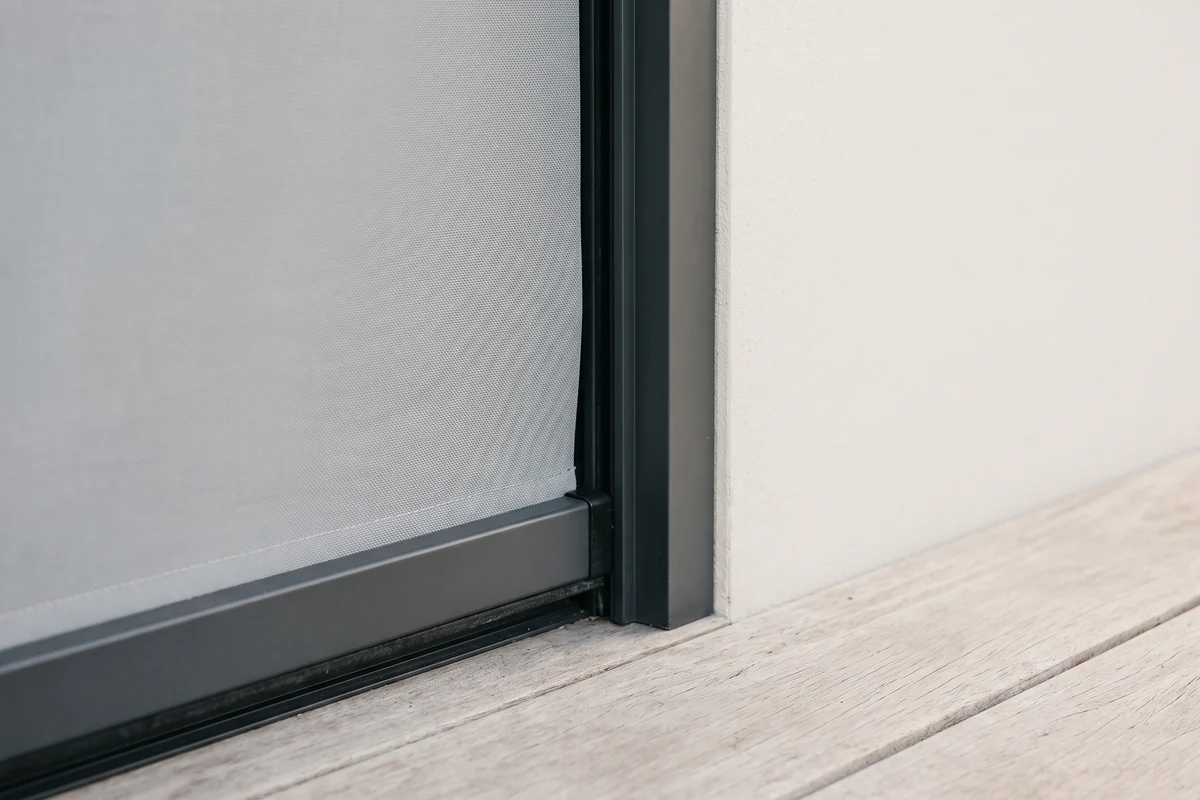
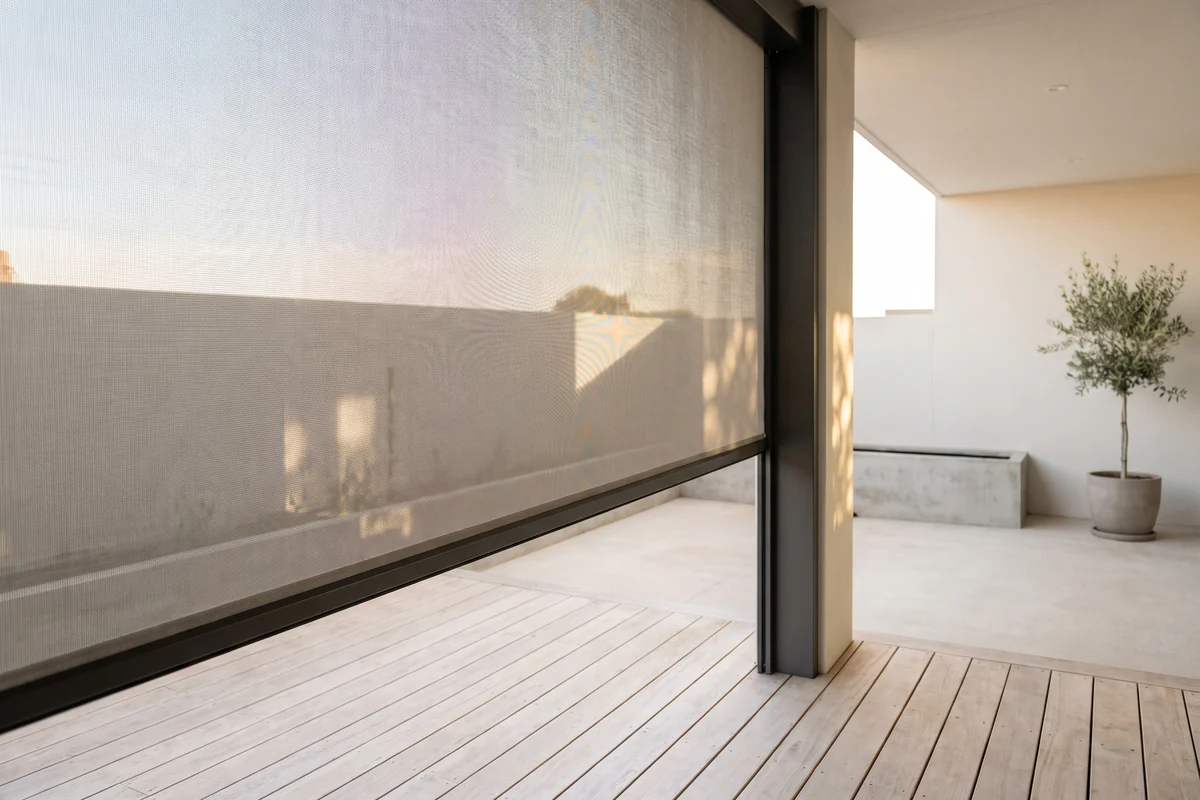
Both systems solve the same problem. A plain outdoor roller blind is held at the top and weighted at the bottom, and the sides are free — so the first decent gust lifts the edges, the blind flaps, and everything you were trying to keep out comes in around the sides. A track-guided blind captures both edges in a vertical channel so the fabric cannot leave it.
The two brands capture the edge differently.
- ZipScreen uses a zip. Its edge system is called z-LOCK, which the manufacturer describes as "zip-guided technology" that is "tightly integrated with the shade fabric and hidden behind the slim frame channels". It is not a zipper in the everyday sense — there is no second half to do up. It is a single welded spine that runs inside the channel and cannot pull out sideways.
- Ziptrak uses a spline. Despite the name, Ziptrak has no zip in it at all. A solid bead — the "side spline" — is welded along each edge of the fabric and runs in the vertical track. Ziptrak's own feature page describes a "new small side spline" that "provides a smoother finish and superior skin appearance".
Functionally these arrive at the same place: a fabric edge that is mechanically trapped rather than merely guided. The engineering argument between them is about how much surface area the edge presents to the channel and how it wears over years of being wound on and off a tube. Both are welded rather than stitched, which matters more than which shape the weld makes, because stitching is the thing that fails first on a cheap outdoor blind.
Where they genuinely diverge is what happens when you let go of the blind.
What each manufacturer actually publishes
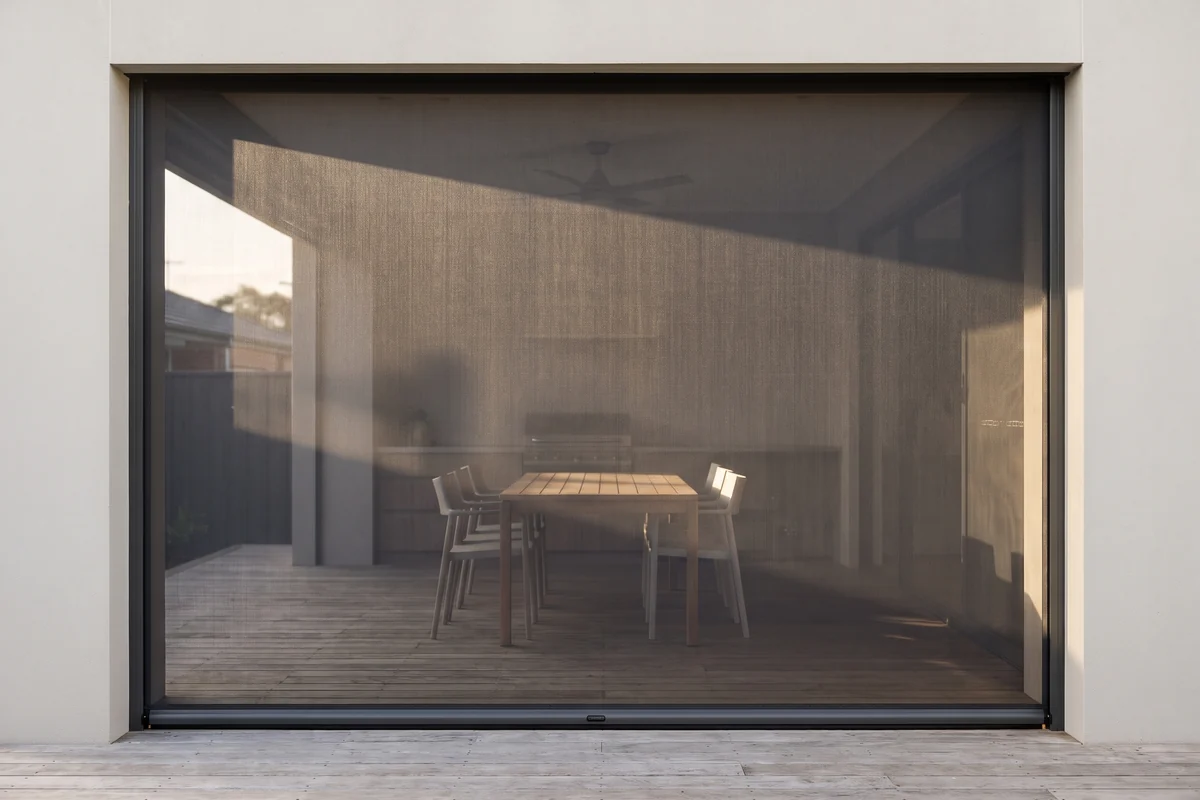
This is the part worth reading slowly, because a lot of the numbers circulating online do not come from either manufacturer. The table below contains only what Ziptrak and ZipScreen publish on their own product pages. Where a cell says "not published", that is the finding — not an omission on my part.
| ZipScreen | Ziptrak | |
|---|---|---|
| Fabric edge | z-LOCK welded zip spine | Welded side spline |
| Locking | Ultra-Lock latching pin, engages automatically when the blind closes | Centre Lock Release — unlocks both sides at once from the middle |
| Stops at any height | Not published | Yes — patented spring-balanced system |
| Operation | Motorised, spring from a weight-bar handle, or crank gear | Manual or motorised |
| Headbox | 125mm square | Not published |
| Frame material | 6061-grade extruded aluminium | Not published |
| Side adjustability | 20mm, plus 15mm each side | Not published |
| Wind speed rating | Not published | Not published |
Two things stand out. ZipScreen publishes more hard numbers — a 125mm square headbox, a 6061-grade aluminium extrusion, and 20mm of adjustment in the side channel with a further 15mm each side. That last figure is the unglamorous one that decides whether a blind can be made to fit an opening that is out of square, which on a rendered balcony is most of them.
Ziptrak publishes fewer dimensions but is clearer about feel. Its spring-balanced system is designed so that "most of the weight of the blind material disappears", and it stops and stays wherever you leave it. If you want a blind you can set half-open to catch a breeze without losing the shade, that is a real difference and Ziptrak names it plainly.
Neither publishes a wind speed rating on the pages a customer would actually read. That is not an oversight either.
Why the wind ratings you read online contradict each other
Search this comparison and you will find confident numbers. One retailer states Ziptrak is rated to 130km/h and ZipScreen to 50km/h. Another puts ZipScreen ahead on the same measure. Both cannot be right, and neither figure appears on either manufacturer's own product page — Ziptrak points instead to a separate blind strength testing document, and ZipScreen's technology page gives no speed at all.
There is a reason for the vagueness, and it is not evasion. A wind speed rating for an external blind is not a property of the blind on its own. It is a property of the blind at a particular width, at a particular height above ground, with a particular fixing substrate, in a particular terrain category. The same system that is comfortable across a 2.4-metre courtyard opening at ground level is a different proposition at 4.5 metres on the eighth floor at Main Beach, where the wind is accelerated by the building itself.
Australian structural wind loads are set by AS 1170.2, and the south-east Queensland coast sits in a higher wind region than most of the country. That is why the honest answer to "what is it rated to" is a question back: how wide, how high, and fixed into what. Any single number quoted without those four things attached is decoration.
So treat the km/h figures on comparison pages — including the ones on pages selling you the blind — as marketing until someone puts them in writing against your opening. A supplier who will not do that in writing has told you something useful.
Two related points that matter more on this coast than the brand choice does:
- Salt air is the real enemy, not wind. Anything within a few streets of the beach is in a corrosive environment, and the componentry — fixings, brackets, motor housings — degrades before the fabric does. Ask what the fixings are made of and specify accordingly. Our warranty, like every warranty in this trade, does not cover damage from salt air, weather or moisture, so the specification is where you win that argument, not the paperwork.
- Fixing substrate decides everything. A track-guided blind transfers real load into whatever it is bolted to. Rendered blockwork is fine. A timber post that has been in the weather for fifteen years may not be, and neither is a lightweight infill panel. This is the check most quotes skip.
External shading is worth the trouble regardless of which system you land on, because stopping heat outside the glass is the only shading that works before the heat is already in the room — the principle behind every passive design guide to shading written for Australian conditions. An internal blind is managing a problem that has already arrived.
What your body corporate has to approve first
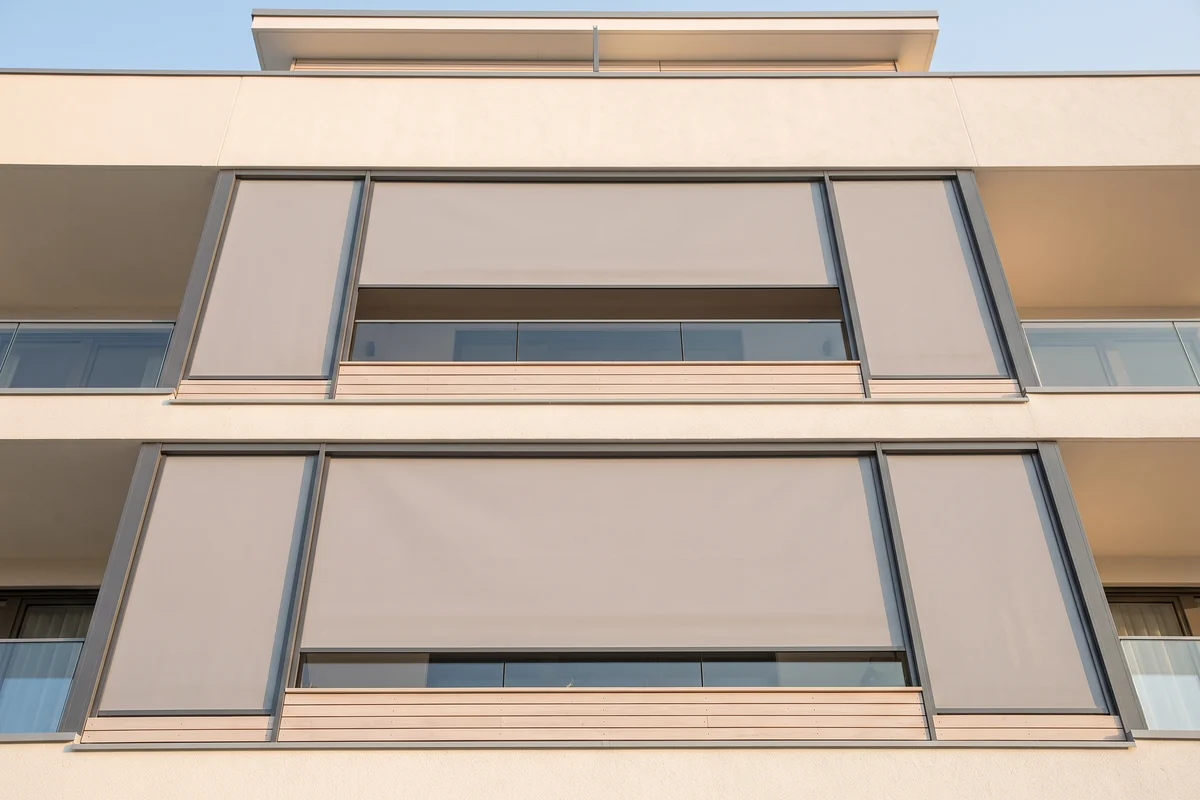
If the opening is a balcony in a strata scheme — which on the Gold Coast it very often is — the brand comparison is the second question. The first is whether you are allowed to fix anything to the building at all, and this is where most balcony projects lose a month.
An external blind fixed to a balcony almost always attaches to common property, even when the balcony is on your title. In Queensland that makes it an improvement to common property rather than a decorating decision. The Queensland Government's guidance on improving common property and lots sets out the thresholds: a committee can authorise an improvement where the total cost is under $3,000, and above that it takes an ordinary resolution at a general meeting.
Read that number against a quote for a motorised track-guided blind across a wide balcony and you can see the problem. Most of these jobs are over the threshold, which means they need a general meeting, which means they run on the body corporate's calendar rather than yours.
What to do about it, in order:
- Read the community management statement and by-laws first. Many schemes already specify an approved colour, fabric and even a system for external blinds, precisely so the building stays uniform. If yours does, the brand decision may already be made for you.
- Get the quote before the meeting, not after. A motion needs a specific proposal — system, colour, fixing detail and cost. A vague request to "install blinds" gets deferred.
- Ask whether a structural engineer is required. For anything at height, a scheme is entitled to ask for an assessment of wind loads and the suitability of the proposed fixings. Budget for it rather than being surprised by it.
- Confirm who maintains it afterwards. Where a lot owner installs something on common property for their own benefit, the owner generally carries the ongoing maintenance. That is worth knowing before you sign, not after the first repair.
None of this is a reason not to do it. Balconies are exactly where these blinds earn their money — they turn an unusable windy slab into a room. It is a reason to start the approval before you start choosing colours.
Not sure which system your opening actually needs?
We measure the opening, check what it can be fixed into, and quote the system that suits it — itemised component by component, with the warranty period stated on the quote.
Which one to specify
We supply ZipScreen. I will give you the honest version of why, including the part that does not flatter the decision.
The specification reasons are real: ZipScreen publishes its extrusion grade and its side-channel adjustment, and that adjustment is what lets a blind fit an out-of-square opening without a visible gap down one side. Its Ultra-Lock engages by itself when the blind closes, which matters because the failure mode on an external blind is not the fabric tearing — it is somebody leaving it half-locked before a storm. And the three control options mean the same system covers a hand-operated courtyard screen and a motorised balcony run.
The part that does not flatter it: Ziptrak's spring balance and stop-at-any-height are genuinely good, and if what you want is a blind you nudge to exactly the height you feel like with one hand, that is a fair reason to want one. Anyone who tells you a competitor's product is simply bad is selling you something. Ziptrak invented this category in Australia and it shows.
Where a track-guided blind wins
- Wide openings where the sides of a plain roller would lift and flap
- Exposed balconies and alfresco areas that are unusable in wind
- Keeping insects, dust and driven rain out of an outdoor room
- Shading glass from outside, before the heat reaches it
Where it is the wrong answer
- Openings that need to stay clear — the tracks are permanent and visible
- Anything the fixings cannot be properly anchored into
- Full weatherproofing — these are screens, not walls, and mesh is not waterproof
- Indoors, where a roller blind or an internal system does the job better and cheaper
The practical decision usually is not the brand. It is the fabric. A mesh screen keeps sun, insects and wind-driven spray out while you can still see through it; a solid PVC keeps weather out and you cannot. Most people who tell me they want "the ones that close the patio in" want mesh across the view and PVC only on the windward end. That mix costs less than doing the whole opening in PVC and it is the version people actually keep using, rather than the one that sits rolled up all year because closing it makes the room dark.
If you are still weighing outdoor against something internal, our Gold Coast outdoor blinds and Brisbane outdoor blinds pages cover the fabrics, the styles and how the install runs.
Frequently asked questions
What is the actual difference between Ziptrak and ZipScreen?
Both are track-guided outdoor blinds that trap the fabric edge in a vertical side channel so it cannot lift in wind. ZipScreen holds the edge with a welded zip spine it calls z-LOCK; Ziptrak holds it with a welded side spline. Beyond the edge, Ziptrak leads on feel — its spring-balanced system stops and stays at any height — while ZipScreen publishes more hard specification, including a 125mm headbox and 20mm of side-channel adjustment.
Does either system actually use a zip?
ZipScreen does, in a sense — z-LOCK is a single zip spine welded to the fabric edge, though there is no second half to do up, so it is not a zipper as you would picture one. Ziptrak, despite the name, uses no zip at all. It welds a solid spline along each edge instead. The two names cause more confusion than any other part of this comparison.
Can zip track blinds be motorised?
Yes, and both systems offer it. ZipScreen publishes three control options — motorised with voice or button control, a spring mechanism operated from a handle on the weight bar, or a crank gear. Ziptrak offers manual or motorised. Motorisation has to be chosen when the blind is being made rather than added later, and if power needs to be run to the opening that is a licensed electrician's job.
Do outdoor zip track blinds keep the rain out?
Partly, and the honest answer depends entirely on the fabric. A solid PVC blind sheds rain well and will keep an outdoor room dry in most weather. A mesh screen will not — it is designed to let air through, so driven rain passes through with it. If you want the view kept open and the weather kept out, you generally need PVC on the windward end and mesh elsewhere.
Do I need body corporate approval for a balcony blind?
Almost certainly, because the fixings usually land in common property even when the balcony is on your title. In Queensland a committee can authorise an improvement costing under $3,000, and anything above that needs an ordinary resolution at a general meeting. Check your community management statement first — many schemes already specify an approved colour and fabric for external blinds.
Which system is better for a wide opening?
Neither brand answers this on its own, because a maximum span is a function of the fabric, the tube, the fixing substrate and how exposed the opening is. Wide openings are also where published width claims vary most between retailers. The reliable approach is to have the opening measured and get the achievable single span confirmed in writing for your specific site rather than trusting a figure from a comparison page.
What warranty comes with outdoor blinds?
We warrant our installation workmanship for 12 months from the date of installation, and the products carry their manufacturer's warranty — between 12 months and 7 years depending on the system, componentry and fabric. The applicable period is stated on your quote. Note that no warranty in this trade covers fading or damage from sunlight, weather, salt air or moisture, which is why specification matters more than paperwork on a coastal opening.
Sources Australian Government Your Home — Glazing · ACCC blinds and window fittings mandatory standard · Sleep Health Foundation
Back to the journalKeep reading
Related from the journal
 Guides
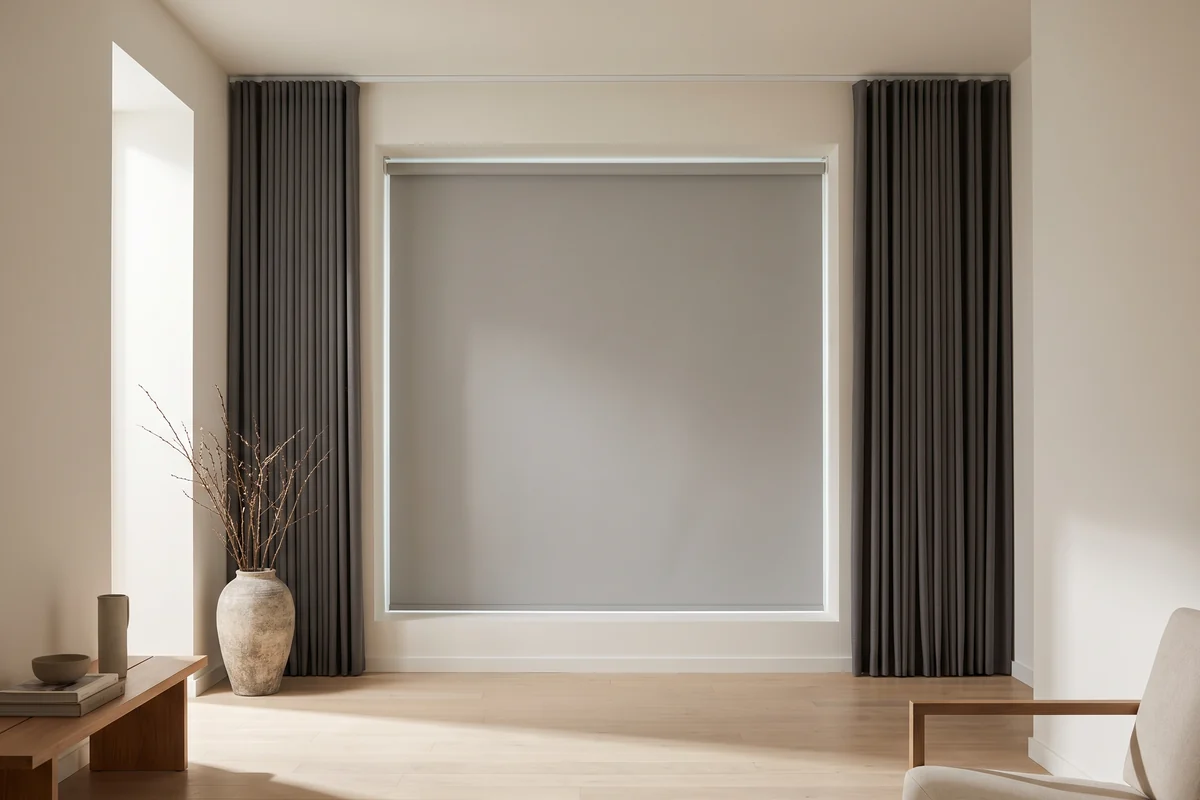
Blinds vs curtains: how to choose, room by room
The opening decides it, not the product. What each one does better, and why the heat argument is really an installation argument.
Read more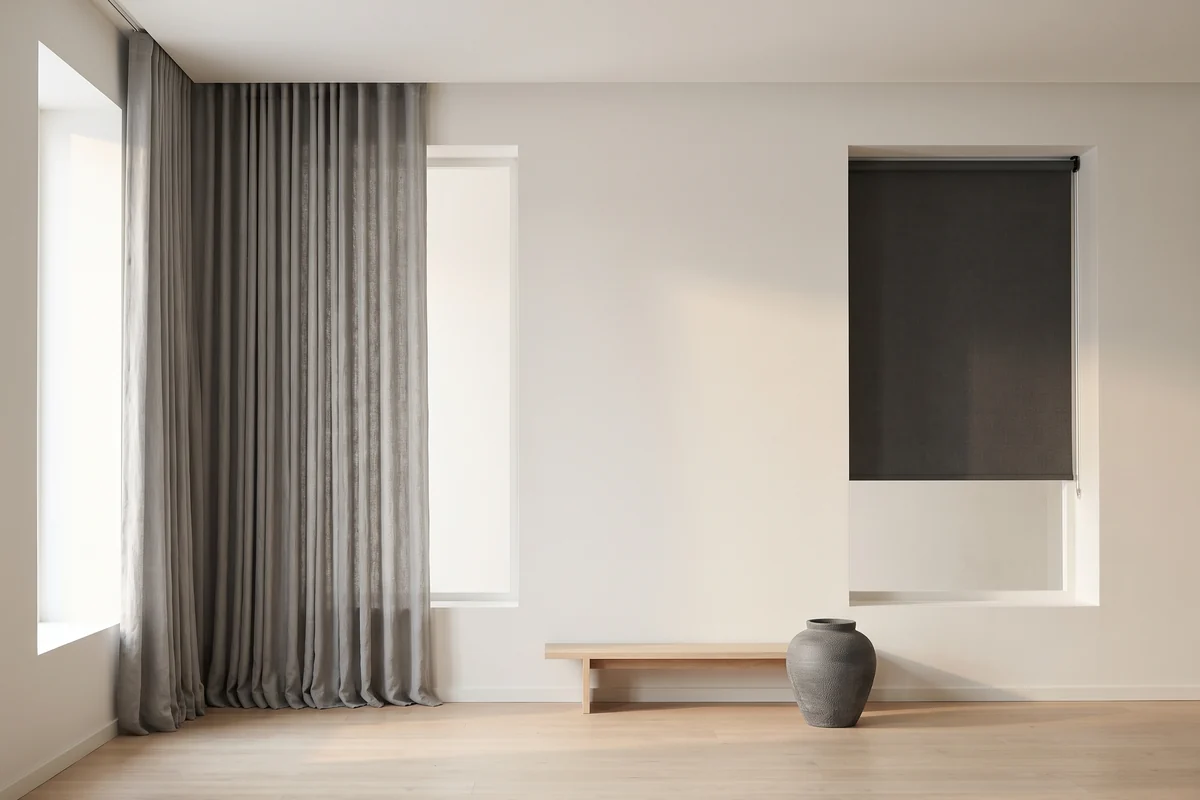 Guides
What is a window treatment?
The American word for window furnishings, and the four families explained for an Australian house.
Read more Guides
How to clean blinds without wrecking them
Dust monthly, wet-clean twice a year, and never soak a blockout roller. A type-by-type method, plus the mould routine.
Read more