

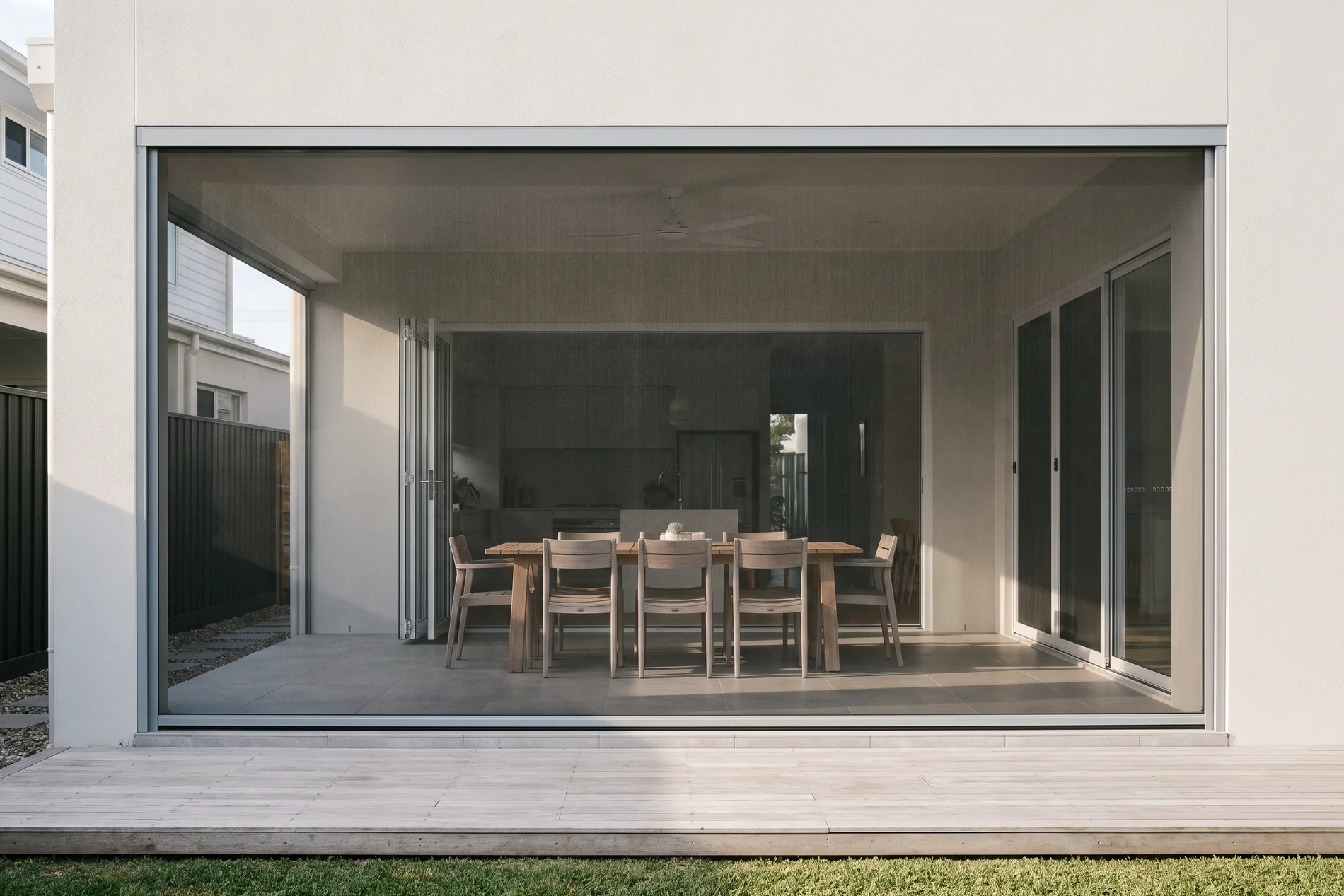
Phantom Executive screens: sizes, mesh and fitting
A motorised screen that disappears into the ceiling and closes an alfresco up to 12 metres wide. What to choose, what to plan before the ceiling goes on, and when not to buy one.
Phantom Executive screens are motorised retractable screens that drop from a slim housing at the press of a button and roll fully out of sight when you raise them. The fabric is zipped into channels down both sides, so it stays taut and closes the edges to insects. One screen can span up to 12 metres, with the drop depending on the fabric.
Buy one for a wide alfresco or a wall of bi-folds you'll close most evenings. For a 3-metre opening you're happy to pull down by hand, a manual zip track blind does the job for less.
I'm writing this as an authorised Phantom dealer who also sells a manual zip track blind, so I have no reason to talk you into the more expensive one. The Executive is very good at one thing: closing a big opening without a post in the middle and without leaving anything on show when it's up. The decisions that make or break it are the housing size, the mesh, and whether the recess gets planned before the ceiling goes on. Here they are in that order.
Know what you're actually buying
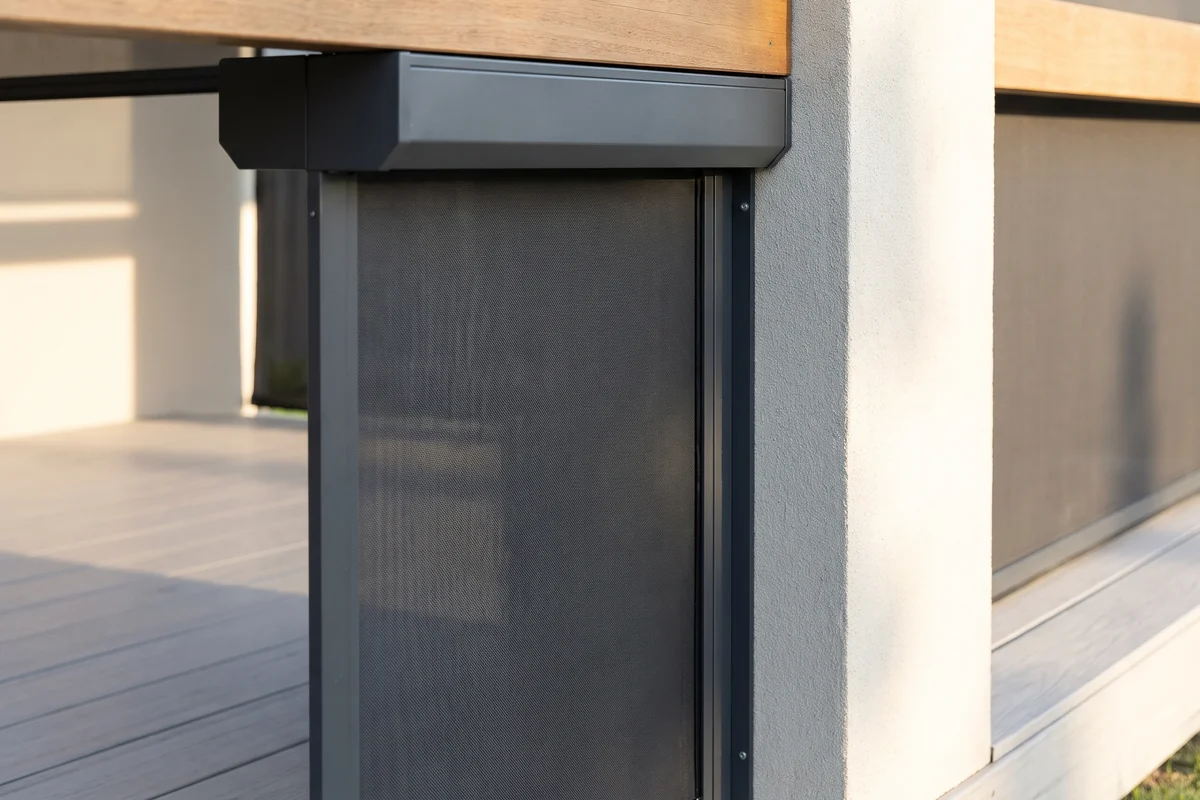
The Executive is a vertical roller screen. A motor inside an aluminium housing turns a tube, and the mesh unrolls straight down. Phantom names the model after the housing: the Executive 100, 140 and 180 have housings 100, 140 and 180 mm deep. A bigger housing holds a bigger roller, and a bigger roller carries a wider screen.
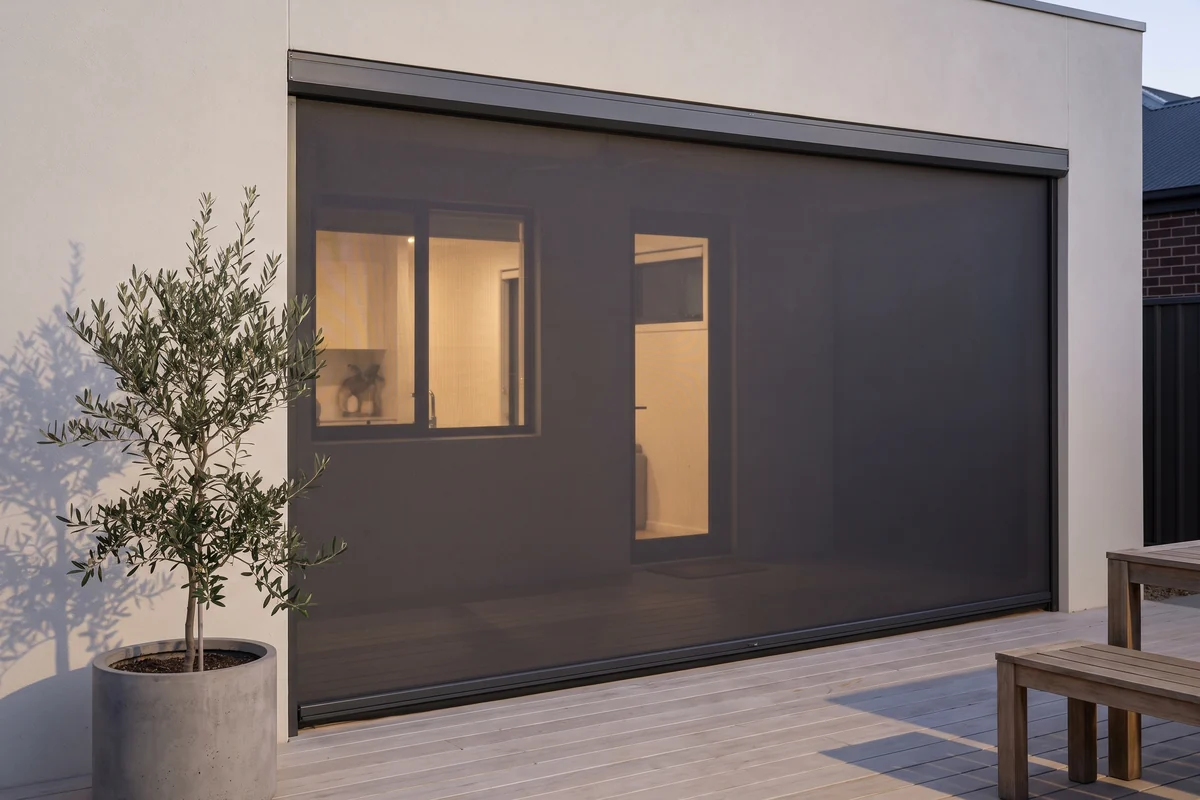
The part that matters is the edge. A zip is bonded down each side of the fabric, and the zip runs inside a captured side channel. That does two jobs. It holds the mesh flat when the wind gets up, instead of letting it billow like a sail. And it leaves no gap at the sides for a mosquito to walk through. A brush seal on the bottom bar closes the gap at the floor, and there's no sill track to trip over, so the doorway stays clear when the screen is up.
- It's motorised, full stop. Every Executive sold in Australia is motor-driven. A remote, a wall switch, or both, and sun and wind sensors if you want it to look after itself.
- It goes inside or outside. Most go on the outside, where they stop heat before it reaches the glass, but the same system can be fitted indoors behind a large window.
- It can carry two fabrics. The dual roller version holds mesh and clear vinyl on one housing, so you can run the screen, the vinyl, or both. Cafés like it. So do alfresco areas that get used in July.
The name is borrowed, by the way. Phantom moved into motorised screens in 2000 by buying a Florida company called Executive Rollscreens, and kept the name. The screens sold here are made to measure in Australia by Phantom Screens Australia.
Size the housing to the opening
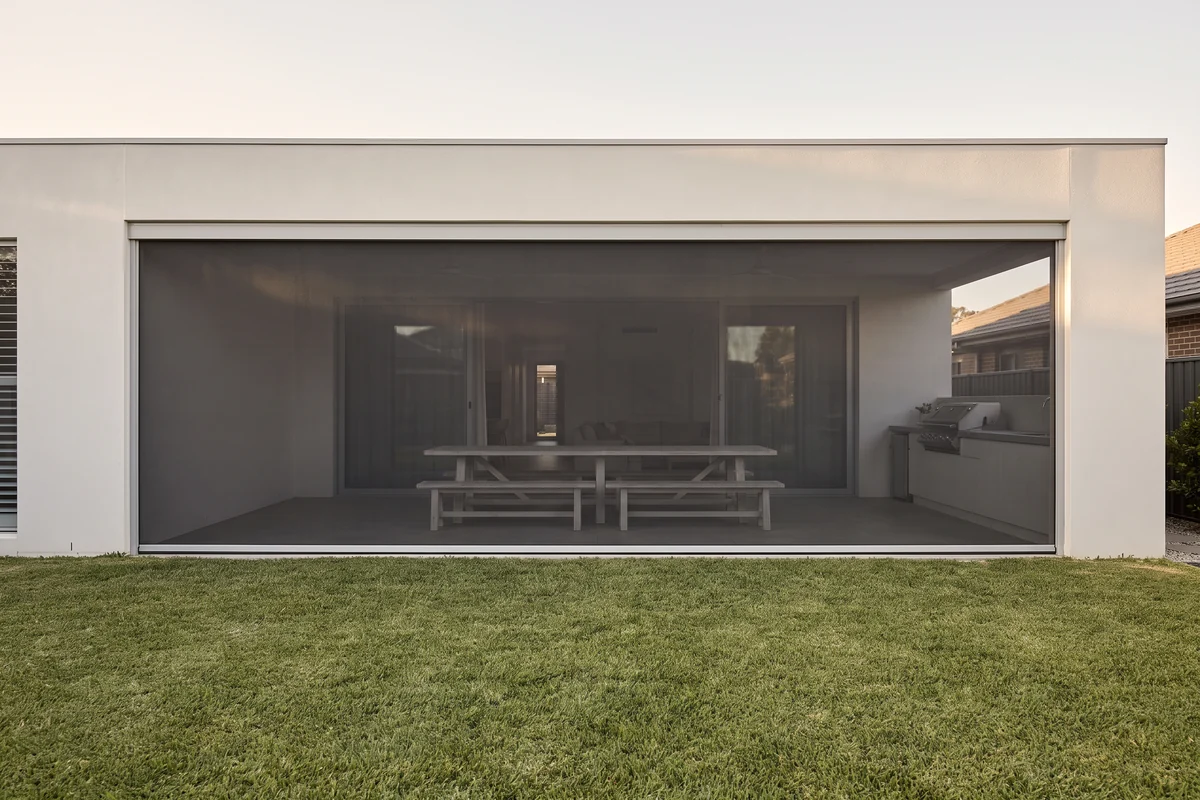
The headline number is 12 metres in one screen. That's real, but it comes with conditions, and the conditions are where quotes differ. These are Phantom's current figures for each housing:
| Housing | Maximum width | Maximum drop | Typical use |
|---|---|---|---|
| Executive 100 | 3 m | 2.45 m | Single doors, windows, a small patio |
| Executive 140 / 180 | 8 m | 5 m | Most alfresco areas and bi-fold walls |
| Executive 180, oversize | 8 to 12 m | 3.3 m | Very wide openings, with support cradles |
| Privacy fabric (140 / 180) | 8 m | 3.9 m | Screening from neighbours |
| Clear PVC (140 / 180) | 5.5 m | 3 m | Wind and rain |
Three things fall out of that table. First, past 8 metres the drop falls to 3.3 metres, so a very wide, very tall opening may still need two screens. Second, the fabric sets the limit as much as the housing does: heavier privacy fabric and solid PVC can't go as wide as mesh. Third, the ratio of width to height matters, and Phantom confirms the final size for each job. Anyone who gives you a firm answer on an 11-metre span from a photo is guessing.
There's also a version for buildings with a lift. Exec Connect is made in two parts that are joined on site, so a screen of around 6.5 metres can reach a penthouse balcony without travelling up the stairwell. On the Gold Coast, where a lot of the best balconies sit twenty floors up, that solves a problem most people only discover on installation day.
Choose the mesh for the bug, not the colour
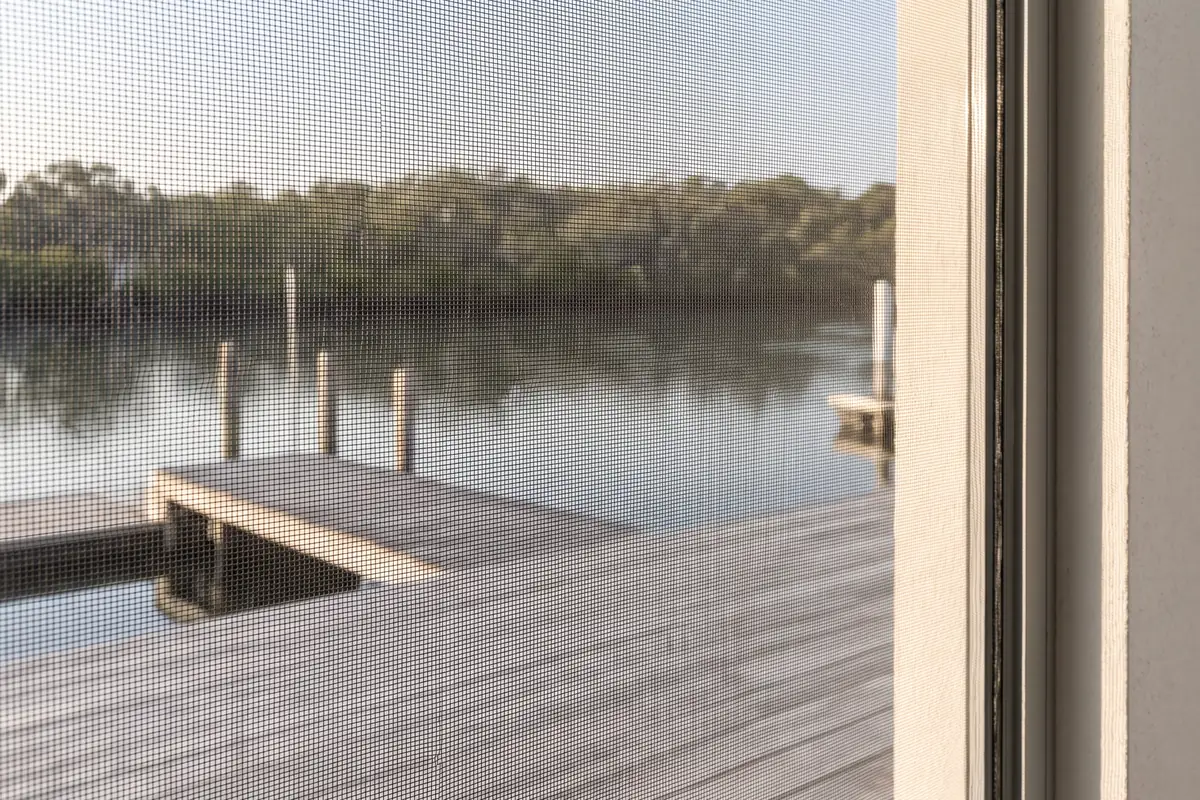
Every mesh is a trade between airflow and view on one side, and shade, heat control and privacy on the other. The number that tells you where a fabric sits is its openness: the share of the fabric that is open space. The same idea runs through indoor sunscreen fabric, and there's a longer explanation in our guide to openness factor in sunscreen blinds.
| Fabric | Openness | Sun blocked (Phantom's figure) | Choose it for |
|---|---|---|---|
| 18×14 insect mesh | about 58% | up to 40% | The default. Most airflow, clearest view |
| 18×18 midge mesh | about 48% | — | Canals, estuaries and bushland |
| PetScreen Lite | about 45% | up to 55% | Dogs and cats that lean on things |
| 30×20 insect mesh | about 32% | up to 65% | Insects plus more sun control |
| Sunbloc 80 | about 25% | up to 80% | Heavy-duty, pet resistant |
| E-Screen 10% | 10% | up to 90% | Glare and heat, with the view kept |
| E-Screen 6% | 6% | more than 10% | West-facing openings in hard sun |
Start with the insect. Standard 18×14 mesh keeps out flies and mosquitoes and costs you almost nothing in breeze or view. If you live on a canal, near mangroves or backing onto bush, the problem is biting midges, which most people call sandflies, and they are small enough to come straight through a standard weave. Tweed Shire Council's advice on mosquitoes and midges is to use a smaller screen size on windows and doors, and that is exactly what 18×18 midge mesh is. Ten points less openness is a small price for an evening outside on a canal at Hope Island or Runaway Bay.
Then think about the sun. A west-facing alfresco is the hardest space on the Gold Coast to sit in at four o'clock, and a roof doesn't fix it. The Australian Government's Your Home guide to shading notes that deep verandas and pergolas on the east and west can still let in very low-angle summer sun, and recommends adjustable shade screens on those sides. E-Screen at 6% or 10% does that job. You'll still see the garden. You won't see much of the afternoon.
One limit to know before you choose: mesh is not privacy at night. With the lights on inside and dark outside, anyone in the yard can see in through any mesh on this list. If the neighbours' deck looks straight into your alfresco, you want a privacy fabric, and you accept less breeze. No mesh gives you airflow and night-time privacy at once. That's physics, not a product gap.
Match the frame, not just the fabric
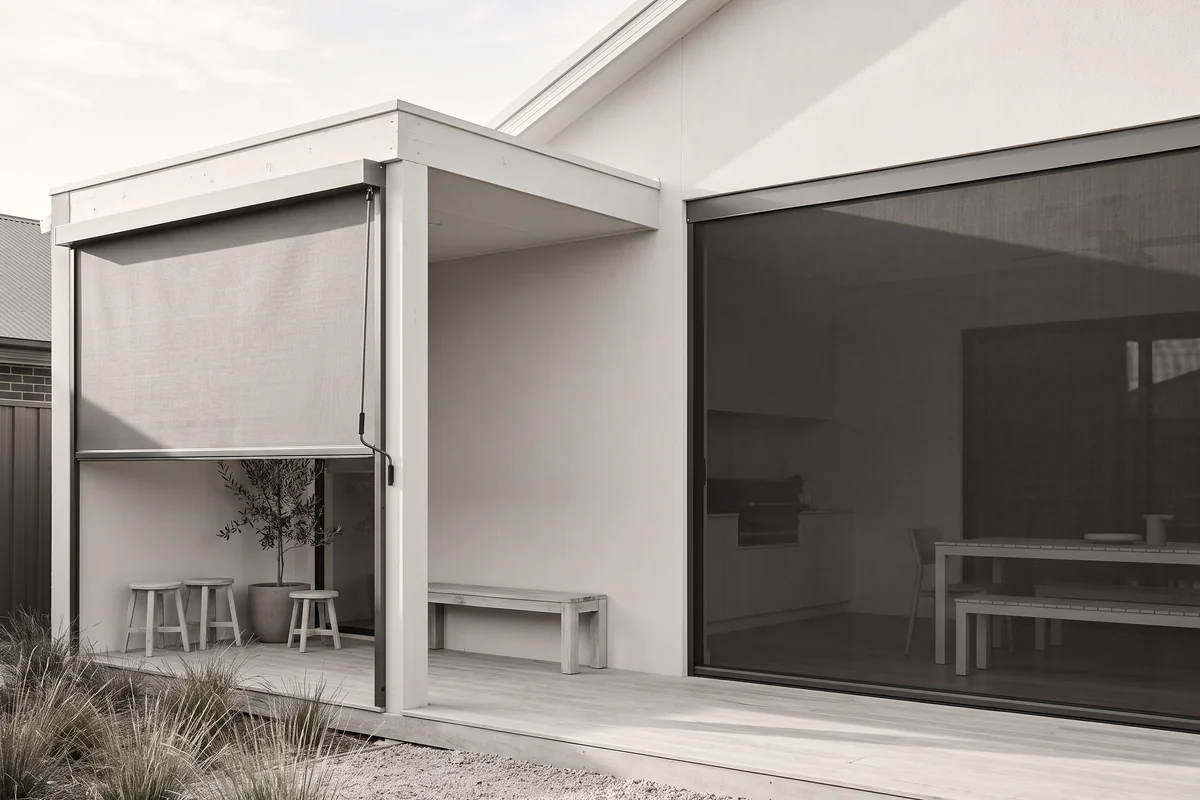
The housing, side channels and bottom bar are powder coated. Phantom has a standard range of colours, can match any Dulux colour at extra cost, and offers woodgrain and anodised finishes. Match the frame to the window joinery or the roof, and the housing all but disappears. Mesh comes mainly in charcoal and grey, with oyster, beige and bronze blends in the solar fabrics.
Pick the Executive or a ZipScreen by width and habit
We sell both, so this is the part of the conversation I'd have with you anyway. A ZipScreen track-guided blind works on the same principle, a zip down each edge in a channel, but it's built as an outdoor blind that can carry mesh, and it can be moved by hand. The Executive is built as an insect screen that also shades, and it's motor-driven only.
| Phantom Executive | ZipScreen | |
|---|---|---|
| Operation | Motorised only | Spring, crank or motorised |
| Widest single span | 12 m (drop limited past 8 m) | 7 m |
| Maximum drop | 5 m | 5 m |
| Built as | An insect screen that shades | An outdoor blind that keeps insects out |
| Recessed into the ceiling | The usual way to fit it | Available as a recess fit |
| Fabrics | Insect, midge, pet, solar, privacy, blockout, PVC | Outdoor mesh and fabric |
| High-rise access | Exec Connect two-part screen | One piece |
Phantom's own rule of thumb, which I agree with, is that a manual zip track blind suits openings up to about 4 metres. Past that, or where the screen goes up and down every day, the Executive earns its price.
Don't buy an Executive for a 3-metre patio you'll close twice a summer. A motor on a small opening you rarely touch is the same mistake as a motor on a bedroom blind you walk past every morning: you pay for the convenience and use it a dozen times a year. A ZipScreen will close that patio for less, and you won't miss the button. Our comparison of alfresco blinds covers where a café blind or a straight drop fits in.
The reverse is just as true. A 9-metre alfresco can't be done in one ZipScreen, and two blinds on a 9-metre opening means a post or a mullion in the middle of your view. If one clear span is the reason you're reading this, that settles it.
Not sure which one your opening needs?
We'll measure it, look at the aspect and how you use the space, and quote both if both would work. Itemised, within 24 to 48 hours of the measure.
Plan the recess before the ceiling goes on
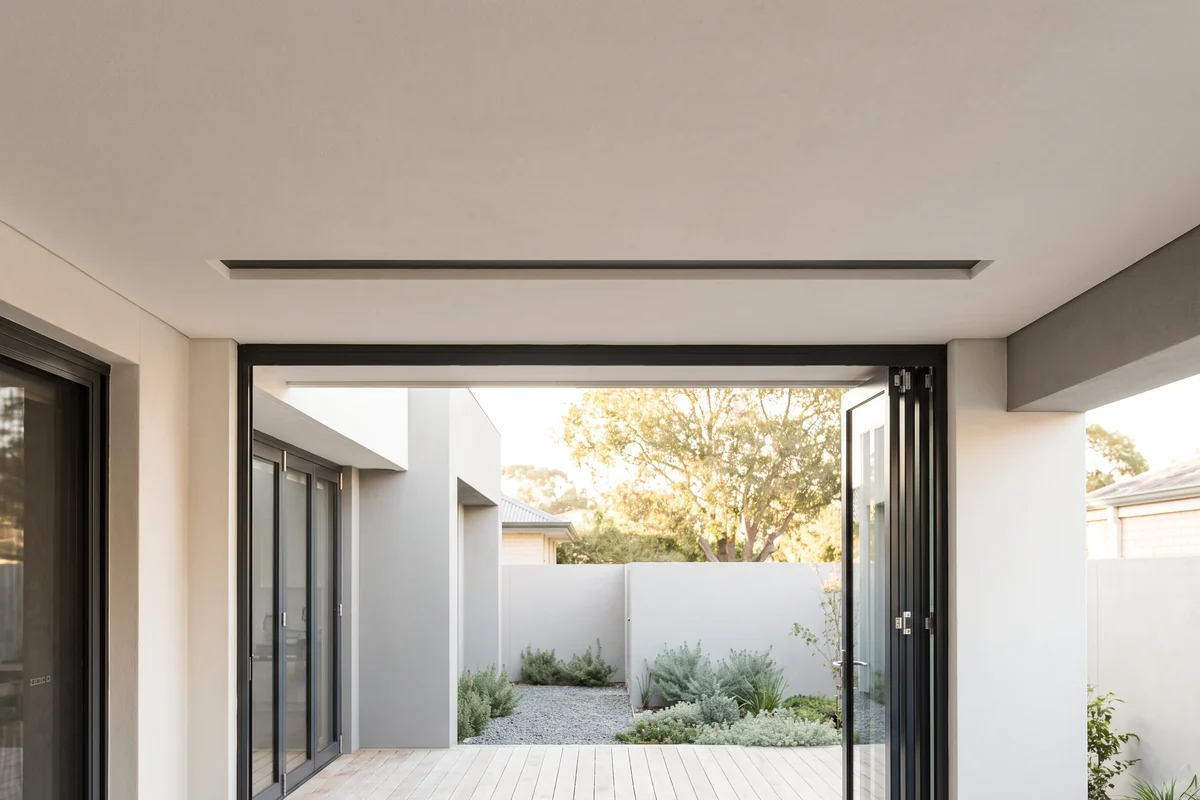
The best Executive installs are the ones you can't see. Fully recessed into a soffit, a beam or a ceiling cavity, the screen leaves nothing but a slot when it's up. Surface mounting, on the face of a beam or under a header, is fine and suits most retrofits, but the housing stays on show.
Recessing is a building decision, not a blinds decision, and it has a deadline. Once the ceiling is lined and painted, a pocket for a 140 or 180 mm housing means cutting it open again. If you're building or renovating, talk to us at frame stage, while the builder can still leave the gap.
- Leave the pocket. Give the builder the housing size for the span you need, so the cavity is framed to suit.
- Run the power. The motor is hardwired. That's a licensed electrician's job, at your cost, and it's far cheaper with the walls open than after.
- Think about the floor. There's no floor track, but the bottom bar comes down in a straight line and its brush seal has to meet the floor along the whole span. Tell us about any step, hob or fall across the opening when we measure.
- Decide on automation now. Sun and wind sensors and home-automation links are much easier to wire in during the build. Smart-home integration is a consultation by separate agreement, so raise it early.
Retrofits work too. We find a tidy route for the cable and mount the housing where it'll read as part of the building. It just won't vanish the way a recessed one does.
Check the by-laws if you live in a unit
A screen on a balcony changes how the building looks from the street, and in a Queensland apartment that usually means the body corporate has a say. Read your scheme's body corporate by-laws and get approval before you order, not after it's made. A housing powder coated to match the balustrade makes that conversation a good deal shorter.
Run it fully down or fully up in wind
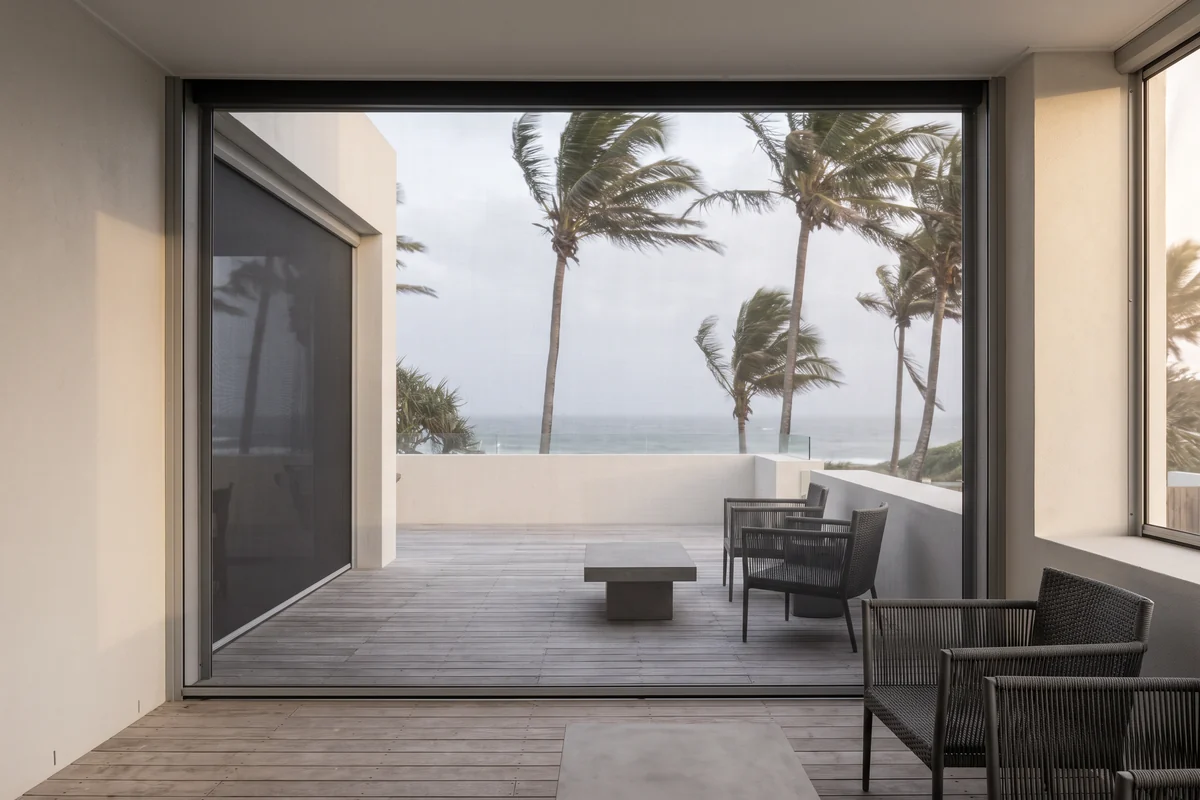
Captured edges are why the Executive can stay down on a breezy afternoon when a loose outdoor blind would be flapping. Mesh lets air through, too, so it carries far less wind load than solid PVC. Phantom also upsizes the roller tube and bottom bar as the screen gets bigger, so a 10-metre screen isn't simply a 4-metre one stretched.
It is still a screen, not a storm shutter. Phantom doesn't publish a wind rating in kilometres an hour, and I wouldn't trust anyone who quoted you one, because what a screen can take depends on its size, its fabric, how exposed it is and what it's fixed to. Three rules cover almost every case:
- All the way down or all the way up. Half-down is the most vulnerable position a screen can be in, so in a breeze pick one end or the other.
- Raise it before a storm. Retracted, the mesh sits inside the housing, out of the weather. It's a big part of why it outlasts a fixed screen.
- Let a sensor do it. A wind sensor raises the screen when gusts pick up, which matters most on a high-rise balcony or a house you leave empty for the weekend.
Look after it once a season
Brush or hose off dust and salt, wash with mild soapy water if it needs more, and let it dry before you roll it up. That last step matters most with clear PVC, which marks if it's rolled wet. Keep leaves out of the side channels. Salt builds up faster on the coast, so rinse more often the closer you are to the beach. If the mesh is ever damaged, it can be replaced, so the frame and motor outlast the fabric.
You may notice slight ripples near the edges of the mesh. Phantom's explanation is that the zip edges need room as they wind onto the roller, so the fabric folds gently on itself. It varies with the weather, softens the longer the screen is down, and doesn't affect how it works.
If you're weighing this up for a house in Brisbane rather than on the coast, the same choices apply, and our outdoor blinds in Brisbane page covers how we work north of the Logan.
Frequently asked questions
What are Phantom screens?
Phantom makes retractable screens that roll away out of sight when you don't need them. The range covers doors, windows and large openings. The Executive is the motorised outdoor model, built for alfresco areas, bi-fold walls and balconies up to 12 metres wide in one screen.
How do Phantom Executive screens work?
A motor in the housing turns a roller, and the mesh drops straight down with its edges zipped into channels on each side. The channels hold the fabric flat in wind and seal the sides against insects, and a brush seal closes the gap at the floor. You control it by remote, wall switch or sun and wind sensors.
How much do Phantom screens cost?
It depends on the width, the drop, the housing size, the fabric, whether it's recessed or surface mounted, any sensors, and the electrical work. Those vary enough that a single figure would mislead you. We measure for free and give you an itemised quote within 24 to 48 hours, valid for 30 days.
Do Phantom Executive screens need wiring?
Yes. The motor needs a hardwired power supply, run by a licensed electrician. On a new build it's done while the walls are open; on a retrofit we find a tidy route for the cable.
Can the screen drop automatically with the sun or wind?
Yes, with optional sensors. A sun sensor lowers the screen when the light gets strong, and a wind sensor raises it when gusts pick up, with nothing for you to do.
How do you clean Phantom screens?
Brush or hose off dust and salt, then wash with mild soapy water if needed. Let the fabric dry fully before rolling it up, especially clear PVC, and keep leaves out of the side channels.
Will a Phantom screen keep sandflies out?
Choose the 18×18 midge mesh. Standard insect mesh stops flies and mosquitoes, but biting midges are small enough to get through it. On canal and estuary homes, midge mesh is the one to specify.
Sources Phantom Screens NZ, Executive specification sheet and motorised outdoor blinds · Phantom Screens Australia mesh brochure · Tweed Shire Council Mosquitoes and midges · Australian Government Your Home — Shading · Queensland Government Body corporate by-laws
Back to the journalKeep reading
Related from the journal
 Guides
Alfresco blinds compared: cafe, straight drop and zip track
Three ways to hang fabric across an outdoor opening, and only one seals the sides. What that changes in wind, rain and insects — with the wind-tunnel figure quoted properly.
Read more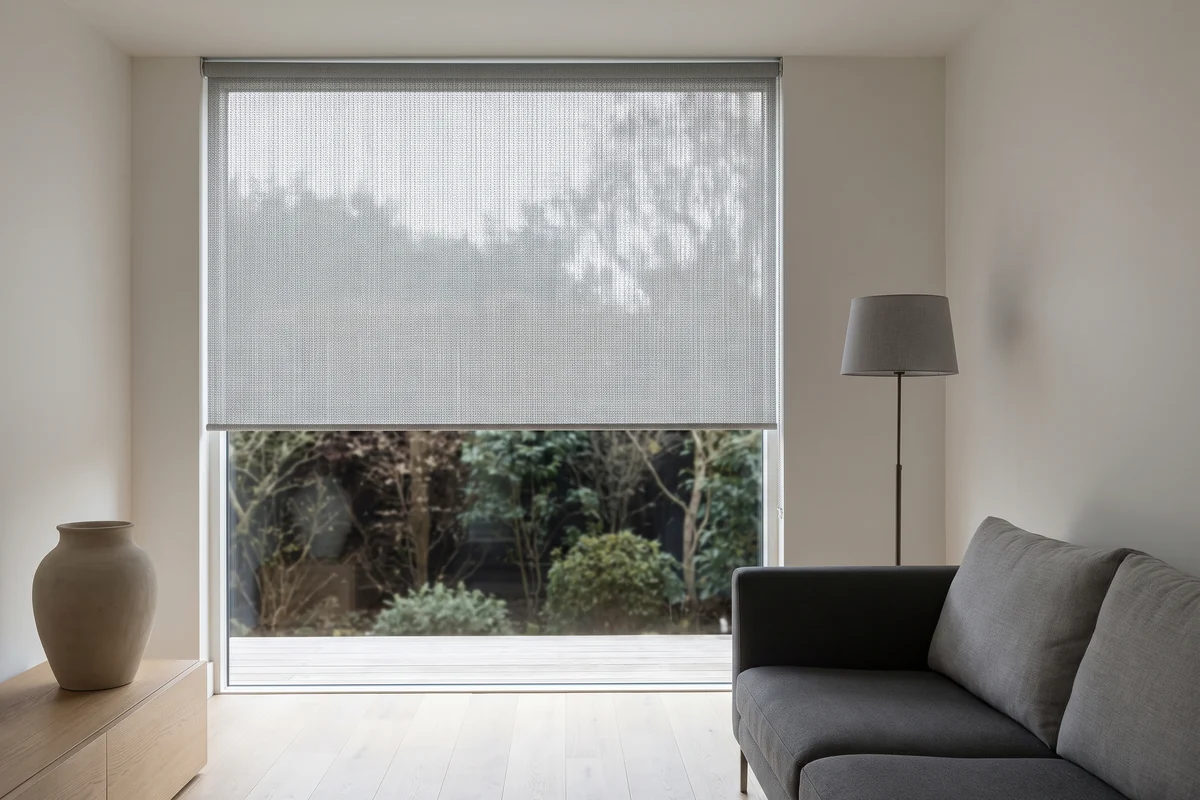 Guides
Sunscreen blinds and openness factor
Openness is the one number that decides how the blind behaves. What 1%, 3%, 5% and 10% each do — and why the American advice about north-facing windows is backwards here.
Read more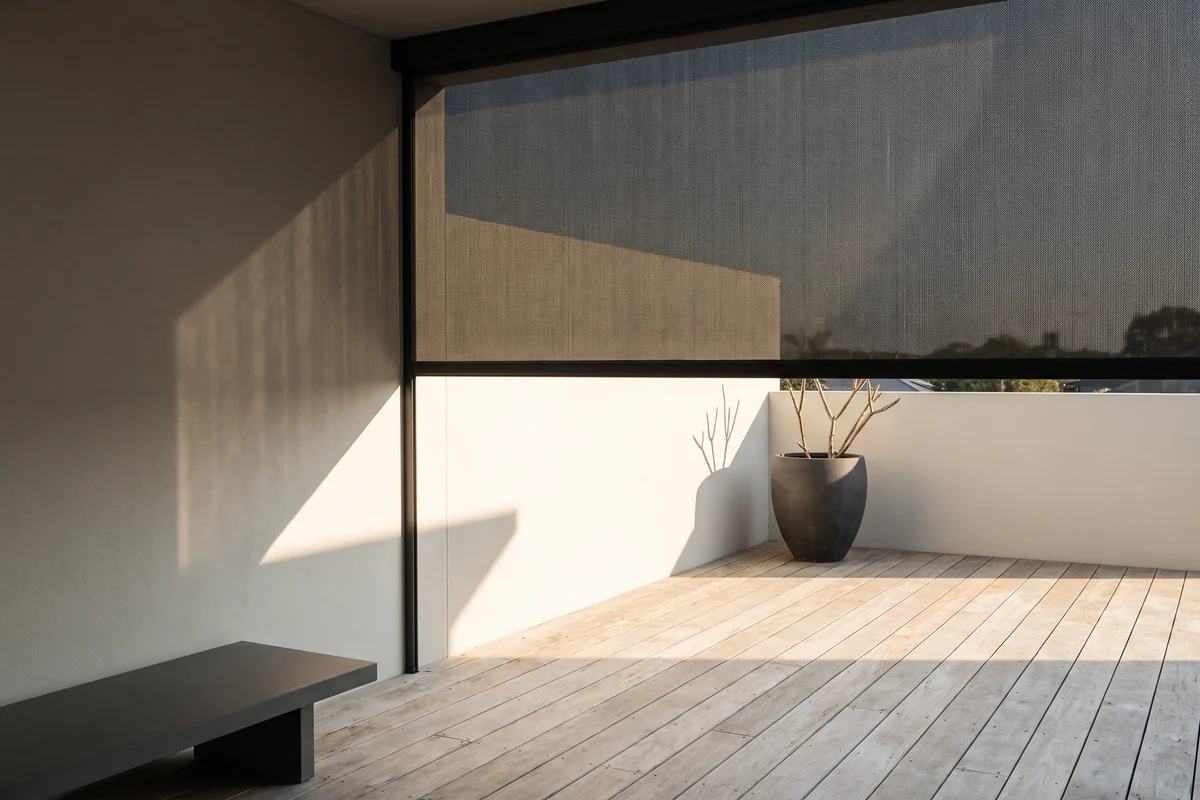 Guides
Do outdoor blinds reduce heat?
The 90% everyone quotes comes from a government shading guide, not a product test. What outdoor blinds actually do about heat, and the wind and rain numbers no competitor prints.
Read more