

Do thermal curtains actually work?
They work — on the heat you let reach the glass. What the government's own numbers say about windows, pelmets and a Queensland summer.
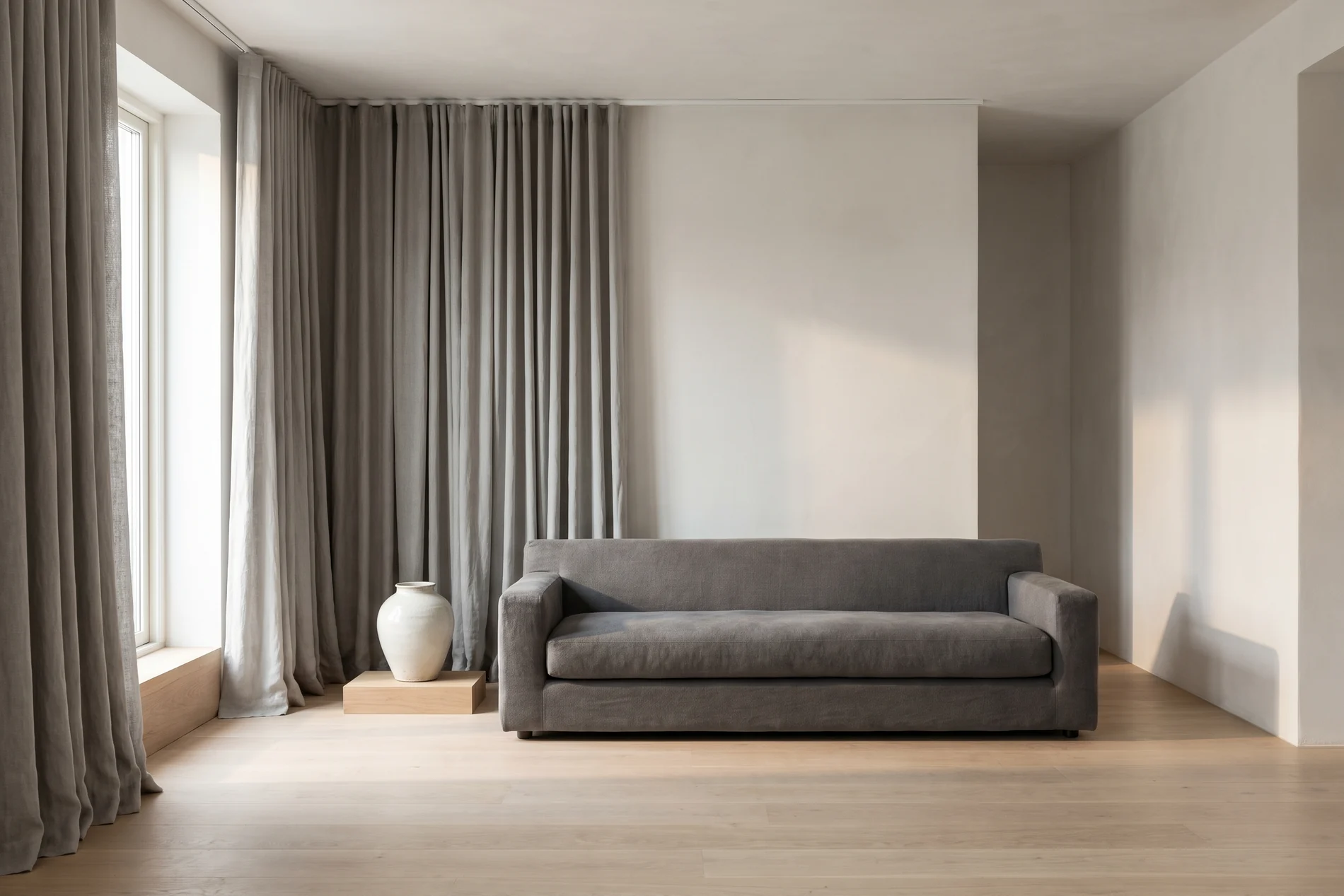
Thermal curtains work, but not the way the label suggests. The fabric isn't the insulator — the still layer of air trapped between fabric and glass is, and that layer only exists if the curtain is sealed top, sides and bottom. A heavy curtain hung loose over a window does very little.
One rule above the rest: seal the edges, or don't bother paying for the lining.
Almost every guide to thermal curtains in this country is written for a Melbourne winter. Ours isn't. So here's what the physics says, and where a curtain stops being the right answer.
It's the air, not the fabric
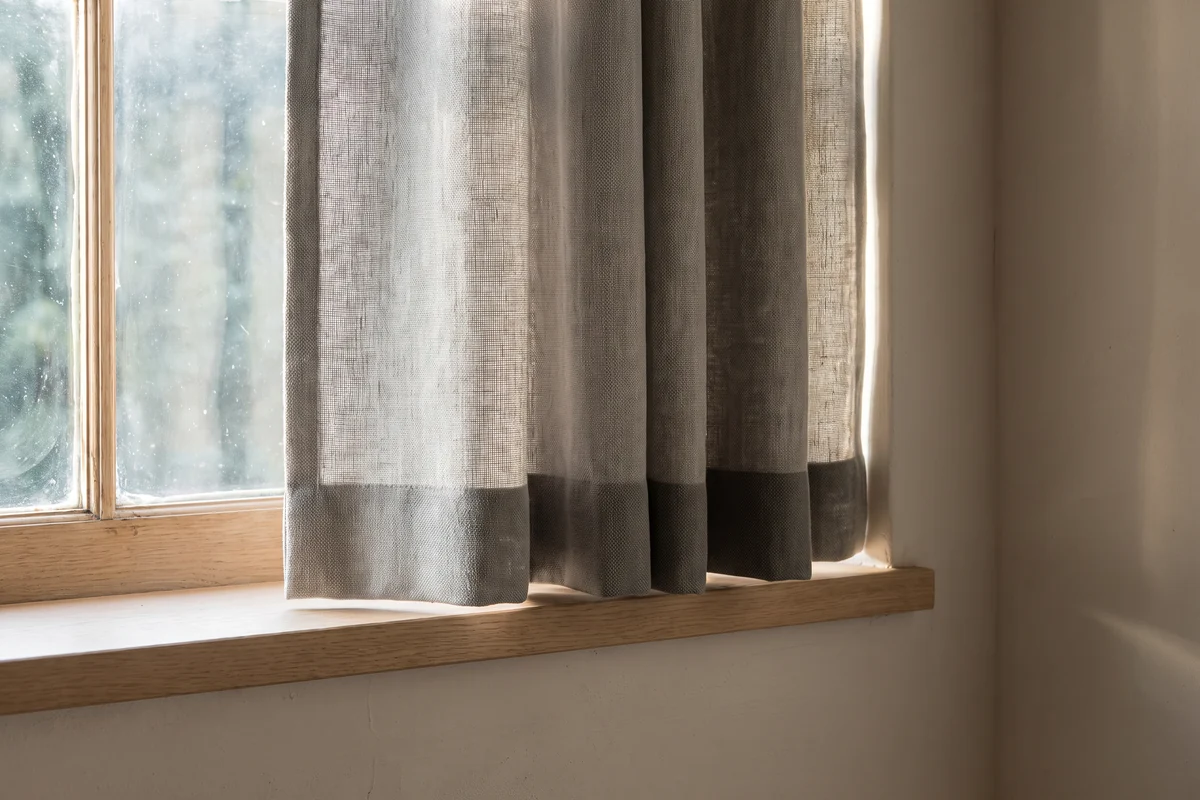
A curtain doesn't block heat so much as slow it down, and it does that by holding a pocket of still air against the glass. Still air is a poor conductor. Moving air isn't — the moment that pocket can circulate, warm air rolls down the glass, spills out at the hem and pulls fresh air in over the top, and your expensive lining is just decorating a convection loop.
So the useful specification isn't fabric weight. It's coverage and closure: how far past the opening the curtain runs, how close it sits to the wall, whether the top is capped. Sealing is the whole game.
Here, the number that matters is 87
Two figures from the government's own guidance on glazing: up to 40% of a home's heating energy is lost through windows, and up to 87% of its heat is gained through them.
Between Byron Bay and Brisbane, the second number is the one costing you money. Nearly every thermal curtain article is about the first — cosy winters, draughty southern houses. Useful in Hobart. Close to irrelevant on a February afternoon in Queensland, where the problem is heat arriving, not leaving.
It arrives with force, too. Direct sun delivers about the same heat as a single-bar radiator over every square metre it lands on. Picture one propped against each pane of your western windows from two o'clock, and the afternoon in that room makes sense.
The gap beats the fabric every time
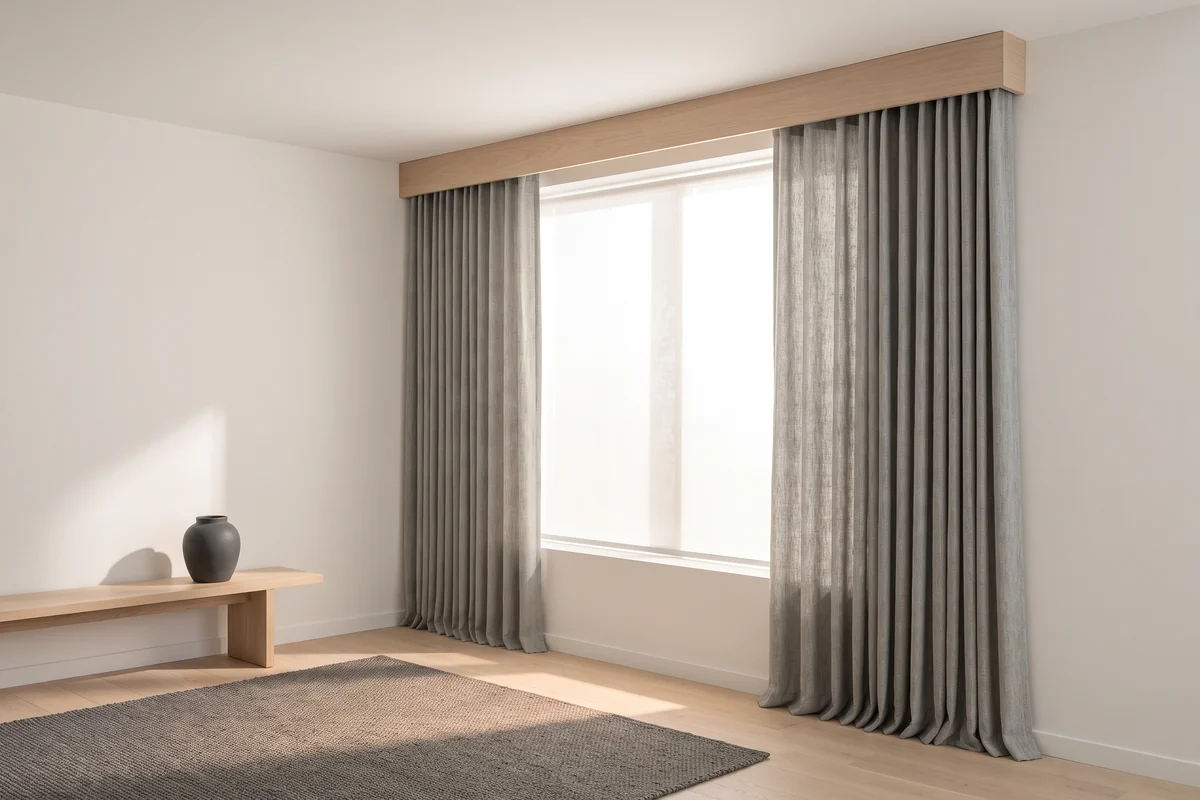
The same government page is unusually blunt about the fix. Reduce heat transfer with snugly fitted curtains and pelmets that trap a layer of still air against the window, it says, and eliminate air gaps around all perimeters.
All of them. Not the ones that show. In practice, four things:
- A pelmet or capped track, so air can't spill over the top.
- Side returns that carry the fabric back to the wall instead of stopping at the architrave.
- A drop to the floor, not to the sill.
- A decent overlap where the two curtains meet.
Miss the top and you've left the loop open, whatever the fabric cost. We supply pelmets for exactly this reason, and hardly anyone asks for one.
It's the same argument as light escaping around a blockout curtain rather than through it — and the stronger version, because air moves through a gap more willingly than light.
| Change | Effect | Worth it? |
|---|---|---|
| Pelmet or capped track | Closes the convection loop at the top | The single biggest one |
| Side returns to the wall | Stops air bypassing the curtain | Yes, and cheap |
| Drop to the floor | Closes the bottom of the loop | Yes |
| Heavier or lined fabric | Modest gain once sealed | Only after the above |
| External shading | Stops the heat reaching the glass | Beats all of it in summer |

For summer heat, a curtain is the second-best answer
Here's the part that costs us a sale. That same government page says plainly that internal blinds are much less effective than stopping solar heat before it enters the window — and effective external shading can block up to 90% of that heat.
Once sunlight is through the glass it has already become heat inside the room, and an internal curtain absorbs it and re-radiates a good share back at you. Shade the glass from outside and the heat never converts. So if your problem is a hot west-facing room in summer, outdoor blinds will beat any curtain you can buy, and we'd rather tell you that than sell you the wrong thing twice.
Curtains still earn their place — overnight, on winter mornings, and wherever external shading isn't practical. Two things narrow the gap: a honeycomb blind holds air in its own cells, which is why the guidance singles out tightly fitted ones; and a metallised fabric reflects solar radiation instead of absorbing it — we supply Verosol SilverScreen as curtain fabric, roller and pleated.
Not sure which of your windows is the problem?
Aspect decides this, not fabric. We measure, work out which openings are costing you, and quote the fix — sometimes a curtain, sometimes not.
Frequently asked questions
Do curtains keep heat out?
Yes, partly — a sealed, lined curtain slows heat through the glass, and closing curtains on the sunny side before the room warms up genuinely helps. But it only works on heat that has already reached the window. Shading the glass outside stops far more.
Do sheer curtains block heat?
Barely. A sheer diffuses glare and takes some of the edge off, but an open weave can't trap a still layer of air — which is where the insulation comes from. Sheers are a daytime privacy answer, not a thermal one.
Do curtains keep heat in better than blinds?
Usually, because a full-length curtain covers more than the opening and can be sealed at all four edges, while most blinds sit inside the reveal with gaps down each side. The exception is a honeycomb blind, whose cells trap air by design.
Do white or light-coloured curtains keep more heat out?
A pale surface facing the glass reflects more solar radiation than a dark one, so it helps a little — far less than sealing the edges, though. The colour that counts is the lining, not the room-side fabric, which is why linings are usually pale.
Do thermal curtains work without a pelmet?
Much less well. Without something capping the top, air circulates over the curtain and down the glass continuously, and the still-air layer never forms. We supply pelmets, and where one doesn't suit the room a ceiling-fixed or capped track does the same job — the point is closing the top, not the joinery.
Is double glazing better than thermal curtains?
For heat loss, yes — it fixes the window rather than covering it, and works whether or not anyone draws the curtains. It also costs many times more. Sealed curtains with pelmets are the sensible retrofit, and the two work together.
Sources Australian Government Your Home — Glazing · ACCC blinds and window fittings mandatory standard · Sleep Health Foundation
Back to the journalKeep reading
Related from the journal
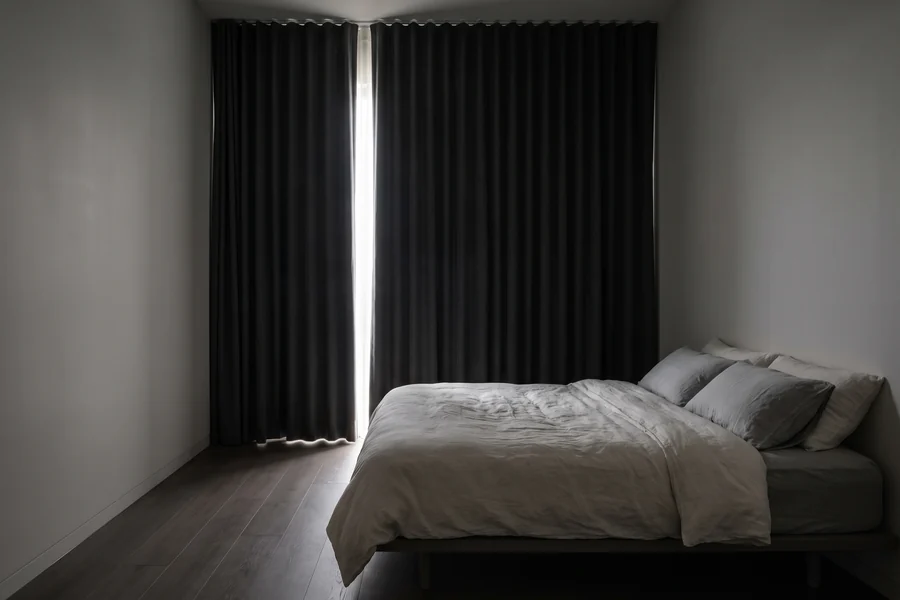 Curtains
Blockout curtains, Brisbane & Gold Coast
Lined and full-height options, and the measuring that makes them seal at the edges rather than glow around them.
Read more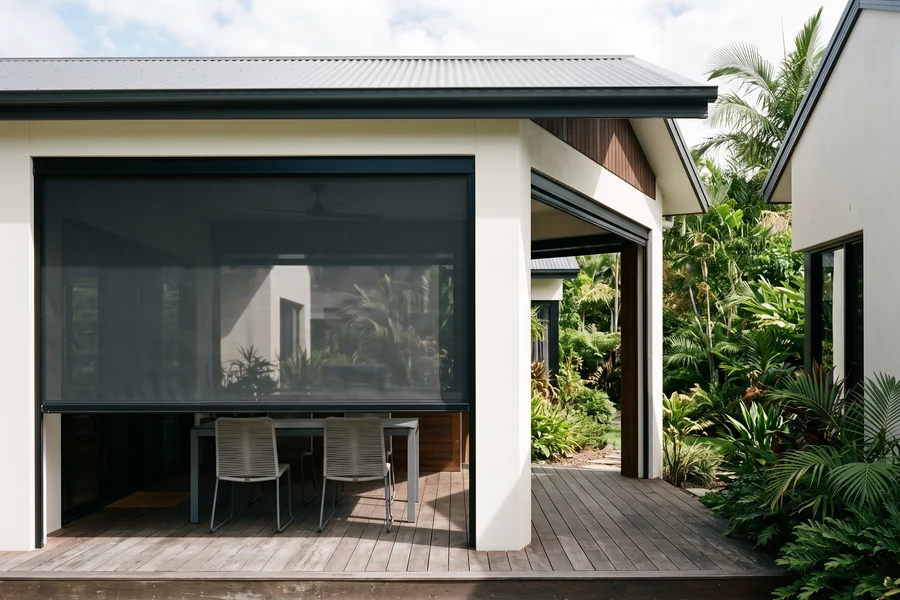 Outdoor
Outdoor blinds, Gold Coast
Stop the heat at the glass instead of absorbing it indoors. Zip track, roller and awning styles for a west-facing wall.
Read more Guides
How to clean blinds without wrecking them
Once the furnishings are doing the thermal work, this is how to keep them doing it — type by type, without ruining the fabric.
Read more